Real Estate

real estate

FintechZoom Real Estate: Market Forecast, PropTech Trends, and Investment Strategies for 2026

FintechZoom Real Estate enters 2026 at a pivotal inflection point. The U.S. housing market is resetting after four years of pandemic-driven extremes, with technology disruption accelerating across every asset class. National Association of Realtors economists forecast a 14% increase in existing home sales for 2026, signaling the first meaningful recovery since 2021.
 
This rebound coincides with a proptech market projected to reach $54.66 billion globally, driven by artificial intelligence, blockchain tokenization, and smart building technologies.
 
For investors, homebuyers, and industry professionals, understanding these converging forces has become essential for capitalizing on the opportunities ahead.

Real Estate Market Forecast Live Upate

FintechZoom Real Estate Market Overview for 2026

The 2026 housing market represents a reset rather than a return to pre-pandemic norms. After three years of stagnation, transaction volumes are thawing. Existing home sales rose 1.7% to an annualized rate of 4.09 million in February 2026, beating expectations.
 
However, unsold inventory climbed 2.4% to 1.29 million units, creating 3.8 months of supply. Median home prices inched up 0.3% year-over-year to $398,000, but the pace of appreciation is moderating significantly. Redfin projects only 1% price growth for 2026, while NAR forecasts 4% and Morgan Stanley anticipates 2%.
 
This divergence reflects regional fragmentation; national averages now matter less than local market selection.
The Federal Reserve’s monetary policy remains the primary lever. With inflation cooling from 2022 peaks, the Fed cut benchmark rates by 100 basis points in 2024 and 75 basis points in 2025. Most analysts expect one additional cut in 2026, bringing mortgage rates into the low-6% range, with occasional dips below 6% during favorable bond market conditions.
 
2026 Housing Market Forecasts by Major Institution
InstitutionHome Price GrowthExisting Home Sales ProjectionMortgage Rate ForecastKey Caveat
NAR4%+14% increase~6.0%Inventory recovery speed varies by metro
Redfin1%+3% increaseLow 6% rangePrice growth constrained by affordability
Morgan Stanley2%Moderate recovery5.50%–5.75% mid-year, rising H2Treasury yield volatility
Realtor.com1.7% sales growth+8.9% inventory6.2% averageInventory remains 12% below pre-2020 levels
This table reveals a consensus around recovery but disagreement on magnitude. The common thread: 2026 offers improved conditions for buyers compared to 2021-2023, though affordability challenges persist.
FintechZoom Real Estate Market Overview for 2026
The 2026 housing market represents a reset rather than a return to pre-pandemic norms. After three years of stagnation, transaction volumes are thawing. Existing home sales rose 1.7% to an annualized rate of 4.09 million in February 2026, beating expectations.  However, unsold inventory climbed 2.4% to 1.29 million units, creating 3.8 months of supply. 
Median home prices inched up 0.3% year-over-year to $398,000, but the pace of appreciation is moderating significantly.  Redfin projects only 1% price growth for 2026, while NAR forecasts 4% and Morgan Stanley anticipates 2%.  This divergence reflects regional fragmentation; national averages now matter less than local market selection.
The Federal Reserve's monetary policy remains the primary lever. With inflation cooling from 2022 peaks, the Fed cut benchmark rates by 100 basis points in 2024 and 75 basis points in 2025.  Most analysts expect one additional cut in 2026, bringing mortgage rates into the low-6% range, with occasional dips below 6% during favorable bond market conditions. 
Table 1: 2026 Housing Market Forecasts by Major Institution
Table
Institution	Home Price Growth	Existing Home Sales Projection	Mortgage Rate Forecast	Key Caveat
NAR	4%	+14% increase	~6.0%	Inventory recovery speed varies by metro
Redfin	1%	+3% increase	Low 6% range	Price growth constrained by affordability
Morgan Stanley	2%	Moderate recovery	5.50%–5.75% mid-year, rising H2	Treasury yield volatility
Realtor.com	1.7% sales growth	+8.9% inventory	6.2% average	Inventory remains 12% below pre-2020 levels
This table reveals a consensus around recovery but disagreement on magnitude. The common thread: 2026 offers improved conditions for buyers compared to 2021-2023, though affordability challenges persist.

FintechZoom Real Estate Regional Hotspots and Price Correction Zones in 2026

FintechZoom Real Estate Southeast and Western Markets Facing Price Declines

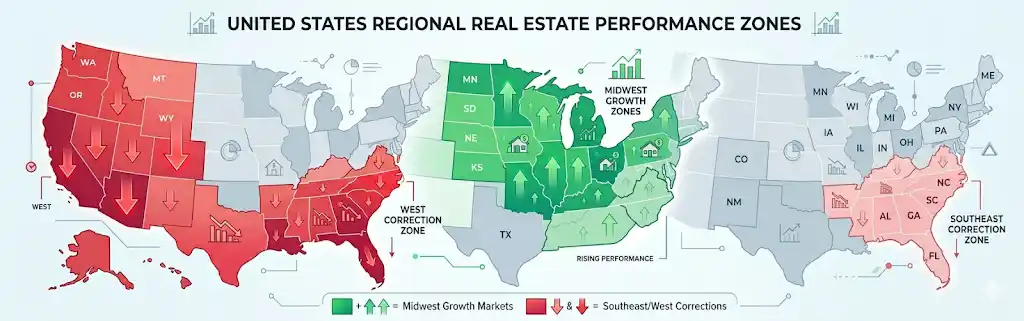
Not all markets will experience uniform growth. Realtor.com identifies 22 of the largest 100 U.S. cities facing price declines in 2026, concentrated heavily in the Southeast and West. Pandemic-era demand normalizing in previously overheated Sun Belt markets explains much of this correction.
Texas and Florida exhibit cyclical overbuilding symptoms. Builder inventory in these states reached highest levels since January 2010, creating downward pressure on pricing as developers compete to move units. Markets that saw 40%+ price appreciation between 2020-2022 are now reverting toward historical mean valuations.

FintechZoom Real Estate Midwest Markets Showing Outsized Growth

Conversely, Midwest markets demonstrate resilience and growth potential. Columbus, Kansas City, Indianapolis, and Oklahoma City emerge as standout performers for 2026. These markets offer tighter inventory levels, stronger rental demand fundamentals, and better alignment between median home prices and local incomes.
Raleigh serves as a case study where inventory levels have realigned with income growth, creating sustainable market conditions absent in coastal peers. These secondary markets attract remote workers seeking affordability while maintaining urban amenities, supporting price stability.

FintechZoom Real Estate Affordability Gap and Mid-Price Home Demand

The affordability crisis defines 2026 market dynamics. Middle-income buyers can afford only 21% of current listings nationwide, down from 50% pre-pandemic. This compression drives demand toward mid-price segments, where competition remains fierce despite overall cooling.
Monthly payments are expected to decline for the first time since 2020, providing relief for qualified buyers. Builders respond by pivoting toward smaller, more affordable product types. Townhomes now comprise a significantly larger share of housing starts compared to a decade ago, addressing the entry-level gap.

FintechZoom Real Estate and the PropTech Revolution in 2026

FintechZoom Real Estate PropTech Market Size and Growth Trajectory

The convergence of real estate and financial technology accelerates in 2026. The global proptech market is valued at approximately $51.70 billion in 2026, with projections ranging from $104.57 billion to $185.31 billion by 2034, representing CAGR between 11.9% and 16.4%.
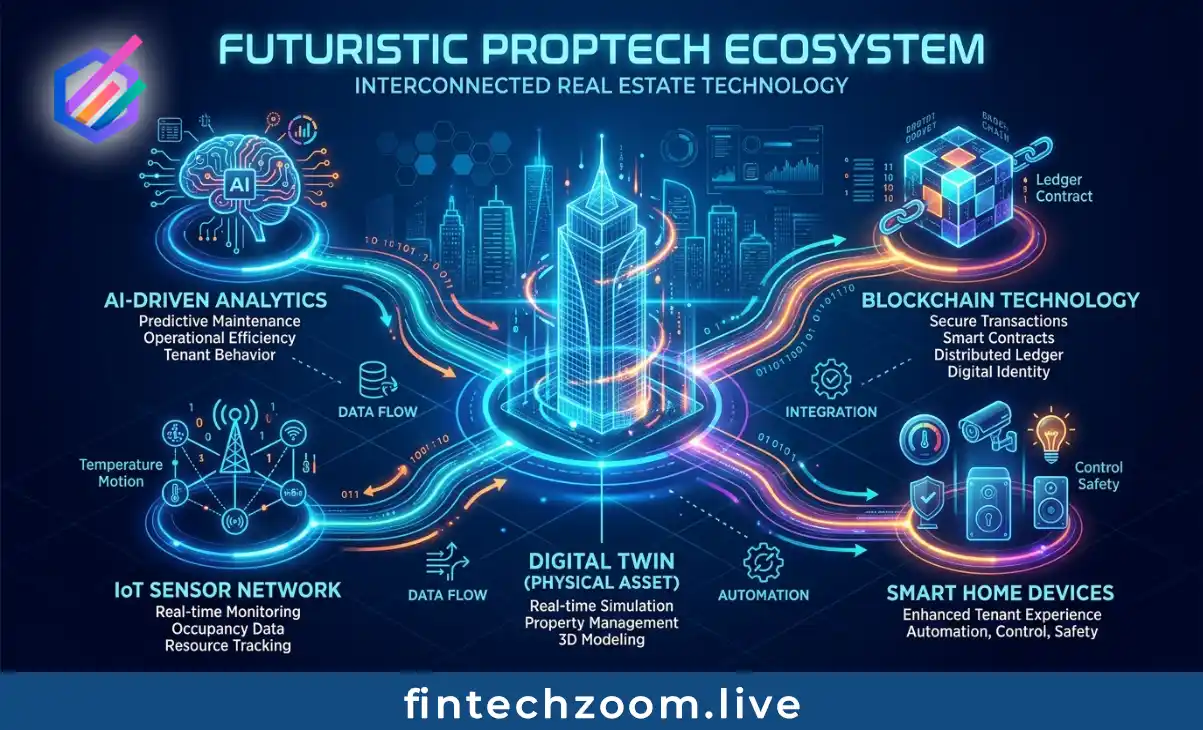
FintechZoom Real Estate PropTech ecosystem with AI, blockchain, and IoT technologies
North America dominates with 38-39% market share, supported by mature venture capital ecosystems and widespread digital adoption.

Construction technology captured $4.8 billion in 2024 funding (32% of total proptech investment), while property management software secured $3.1 billion. Cloud-based deployment models lead, expected to represent 55.48% of market share in 2026, offering scalability and cost efficiency for property operators.

FintechZoom Real Estate AI Adoption Across the Industry

Artificial intelligence has transitioned from experimental to essential. The share of commercial real estate operators running live AI models jumped from 5% to 92% in just three years.

This rapid adoption stems from measurable returns: AI-powered property management reduces tenant ticket volume by 25-40%, while predictive maintenance cuts operational costs by 17.6% and extends equipment lifespans by 25-30%.

Automated valuation models (AVMs) now achieve median error rates of 2.8%, down from 10-15% five years ago, shifting property pricing toward real-time market intelligence.

A Government Accountability Office report found loans using automated tools had defect rates of 2.3% compared to 9.6% for manual processing.

Agentic AI represents the next frontier. These autonomous, goal-driven systems execute multi-step workflows with minimal human prompting, handling lease drafting, tenant onboarding, and portfolio optimization. Analysts project these systems could automate up to 70% of tasks performed by junior staff by 2027.

FintechZoom Real Estate Blockchain and Tokenized Property Ownership

Blockchain technology matures beyond speculation into practical transaction infrastructure in 2026. Smart contracts auto-release escrow when milestones clear, compressing closing timelines from weeks to days. These self-executing programs handle ownership tracking, compliance enforcement, dividend distribution, and transfer restrictions without intermediary intervention.

Tokenized ownership democratizes access to commercial-grade real estate. Fractional shares of prime properties become available to retail investors through platforms using ERC-3643 (T-REX) standards, which embed compliance rules directly into token contracts. Over $28 billion in assets have been tokenized through this standard.

Blockchain-based title verification reduces fraud risk and accelerates title search processes. Title defects that once delayed closings for weeks are now flagged instantaneously through distributed ledger verification.

FintechZoom Real Estate Mortgage Rate Projections and Financing Landscape

FintechZoom Real Estate Federal Reserve Policy and Rate Expectations

The Federal Reserve’s path in 2026 hinges on inflation trajectory and labor market health. The Fed held rates steady in March 2026 and markets anticipate only one rate cut for the entire year.

This cautious approach reflects persistent inflation above the 2% target and unemployment hovering around 4.4%.

Fed leadership transitions in May 2026 introduce additional uncertainty. Historical patterns suggest central banks adopt wait-and-see approaches during leadership changes, potentially delaying aggressive rate reductions even if economic data supports them.

JPMorgan offers a conservative counterpoint to optimistic forecasts, suggesting mortgage rates will remain above 6% throughout 2026 regardless of Fed cuts, citing elevated 10-year Treasury yields and inflation stickiness.

FintechZoom Real Estate Digital Mortgage and Lending Innovation

PropTech fintech segments grow at 38% CAGR, driven by digitization of mortgage origination and underwriting. Real estate fintech companies experience 60% revenue correlation with interest rate changes, making 2026’s rate environment critical for sector performance.
Integrated platforms now combine mortgage comparison, pre-approval, and closing within single workflows. E-signatures, AI-powered underwriting, and automated loan origination reduce processing times from 45 days to under 20 days for qualified borrowers. These efficiencies particularly benefit first-time buyers navigating complex financing landscapes.
Mortgage Rate Scenarios and Monthly Payment Impact for 2026
Mortgage RateMonthly Payment ($400K Home, 20% Down)Buyer Pool ImpactMarket Activity Forecast
5.50%$1,815+1.6M renters qualifyHigh activity, bidding wars return
6.00%$1,919+5.5M total buyers qualifiedModerate recovery, balanced market
6.50%$2,027Baseline current conditionsContinued stagnation
7.00%$2,139-2M buyers priced outSignificant slowdown
This table illustrates the nonlinear impact of rate changes. Each 50-basis-point reduction unlocks substantial buyer segments, explaining why industry participants closely monitor Treasury yield movements.

FintechZoom Real Estate Investment Strategies for 2026

FintechZoom Real Estate REIT and Real Estate ETF Opportunities

Commercial real estate investment activity is expected to increase 16% in 2026 to $562 billion. Income-driven returns replace price appreciation as the primary value driver, favoring yield-focused investors.
Data center REITs experience record leasing activity driven by AI infrastructure demand. Supply growth remains constrained by power delivery timelines, supporting rental rate growth. Healthcare real estate stabilizes as construction completions drop sharply, reducing new supply pressure.
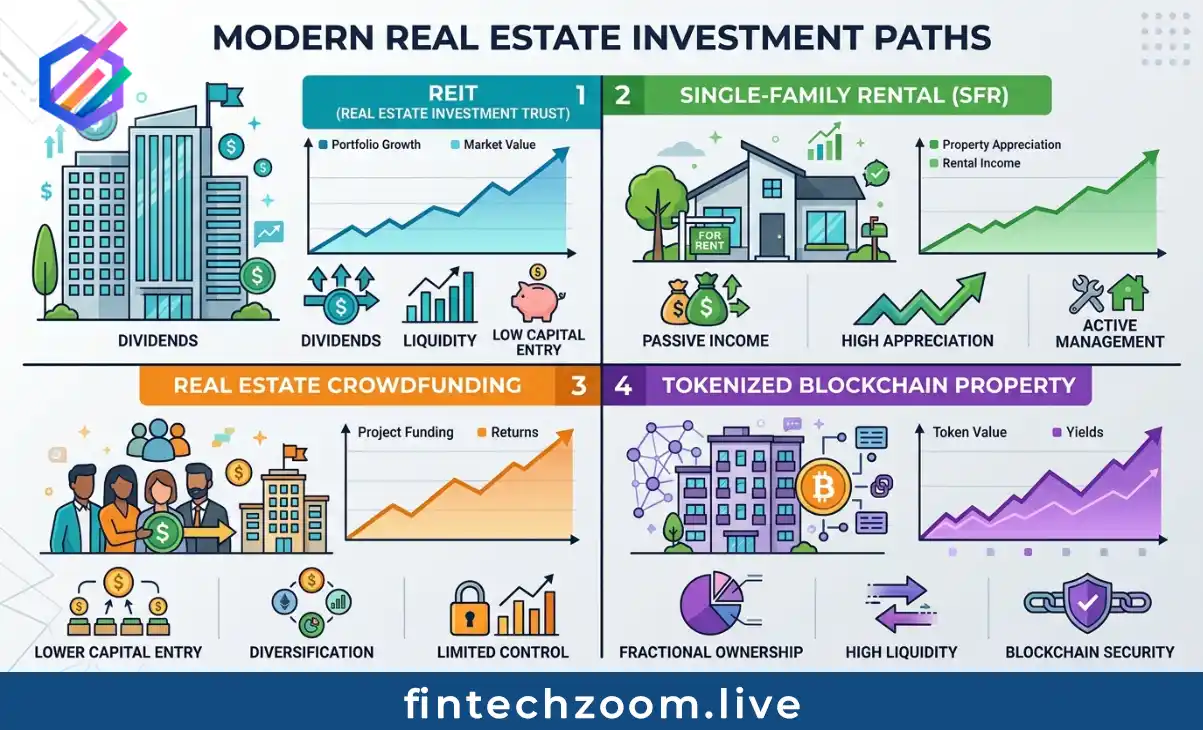
FintechZoom Real Estate investment strategy comparison for 2026

FintechZoom Real Estate Single-Family Rental (SFR) Outperformance

High prices and persistent rates extend rental tenure for millions of households, supporting landlord cash flows. Single-family rentals outperform apartments where oversupply still works through construction pipelines from 2021-2023.
Midwest affordable markets (Indianapolis, Kansas City, Oklahoma City) offer strongest SFR returns due to favorable price-to-rent ratios. The era of passive appreciation ends; 2026 returns depend on active management, tenant selection, and operational efficiency.
Institutional investors continue consolidating SFR portfolios, with projections indicating institutional ownership will reach 7.6 million homes (40% of all SFRs) by 2030. This consolidation increases demand for sophisticated property management software and data analytics platforms.

FintechZoom Real Estate Crowdfunding and Fractional Platforms

Platforms like Fundrise and Roofstock enable entry with lower capital requirements, typically $10-$50 minimums versus $50,000+ for direct property acquisition. These vehicles offer diversification across multiple markets and property types but carry platform risk and liquidity constraints.
Tokenization opens commercial-grade properties to retail investors. Fractional shares of industrial warehouses, medical office buildings, and multifamily complexes become accessible through blockchain-based platforms, though regulatory compliance and custody solutions remain evolving considerations.

FintechZoom Real Estate Smart Buildings, IoT, and Digital Twins

FintechZoom Real Estate Smart Building Technology Adoption

Smart building systems monitoring energy usage achieve widespread adoption in 2026. Predictive maintenance models cut annual repair costs by 28% and lift net operating income by 90-130 basis points through operational efficiency gains.
 
IoT-enabled remote monitoring extends beyond energy management into access control, water leak detection, and tenant experience optimization. These systems deliver average energy savings of 14-30% alongside 91% resident satisfaction rates.
 
Property managers leverage these technologies to reduce on-site staffing needs while improving response times.

FintechZoom Real Estate Digital Twins and Virtual Property Experiences

Digital twins create real-time virtual replicas of physical buildings, enabling remote management optimization and scenario planning. These models integrate IoT sensor data, maintenance records, and space utilization patterns to predict equipment failures before they occur.
VR/AR property tours mature beyond novelty into standard practice. Remote buyers explore properties through immersive 3D experiences, reducing transaction friction for out-of-state investors and relocating homeowners. Matterport’s integration into CoStar’s platform following a $1.6 billion acquisition exemplifies this trend toward digital-first property marketing.
Wellness features (advanced air filtration, water purification, meditation spaces) differentiate luxury properties in 2026, with smart building systems monitoring and optimizing these environmental quality metrics.

FintechZoom Real Estate Commercial Sector Recovery in 2026

FintechZoom Real Estate Office Demand Recovery

The office sector shows stabilization signs after years of remote work disruption. Occupiers focus on real estate for cost savings and operational efficiencies rather than expansion. Well-located, amenity-rich office properties command premium rents while secondary Class B assets face continued obsolescence risk.
Flight-to-quality accelerates as tenants prioritize collaboration spaces, wellness amenities, and flexible lease terms. Landlords invest heavily in proptech upgrades to meet these evolving tenant expectations.

FintechZoom Real Estate Data Center and Life Sciences Growth

Data center leasing activity hits all-time highs in 2026, driven by AI training and inference workloads. Supply growth faces constraints from power delivery timelines, with utility interconnection delays extending to 36+ months in primary markets. Secondary markets along Interstate 20 across the Sun Belt attract greenfield development due to available power infrastructure.
Life sciences speculative lab space reaches delivery milestones by year-end 2026, completing pipelines started in 2023-2024. Demand remains concentrated in established biotech clusters (Boston, San Diego, Research Triangle), though secondary markets gain traction as cost pressures mount.

FintechZoom Real Estate Risks, Tariffs, and Policy Uncertainty

Trade policy volatility creates financial market uncertainty rippling into real estate. Potential tariffs on building materials could raise construction costs 8-15%, offsetting deregulation efforts intended to spur housing supply.
Government housing affordability policies emerge from both political parties, including YIMBY (Yes In My Backyard) measures and zoning deregulation. However, the structural housing deficit remains the primary constraint. Housing stock remains insufficient for population growth, suggesting the only long-term affordability solution is increased new construction at scale.

FintechZoom Real Estate Expert Tips for First-Time Buyers in 2026

Market conditions favor buyers more than any period since 2020. Rising inventory and slowing price growth create negotiation leverage absent in recent years. Homes priced 3-5% above market value face extended days on market and deeper eventual price reductions.
Generative AI tools help buyers identify suitable cities, neighborhoods, and individual properties matching budget constraints and lifestyle preferences. These platforms analyze commute patterns, school ratings, crime statistics, and price trends to generate personalized recommendations.
Preparation steps for 2026 buyers include:
  • Securing mortgage pre-approval before house hunting to strengthen offers
  • Optimizing debt-to-income ratios by paying down revolving credit
  • Researching down payment assistance programs available at state and municipal levels
  • Targeting properties listed 30+ days for maximum negotiation leverage

Frequently Asked Questions About FintechZoom Real Estate

What is the FintechZoom real estate market forecast for 2026? NAR forecasts a 14% increase in existing home sales, with mortgage rates potentially dropping to 6% and home prices rising 1-4% depending on the region.
 
Will housing prices go down in 2026? National prices will likely rise modestly (1-4%), but 22 of the largest 100 cities may see declines, concentrated in the Southeast and West where pandemic-era overbuilding corrects.
What mortgage rates are expected in 2026? Forecasts range from 5.50% (Morgan Stanley mid-year) to above 6% (JPMorgan), with most analysts expecting low-6% averages.
 
How is AI changing real estate in 2026? AI now automates valuations with 2.8% error rates, reduces property management costs by 17.6%, and enables agentic systems that handle lease drafting and tenant relations with minimal human intervention.
 
What is proptech and why does it matter for real estate investors? PropTech encompasses technology solutions applied to real estate, valued at $51.8 billion in 2026. It drives efficiency, transparency, and new investment access through tokenization and fractional platforms.
 
Are REITs a good investment in 2026? Data center and healthcare REITs show particular strength due to AI infrastructure demand and supply constraints. Income-focused REIT strategies outperform appreciation-dependent approaches in the current cycle.
Which U.S. cities are best for real estate investment in 2026? Midwest markets (Columbus, Kansas City, Indianapolis, Oklahoma City) offer favorable supply-demand dynamics and price-to-rent ratios compared to overheated coastal and Sun Belt markets.
How does blockchain tokenization work in real estate? Smart contracts on blockchain networks enable fractional ownership of commercial properties, automated dividend distributions, and compliance-enforced transfers, reducing barriers to institutional-quality assets.

Analyze, Adapt, and Thrive in the Digital Finance Era

Navigate the intersection of capital and code with expert analysis on emerging market trends and disruptive technologies. Our content delivers actionable intelligence on everything from decentralized finance to AI-driven investing, empowering you to leverage innovation for sustainable growth. Dive into the data-driven insights that are actively redefining the global financial landscape.

Curated Editorial Insights Across FintechZoom’s Core Verticals: Thought-provoking analysis in Markets, Business Strategy, Crypto Innovation, Personal Finance, Economic Policy, and Lifestyle Wealth, designed to challenge conventional thinking, deepen financial literacy, and empower readers to make smarter, forward-looking decisions.