
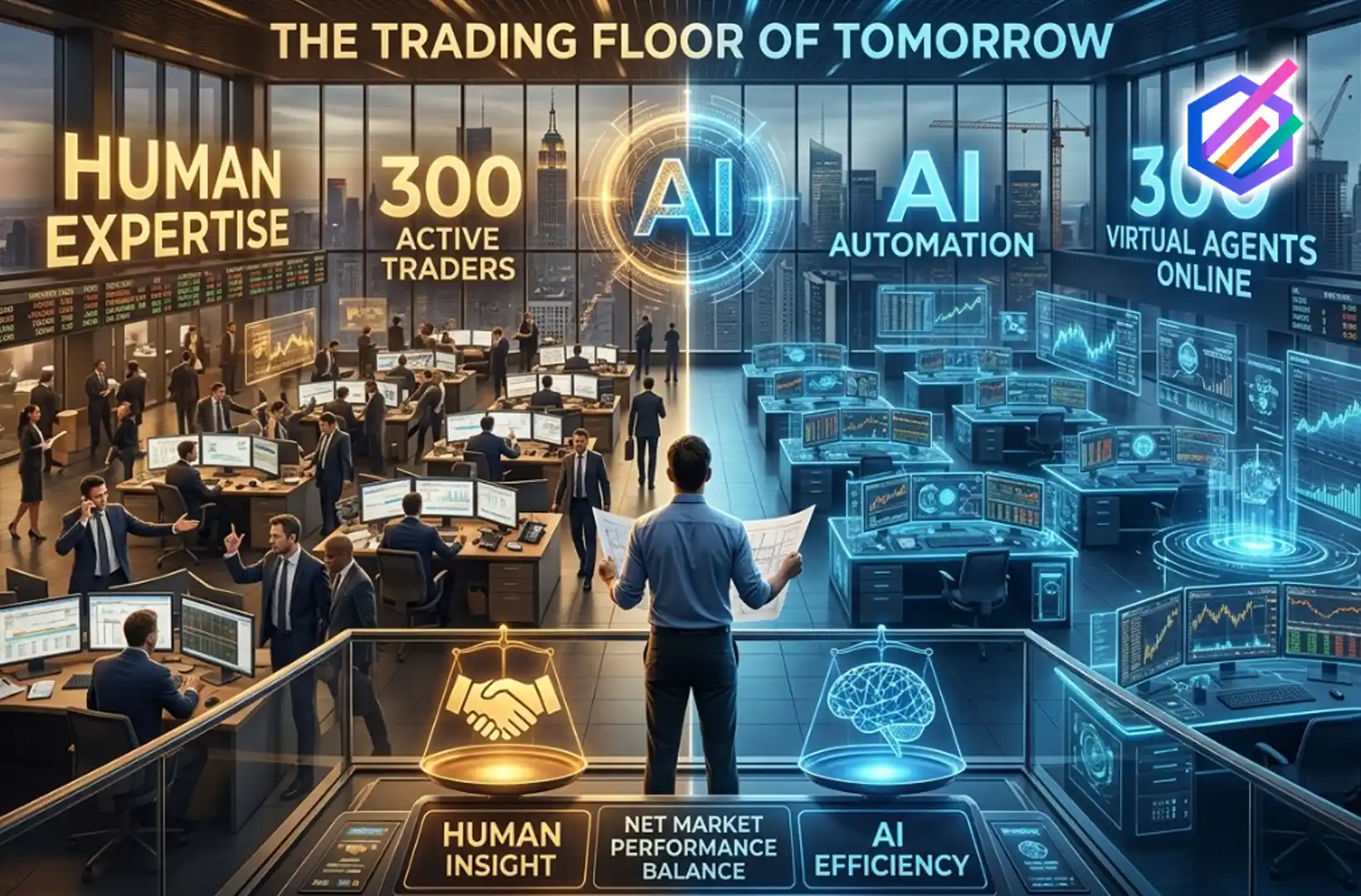
AI finance job cuts 2026 are not a forecast anymore. They are happening now. Across Wall Street banks, payments platforms, digital lending firms, and venture-backed fintech companies, teams are getting smaller. The reasons given in earnings calls and press releases sound polished: efficiency, consolidation, realignment. The underlying reality is the same everywhere. AI is doing more and humans are doing less.
This article breaks down exactly what is happening. You will see which roles face the highest risk, which firms have already made the cuts, and what the data says about where this goes next. You will also find out which finance skills remain genuinely hard to automate and how to protect your career regardless of where AI lands next.
The goal here is not to alarm you. It is to give you an honest, data-backed picture so you can make better decisions about your career, your team, or your investments in fintech stocks like JPM, GS, V, and MA.
AI Finance Job Cuts 2026: What the Data Actually Shows
Hard Numbers Behind the Fintech Workforce Reduction
The numbers behind AI finance job cuts 2026 are real and measurable. According to data tracked by workforce analytics platforms, Wall Street banks alone plan to remove approximately 200,000 positions over the next three to five years. These are not roles being eliminated all at once. They are being quietly phased out as AI tools take over repetitive, rule-based work.
In the first half of 2025 alone, approximately 78,000 tech and finance jobs were directly tied to AI-driven automation decisions. That number does not include the broader wave of fintech layoffs across payments, crypto infrastructure, and lending platforms that continued into early 2026.
About one in six employers across the financial sector told researchers they expect AI to reduce headcount in 2026. Among large private sector firms, that figure climbs to 26 percent. Credit analyst positions are forecast to drop by 3.9 percent as AI tools process financial risk faster than any human team can.
Does this mean finance careers are over? No. It means the structure of finance teams is changing. Layers of middle management are thinning. Entry-level roles that once served as learning rungs are shrinking. And hiring managers are now looking for a different kind of candidate entirely.
Pro Tip: Track fintech layoffs by sector using tools like Layoffs.fyi and LinkedIn Workforce Insights. If your role shows up repeatedly in the same category across multiple companies, that is your signal to upskill now.
Which Fintech Companies Are Leading AI Finance Job Cuts 2026
The fintech workforce reduction in 2026 is not confined to one type of company. Banks, pure-play fintechs, and payments giants are all reshaping their headcounts for similar reasons. Here are some of the clearest examples on record.
Klarna eliminated the equivalent of 700 full-time customer service roles after its AI assistant took over the majority of support queries. The company reported the change publicly and framed it as a productivity gain rather than a cost cut.
JPMorgan Chase has been using its COiN platform to process legal documents since 2017. What once took 360,000 hours of human labor per year now takes seconds. The platform has since expanded into other back-office workflows, and AI finance job cuts 2026 reporting from the firm continues to reflect a shrinking back-office headcount.
Goldman Sachs has invested heavily in document AI and code generation tools. Junior analyst roles and back-office positions have been the most directly affected. The firm’s internal research has noted that up to a quarter of existing Goldman tasks could be automated with current AI technology.
Citigroup has been restructuring its risk and compliance teams as AI models take on more of the heavy analytical lifting. Wells Fargo has reduced its fraud investigation headcount as AI fraud detection has become standard practice across the industry.
These are not small or experimental moves. They are structural changes backed by multi-year technology investment and visible in earnings reports. AI finance job cuts 2026 are showing up in the numbers that public companies report to shareholders.
| Company | AI Initiative | Workforce Impact |
|---|---|---|
| JPMorgan Chase | COiN document processing | 360,000+ hours of work automated annually |
| Goldman Sachs | LLM-based document review | Junior analyst and back-office reductions |
| Klarna | AI customer service assistant | 700 FTE roles replaced |
| Citigroup | AI-driven risk and compliance modeling | Compliance team restructuring |
| Wells Fargo | AI fraud detection systems | Fraud investigation team reductions |
Source: FintechZoom.live analysis based on company disclosures, World Economic Forum Future of Jobs data, and McKinsey Global Institute automation research.
AI Finance Job Cuts 2026: Which Finance Roles Are Being Replaced Right Now
The Risk Breakdown for AI Finance Job Cuts 2026
Not every finance job faces the same level of AI exposure. The risks break down clearly when you look at what AI tools are actually good at. They excel at pattern recognition, document analysis, data entry, report generation, and rule-based decisions. Jobs built on those tasks face the most pressure from AI finance job cuts 2026.
Jobs built on trust, judgment, relationships, and accountability are much harder to automate. An AI cannot sit across from a CEO and close a deal. It cannot take legal responsibility for a compliance decision. It cannot build the kind of institutional trust that brings a family office back year after year.
Here is a full breakdown of where finance roles stand today.
Finance Role Risk Assessment – 2026
| Finance Role | AI Risk Level | Reason | Safe Skills to Build |
|---|---|---|---|
| Data Entry / Back Office | CRITICAL | RPA automates 90% of tasks | Process Design, AI Oversight |
| Credit Underwriting Analyst | HIGH | AI models process risk faster | Complex Deal Structuring |
| Equity Research Associate | HIGH | LLMs generate draft reports | Thematic Research, Client Access |
| Compliance Document Reviewer | HIGH | NLP reads contracts at scale | Regulatory Interpretation |
| Customer Service Agent | HIGH | AI chatbots handle 80% of calls | Escalation Management |
| Junior Financial Analyst | MODERATE | AI handles data modeling basics | Storytelling, Board Presentation |
| Loan Processing Officer | MODERATE | End-to-end platforms reduce steps | Relationship Underwriting |
| Investment Banker (Mid-Level) | LOW-MODERATE | Deal advisory needs human trust | Origination, Client Networks |
| CFO / Risk Strategist | LOW | Judgment and accountability cannot be coded | Stay current with AI tools |
| Relationship Manager | LOW | Trust-based roles remain human | Cross-sell, Digital Fluency |
Source: FintechZoom analysis based on World Economic Forum Future of Jobs data, McKinsey Global Institute automation research, and verified company announcements.
Pro Tip: If your role sits in the HIGH or CRITICAL category, focus on the adjacent skills in the final column. Most of those skills can be developed in under six months with the right online courses or internal projects.
What AI Tools Are Driving AI Finance Job Cuts 2026
The Technology Behind the Fintech Workforce Reduction
Understanding AI finance job cuts 2026 means understanding the tools causing them. These are not vague or hypothetical platforms. They are production systems actively running inside major financial institutions right now.
Robotic Process Automation (RPA) handles repetitive back-office tasks. Account reconciliation, data entry between systems, and routine report generation are now handled by tools like UiPath and Automation Anywhere, which are embedded in banks and insurers globally. RPA alone accounts for a significant share of AI finance job cuts 2026 in operations roles.
Large Language Models (LLMs) are being used to draft equity research summaries, review contracts, and generate client-facing communications. Goldman Sachs and Morgan Stanley have both piloted LLM tools for analyst workflows. The output is not always published directly, but it significantly reduces the time analysts spend on first drafts. This is one of the clearest drivers of AI finance job cuts 2026 among junior research staff.
AI underwriting platforms like Zest AI and Upstart have moved credit decisioning away from human underwriters in consumer and small business lending. These systems process thousands of data points per application in real time, which directly affects the need for large analyst teams.
Fraud detection AI has replaced entire investigation teams at companies like Stripe, PayPal, and major banks. The AI identifies anomalies faster and with fewer false positives than manual review teams could produce.
Natural Language Processing (NLP) tools scan regulatory filings, court documents, and compliance records at a scale no human team can match. This has directly reduced the number of junior compliance analysts needed at large financial institutions and remains a key driver of AI finance job cuts 2026 in legal and compliance functions.

What does this mean for AI in investment banking jobs? It means the pipeline model is changing. Instead of a pyramid of analysts doing foundational work under a few senior bankers, firms are moving to flat teams where AI handles the volume and senior staff focus entirely on judgment and client relationships. AI finance job cuts 2026 are restructuring the analyst pipeline at its base.
Will AI Replace Finance Jobs Completely? The Real Answer for 2026
Where Human Judgment Still Holds Against AI Finance Job Cuts 2026
The answer to whether AI will replace finance jobs entirely is no. But the more useful answer is more specific than that.
AI is very good at processing and applying rules. It is not good at forming genuine relationships, taking moral responsibility for decisions, operating in ambiguous regulatory grey zones, or persuading a nervous client to stay invested during a market crash. Those capabilities matter enormously in finance and they represent a meaningful buffer against AI finance job cuts 2026 for roles where these skills dominate.
Consider merger and acquisition advisory. A deal lives or dies on trust between advisors and principals. It involves navigating competing board interests and reading room dynamics that no model can process. AI can analyze comparable transactions and generate financial models in seconds. The deal still closes because of the human advisor in the room.
Consider regulatory compliance at a senior level. Compliance officers who can interpret the intent of a new rule, advise on a novel product structure, and communicate clearly with regulators are not being replaced by AI finance job cuts 2026. They are being freed from the paperwork that used to consume 60 percent of their time.
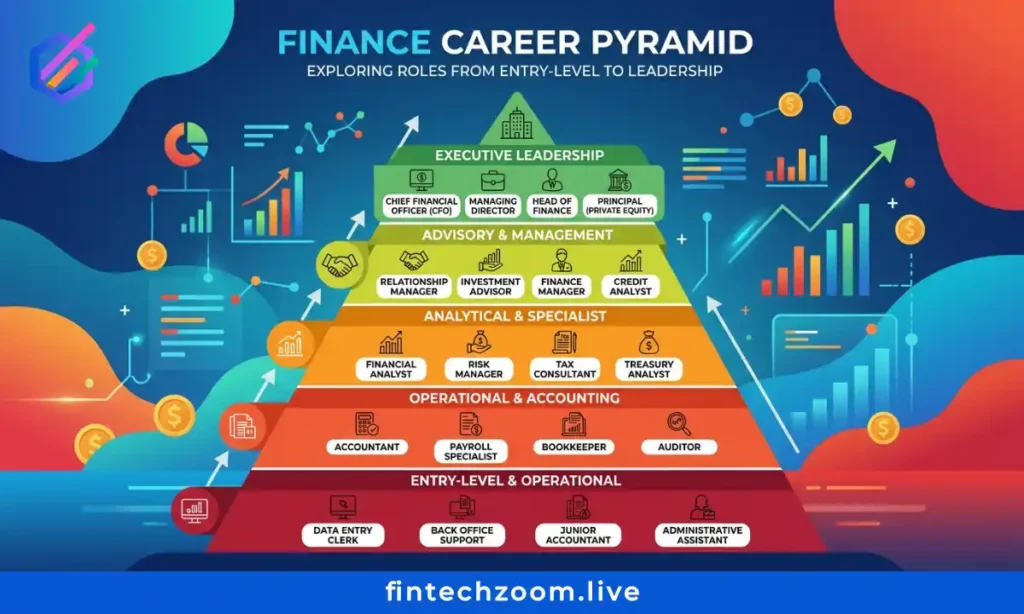
The finance career AI disruption story is not really about replacement. It is about the removal of layers. The middle of the career pyramid is being hollowed out. Entry-level roles that once provided training are disappearing. Senior roles that require real judgment are staying and paying more.
This means early-career professionals face a harder path. The traditional route of analyst to associate to VP by grinding through spreadsheets is narrowing. The new path requires demonstrating judgment and communication skills earlier and at a higher level than the previous generation needed to.
- AI replaces tasks, not whole roles in most cases
- Judgment, relationships, and accountability remain human advantages
- Entry-level and mid-tier analytical roles face the most structural risk from AI finance job cuts 2026
- Senior advisory and compliance roles are becoming more valuable, not less
- Finance professionals who understand AI tools have a measurable edge over those who do not
How FintechZoom Covers AI Finance Job Cuts 2026
Real-Time Data, Verified Reporting, and Career Intelligence
FintechZoom tracks AI finance job cuts 2026 and the broader shifts in fintech employment as part of its core editorial mission. The site covers individual company announcements, aggregate layoff data, and the underlying technology trends driving workforce changes across banking, payments, lending, and investment management.
Unlike general news sites that report layoffs as isolated events, FintechZoom connects the dots between technology adoption, earnings disclosures, and workforce strategy. When JPMorgan announces an expansion of its AI infrastructure, FintechZoom reports both the technology layer and the staffing implications in the same coverage.
The site also covers the stocks of companies undergoing these changes. Readers tracking Goldman Sachs AI automation layoffs can access FintechZoom’s stock analysis alongside news coverage. This gives investors and finance professionals the same picture in one place.
FintechZoom’s content is written by finance professionals with real industry backgrounds. Articles are fact-checked against primary sources. When data or company statements are cited, they link to original disclosures.
Whether you are a finance professional evaluating your career options, an investor tracking how AI affects bank valuations, or a hiring manager rethinking your team structure, FintechZoom gives you the information you need to make a real decision about AI finance job cuts 2026 and what they mean for you.
Why Tracking AI Finance Job Cuts 2026 Right Now Matters for Your Career
What You Gain by Staying Current on AI Finance Job Cuts 2026
The professionals who move earliest on information about AI finance job cuts 2026 are the ones who end up with the most options. Waiting until your own role is directly affected narrows what you can do about it. Acting now, while the restructuring is still in its middle stages, gives you time to reposition.
Here is what you can do today. Read FintechZoom’s stock coverage for JPMorgan, Goldman Sachs, Visa, and Mastercard. Understanding how AI investments affect their valuations gives you insight into how seriously these firms are taking automation and where the next wave of AI finance job cuts 2026 is likely to come from.
Review your own role against the risk table above. If you are in a moderate or high-risk category, now is the time to build the adjacent skills that move you into safer territory. Most of the skills in the safe column can be developed with six months of focused effort.
Bookmark FintechZoom’s fintech and AI in finance sections. New coverage on AI finance job cuts 2026, layoff data, and career strategy is published regularly and draws on primary sources rather than secondhand aggregation.
- Track JPM, GS, V, and MA stocks alongside their AI investment announcements to identify where AI finance job cuts 2026 will surface next
- Use the role risk table to evaluate your own career position honestly
- Follow FintechZoom’s fintech trends section for ongoing coverage of AI workforce changes
- Build skills in AI tool management, model oversight, and high-stakes communication now

FAQ: AI Finance Job Cuts 2026
What are AI finance job cuts 2026 and why are they happening now?
AI finance job cuts 2026 refer to the reduction of finance and banking roles driven by the adoption of AI automation tools including RPA, LLMs, NLP, and AI-powered underwriting and fraud detection systems. These cuts are happening now because AI tools have reached production-level reliability. Banks and fintech firms that invested in AI infrastructure over the past three to five years are now in the phase where those tools are actively replacing human workflows rather than supplementing them.
Which finance jobs are most at risk from AI finance job cuts 2026?
The roles facing the highest risk from AI finance job cuts 2026 are data entry and back-office operations, credit underwriting analysts, equity research associates, compliance document reviewers, and customer service agents. These roles involve the kinds of rule-based, pattern-recognition, or document-processing tasks that AI tools handle with high accuracy at low cost.
Are senior finance roles protected from AI finance job cuts 2026?
Senior roles involving judgment, relationships, and accountability are significantly better protected. CFOs, risk strategists, senior compliance officers, investment bankers advising on major transactions, and relationship managers working with high-net-worth clients are not being replaced by AI finance job cuts 2026. They are often freed from lower-value tasks, which makes their remaining work more visible and more directly tied to business outcomes.
Which companies have made the biggest AI-related finance job cuts in 2026?
The most documented examples of AI finance job cuts 2026 include Klarna replacing 700 customer service FTEs with AI, JPMorgan Chase automating over 360,000 hours of document processing annually through its COiN platform, Goldman Sachs reducing junior analyst and document review headcount through LLM adoption, Citigroup restructuring its compliance teams, and Wells Fargo scaling back fraud investigation teams as AI detection improves.
Will AI replace all finance jobs eventually?
No. The more accurate framing is that AI finance job cuts 2026 and beyond will continue to hollow out the middle layers of finance teams. Roles that depend on rule-following, data entry, and report generation face ongoing reduction. Roles that depend on human judgment, relationship trust, regulatory interpretation, and strategic communication face much lower risk. The finance industry will continue to employ people, but in smaller numbers and at higher average skill levels.
How can finance professionals protect their careers from AI finance job cuts 2026?
Finance professionals facing exposure from AI finance job cuts 2026 should focus on building skills in the areas AI cannot replicate. These include complex deal structuring, client relationship management, regulatory interpretation, escalation and exception handling, board-level communication, and AI tool oversight. Developing even basic fluency with the AI tools now being used in your sector is an advantage because it positions you as someone who manages the technology rather than being replaced by it.
What does FintechZoom track on AI finance job cuts 2026?
FintechZoom covers AI finance job cuts 2026 through a combination of company-level reporting, workforce analytics data, and stock analysis for financial sector companies undergoing AI-driven restructuring. Readers can follow coverage of JPM, GS, V, MA, and major fintech firms to stay current on which roles are being affected, what technology is driving the changes, and what the workforce implications mean for investors and professionals.
Are AI finance job cuts 2026 visible in stock performance for affected companies?
Yes, in some cases. Companies that are reducing headcount through AI often show short-term efficiency gains that are reflected in margin improvement and cost-of-revenue metrics. However, AI finance job cuts 2026 at firms like Goldman Sachs and Citigroup are part of longer-term restructuring stories that require tracking over multiple earnings cycles rather than a single quarter. FintechZoom’s stock analysis pages for GS, JPM, V, and MA give readers a way to follow both the workforce and financial performance dimensions of these changes in one place.
External Authority Links
- World Economic Forum – Future of Jobs Report
- McKinsey Global Institute – The Future of Work After COVID-19
- JPMorgan Chase Annual Report
- Goldman Sachs AI and Technology
Risk Disclaimer
The information in this article is for informational and educational purposes only. FintechZoom does not provide financial, legal, or career advice. Employment and automation trends described are based on publicly available data and research reports. Individual career outcomes may vary. Data cited from workforce analytics platforms and institutional research should be verified against original sources before being used for professional or investment decisions.