Last revised: November 16, 2026 · By the FintechZoom Markets Desk, reviewed under our editorial policy
The fintech cybersecurity trends of 2026 are measured in fraud losses more than in breaches. The FBI counted 1,008,597 complaints and $20.877 billion in reported losses for 2025, up 26 percent from 2024; cryptocurrency was involved in $11.37 billion of those losses, and a new AI category linked 22,364 complaints to $893 million in losses (FBI IC3 2025 Internet Crime Report, April 2026). On the defensive side, the dates have moved from forecasts to documents: NIST finalised its post-quantum transition guide on October 27, 2026, and an executive order signed on June 22, 2026 sets 2030 and 2031 deadlines for the most sensitive US federal systems (NIST, October 2026).
This guide covers five areas where the evidence changed during 2026: AI-assisted fraud and deepfakes, crypto and investment fraud, ransomware and insider threats, third-party and cloud concentration, and the post-quantum timeline. It then sets out the rules fintech firms answer to in the US and EU. It replaces an April 2026 version that relied on vendor forecasts. Consumer account settings are covered separately in our finance app settings guide.
Fintech cybersecurity trends 2026 at a glance
| Trend | Latest dated evidence | Source |
|---|---|---|
| AI-assisted fraud | 22,364 complaints and $893.3 million in losses tied to AI in 2025, the first year the FBI reported the category | FBI IC3, 2025 report |
| Deepfakes in onboarding | FinCEN reported a rise in suspicious activity reports describing deepfake identity documents and issued alert FIN-2024-Alert004 | FinCEN, Nov 13, 2024 |
| Crypto and investment fraud | $11.37 billion in crypto-related losses and $8.65 billion in investment fraud losses in 2025 | FBI IC3, 2025 report |
| Ransomware | More than 120 active ransomware brands observed in 2025; crypto still the preferred ransom payment | Europol IOCTA 2026 |
| Phishing as the entry point | About 60 percent of observed intrusions in the EU began with phishing (July 2024 to June 2025) | ENISA Threat Landscape 2025 |
| Third-party concentration | 19 critical ICT third-party providers designated for direct EU oversight | ESAs via Morgan Lewis, Nov 18, 2025 |
| Quantum readiness | Quantum-vulnerable public-key algorithms deprecated after 2030 and disallowed after 2035 under NIST guidance | NIST IR 8547 final, Oct 27, 2026 (CSA summary) |
AI-driven fraud and deepfakes

The FBI added an artificial intelligence section to its annual report for the first time in 2026. It linked 22,364 complaints filed in 2025 to $893,346,472 in losses, mostly investment scams, impersonation and tech support fraud in which AI-generated voices, video or text made the approach more convincing (FBI IC3, page 39). That is a small share of the $20.9 billion total, but it counts only cases where victims or investigators could tell AI was used.
Europol describes the same shift from the European side. Its Internet Organised Crime Threat Assessment 2026 says generative AI gives fraudsters more realistic business email compromise and CEO fraud, AI-assisted impersonation of bank helpdesk staff and police, and voice chatbots that pre-screen victims, often built on jailbroken language models (Europol IOCTA 2026). ENISA reported that AI-supported phishing made up more than 80 percent of observed social engineering activity worldwide by early 2025, a figure it attributes to other reporting rather than its own counts (ENISA, October 1, 2025).
Deepfakes at onboarding and in payment approvals
In the US, the main regulatory reference point is still FinCEN alert FIN-2024-Alert004 of November 13, 2024. FinCEN said it had seen more suspicious activity reports describing suspected deepfake media, especially fake identity documents used to get past identity verification, and it gave banks red flag indicators for reporting (FinCEN). The best documented corporate case remains the Hong Kong fraud against engineering firm Arup, where an employee joined a video call with a deepfaked chief financial officer and other fake colleagues and then sent about $25 million (HK$200 million) to five local bank accounts; Arup reported it to police in January 2024 (CFO Dive, May 17, 2024).
For fintech firms the practical response has two parts. Onboarding checks need liveness testing and document checks that do not rely on a single selfie or video, and payment approvals need a call-back or second channel that a deepfake on the first channel cannot answer. Neither control is new; the IC3 and FinCEN data show why both matter more in 2026.
Crypto and investment fraud
Crypto is where reported losses are largest. IC3 logged 181,565 crypto-related complaints with $11.37 billion in losses in 2025, and investment fraud, much of it crypto based, accounted for $8.65 billion from 72,984 complaints. People aged 60 and over reported $7.75 billion in losses across 201,266 complaints (FBI IC3 2025 report). Europol adds that crypto investment fraud in Europe now runs largely through very large online platforms (Europol IOCTA 2026).
Exchanges themselves remain targets. On February 26, 2025 the FBI attributed the theft of about $1.5 billion in virtual assets from the exchange Bybit, carried out on or about February 21, 2025, to North Korean actors it tracks as TraderTraitor (FBI PSA I-022625-PSA). For market context on the assets involved, see our cryptocurrency market page.
Ransomware, extortion and insider threats
Europol observed more than 120 active ransomware brands during 2025 and describes a fragmented market in which affiliates move between brands and ransomware-as-a-service groups add AI tools to attract them (eucrim summary of IOCTA 2026). ENISA, which analysed 4,875 incidents from July 2024 to June 2025, called ransomware the most impactful threat in the EU and found phishing behind about 60 percent of intrusions. Finance was the fourth most targeted sector in its sample at 4.5 percent of incidents (ENISA Threat Landscape 2025).
US complaint data understate the problem. IC3 received 3,611 ransomware complaints in 2025 with $32.3 million in reported losses, a figure that excludes most downtime, recovery and lost business costs (FBI IC3 2025 report).
Insiders and support desks
Extortion does not always need malware. On May 15, 2025 Coinbase disclosed that criminals had bribed overseas customer support agents to copy customer data, including names, addresses, account data and government ID images, for fewer than 1 percent of monthly transacting users, then demanded a $20 million ransom that the company refused. Its regulatory filing gave a preliminary estimate of $180 million to $400 million for remediation and voluntary customer reimbursements (Insurance Journal, May 15, 2025). The case shows why access controls, monitoring and data minimisation for outsourced support staff now sit alongside perimeter security.
Third-party, cloud and virtualization concentration
Fintech firms rarely run their own infrastructure end to end, so a fault at a cloud host, core banking vendor or managed service provider can hit many firms at once. The EU has moved furthest on this. On November 18, 2025 the European Supervisory Authorities designated 19 critical ICT third-party providers under the Digital Operational Resilience Act (DORA), covering hyperscale cloud, data centre, network, financial software and some managed service providers, which brings them under direct EU oversight (Morgan Lewis on the ESAs list).
Attackers also go after the layers fintechs share with everyone else: hypervisors, cloud management consoles and identity providers. Asset inventories are the starting control, and New York made them mandatory for regulated firms from November 1, 2025 (see the regulation section below).
Quantum readiness: the timeline is now on paper
The quantum risk for finance is the harvest now, decrypt later problem: data encrypted now with RSA or elliptic curve keys can be stored and read once a large enough quantum computer exists. No public evidence shows that such a machine existed as of November 2026. What changed this year is that governments and standard setters put dates on the migration.
| Date | Milestone | Source |
|---|---|---|
| August 2024 | NIST publishes its first post-quantum standards, FIPS 203, 204 and 205 | NIST CSRC |
| March 2025 | NIST selects HQC as a backup key-encapsulation algorithm; a FIPS for it is under development | CSA research note |
| January 13, 2026 | G7 Cyber Expert Group statement: points to 2035 as an overall target and suggests addressing the most critical systems in 2030 to 2032; not binding guidance | G7 CEG roadmap |
| June 22, 2026 | Executive Order 14412: US federal high-value assets and high-impact systems move to PQC key establishment by December 31, 2030 and PQC signatures by December 31, 2031 | Federal Register |
| October 27, 2026 | NIST IR 8547 final: quantum-vulnerable public-key algorithms deprecated after 2030 and disallowed after 2035; ML-KEM-768 recommended as default | NIST |
| After 2035 | RSA, ECDSA, EdDSA, Diffie-Hellman and ECDH disallowed in systems that follow NIST guidance | CSA research note |
The final NIST report goes further than its November 2024 draft, which would have deprecated only the 112-bit parameter sets after 2030. The final text deprecates all quantum-vulnerable public-key algorithms after 2030 regardless of key size, allows hybrid schemes such as ML-KEM combined with ECDH to be FIPS validated, and requires US agencies to support TLS 1.3 by January 2, 2030 (Cloud Security Alliance, October 30, 2026). Banks and payment firms that sell to US agencies, or that follow NIST as their security baseline, are likely to feel these dates first.
The G7 Cyber Expert Group statement, published by the UK government on January 13, 2026, says it does not set guidance or regulatory expectations, but it gives supervisors and boards a shared timetable to plan against (GOV.UK). The usual first steps are a cryptographic inventory, a list of long-lived data that would still be sensitive in 2035, and vendor questions about PQC support.
Regulation fintech security teams answer to in 2026
Rules on cybersecurity for financial firms did not loosen in 2026, but one of them is under review. The table lists the main US and EU requirements and their status on November 16, 2026.
| Rule | What it requires | Status | Source |
|---|---|---|---|
| SEC Form 8-K Item 1.05 and Regulation S-K Item 106 | Listed companies disclose a material cyber incident within four business days of deciding it is material, and describe cyber risk management and board oversight in the annual report | In force since December 2023; under review since January 13, 2026 | SEC, July 26, 2023 |
| SEC Regulation S-P (amended May 2024) | Broker-dealers, advisers and funds keep an incident response program, notify affected individuals within 30 days, and require service providers to report breaches within 72 hours | Larger firms from December 3, 2025; smaller firms from June 3, 2026 | Parker Poe, June 1, 2026 |
| NYDFS 23 NYCRR Part 500 (second amendment, November 2023) | Multi-factor authentication for any user of any information system, and a written asset inventory with owner, location, classification and recovery time | Final phase in force since November 1, 2025 | Hogan Lovells |
| EU DORA | ICT risk management, major incident reporting, resilience testing and third-party risk rules for banks, insurers, payment and e-money institutions, investment firms and crypto-asset service providers | Applies since January 17, 2025; 19 critical providers designated November 18, 2025 | Mayer Brown, Morgan Lewis |
| FinCEN deepfake alert | Red flags for deepfake identity documents and the reporting of related suspicious activity | Issued November 13, 2024 | FinCEN |
The SEC disclosure rule review
SEC Chairman Paul Atkins opened a review of Regulation S-K on January 13, 2026, which put the 2023 cyber disclosure rules up for comment. On April 10, 2026 the American Bankers Association, Bank Policy Institute, SIFMA, the Independent Community Bankers of America and the Institute of International Bankers asked the SEC to rescind Item 1.05 and Item 106, or failing that to narrow them and add a safe harbor (joint trades letter). American Banker reported on June 12, 2026 that the rule could be rescinded because a commissioner who dissented in 2023 is now in the majority (American Banker). As of November 16, 2026 we found no proposed or adopted rescission, so listed fintechs still file under Item 1.05.
For a wider view of regulatory changes affecting fintech this year, see our fintech regulation news 2026 page.
Converged fraud, AML and cyber teams
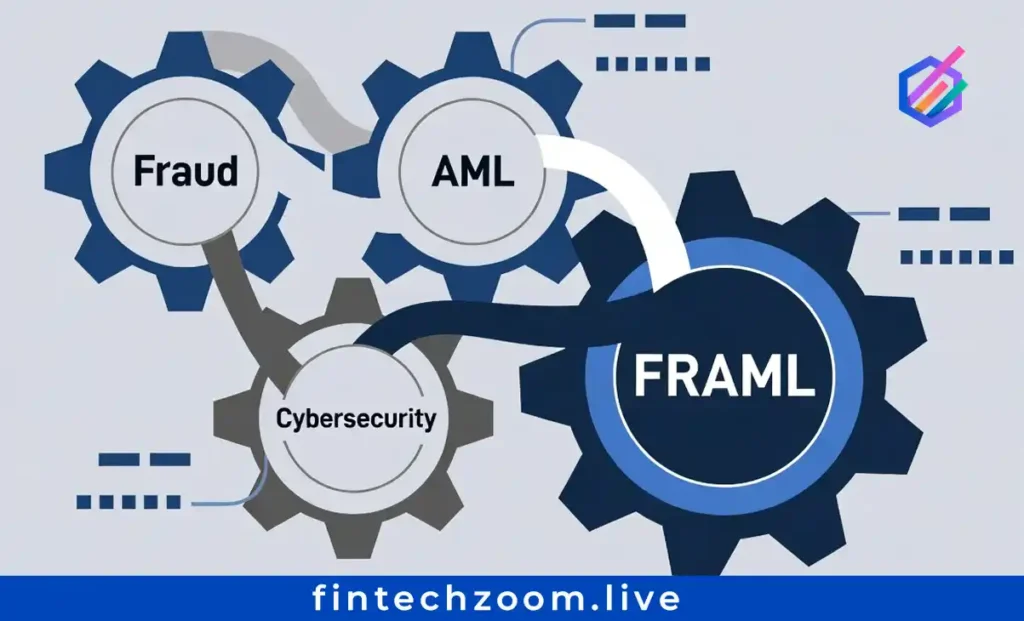
Some banks and fintechs are merging fraud, anti-money laundering and cyber monitoring into one financial crime function, often called FRAML. The case for it is visible in the cases above: an account takeover starts as a cyber event, becomes a fraud loss and ends as money laundering through mule accounts or crypto. FinCEN treats cybercrime and fraud as two of its national AML priorities, which is why its deepfake alert sits in a money laundering framework (FinCEN).
Shared data is the main gain: device, login and payment signals that a cyber team sees can feed the transaction monitoring a compliance team runs. The risk is new AI tools adopted without review. Staff pasting customer data into public chatbots, sometimes called shadow AI, can breach privacy rules and the confidentiality terms in DORA and NYDFS vendor contracts, and the usual controls are an approved-tool list and data loss prevention. For how AI is used elsewhere in finance, see our AI in finance trends 2026 guide, and for the wider technology backdrop, the 2026 tech reset.
What this means for fintech users
Most of the losses in the IC3 data came from people being persuaded to send money, not from systems being broken into. The settings that block the most common attacks, such as app-based or passkey sign-in instead of SMS codes, transfer limits and alerts, are covered step by step in our finance app settings guide. Two habits matter most against the 2026 schemes: treat any urgent request to move money, even on a video call, as unverified until you call back on a number you already have, and never move funds to a new investment platform introduced by someone you met online.
From our desk: what we found checking this update
The April edition said the SEC had issued a Post-Quantum Financial Infrastructure Framework. The document it described is a written submission from a private individual to the SEC Crypto Task Force, dated September 3, 2025, not an SEC framework or rule (SEC Crypto Task Force submission); we removed the claim and its 3 percent statistic. We also removed an unsourced $5.5 trillion money laundering figure. The old quantum image showed a migration timeline of 2023, 2025, 2025 and 2026 that matched no official schedule, so we replaced it with the dated table above. Finally, the IC3 report gives two different-looking crypto figures, $7.2 billion and $11.4 billion: the first is crypto investment fraud only and the second covers all crypto-related complaints.
Fintech cybersecurity trends 2026 FAQs
What are the biggest fintech cybersecurity trends in 2026?
The largest by reported losses is fraud that persuades victims to send money, much of it involving crypto and investment schemes. The FBI counted $20.877 billion in reported US losses for 2025. Other trends are AI-assisted impersonation and deepfakes, ransomware run by more than 120 active brands according to Europol, dependence on a small number of cloud and technology providers, and the start of the move to post-quantum cryptography.
How much did Americans lose to cybercrime in 2025?
The FBI Internet Crime Complaint Center recorded 1,008,597 complaints and $20.877 billion in losses for 2025, up 26 percent from 2024. Crypto-related complaints accounted for $11.37 billion, investment fraud for $8.65 billion and business email compromise for $3.05 billion. People aged 60 and over reported $7.75 billion in losses.
How are deepfakes used in financial fraud?
Criminals use AI-generated images and documents to open accounts under false identities, and AI-generated voices or video to impersonate executives, bank staff or relatives and ask for urgent payments. FinCEN warned banks about deepfake identity documents in alert FIN-2024-Alert004 on November 13, 2024. In a widely reported 2024 case, an Arup employee in Hong Kong sent about $25 million after a video call with a deepfaked finance chief.
What is post-quantum cryptography and when do banks need it?
Post-quantum cryptography uses algorithms designed to resist attacks by future quantum computers. NIST published its first standards in August 2024 and its final transition report on October 27, 2026, which deprecates quantum-vulnerable public-key algorithms after 2030 and disallows them after 2035. The G7 Cyber Expert Group suggests financial firms address their most critical systems in 2030 to 2032, though its statement is not binding.
What is harvest now, decrypt later?
It is the risk that attackers copy encrypted data now and store it until a quantum computer can break the encryption. Data that must stay confidential for many years, such as account records, identity data and long-term contracts, is most exposed. It is the main reason firms are starting post-quantum migration before such computers exist.
Is the SEC four-day cyber incident disclosure rule still in force?
Yes, as of November 16, 2026. Listed companies must file Form 8-K Item 1.05 within four business days of deciding a cyber incident is material. The SEC opened a review of Regulation S-K on January 13, 2026, and five bank and securities trade groups asked for the rule to be rescinded on April 10, 2026, but we found no proposed or adopted rescission.
What does DORA require from fintech firms in the EU?
The Digital Operational Resilience Act has applied since January 17, 2025 to banks, insurers, payment and e-money institutions, investment firms and crypto-asset service providers. It sets rules for ICT risk management, major incident reporting, resilience testing and management of technology suppliers. On November 18, 2025 EU supervisors designated 19 critical ICT third-party providers for direct oversight.
What changed in New York cybersecurity rules for financial firms?
The final phase of the amended NYDFS Part 500 took effect on November 1, 2025. Regulated firms must use multi-factor authentication for any user accessing any information system, with narrower rules for small firms, and must keep a written asset inventory that records each system owner, location, classification and recovery time objective.
How can fintech app users protect themselves?
Use app-based or passkey sign-in rather than SMS codes where offered, switch on transfer alerts and limits, and verify any urgent payment request by calling back on a number you already know, even if the request came by video. Be wary of investment platforms introduced by people met online, which drove the largest share of reported losses in 2025.
How we report on fintech cybersecurity: we rely on law enforcement reports, regulator texts, standards bodies and company filings, give each figure its date and source, and say when a figure comes from a secondary report. Complaint-based loss data such as the IC3 report count only what victims report, so true losses are higher. We do not name security vendors as recommendations and we make no buy or sell calls on any company mentioned.
Revision history: November 16, 2026, full rewrite with 2025 FBI IC3 data, Europol IOCTA 2026, ENISA 2025, the final NIST IR 8547, Executive Order 14412, the G7 quantum roadmap, the SEC rule review, DORA, NYDFS and Regulation S-P dates, FAQ and sources; previous edition April 13, 2026.
Related: Finance app security settings · AI in finance trends 2026 · Fintech regulation news 2026 · The 2026 tech reset · Best finance apps 2026 · Cryptocurrency prices · All articles
This article is for information only and is not investment, legal or security advice. See our disclaimer.
Sources: FBI IC3 2025 Internet Crime Report · FinCEN deepfake alert, Nov 13, 2024 · Europol IOCTA 2026 · eucrim on IOCTA 2026 · ENISA Threat Landscape 2025 · CFO Dive on Arup · FBI PSA on Bybit, Feb 26, 2025 · Insurance Journal on Coinbase, May 15, 2025 · Morgan Lewis on DORA critical providers · Mayer Brown on DORA · Hogan Lovells on NYDFS Part 500 · NIST post-quantum cryptography project · NIST on IR 8547, Oct 2026 · Cloud Security Alliance on IR 8547 · Executive Order 14412, Federal Register · G7 CEG quantum roadmap · GOV.UK G7 CEG statement · SEC cyber disclosure rules, July 26, 2023 · Joint trades letter to SEC, Apr 10, 2026 · American Banker, June 12, 2026 · Parker Poe on Regulation S-P · SEC Crypto Task Force submission, Sep 3, 2025