Last revised: November 17, 2026 · By the FintechZoom Markets Desk, reviewed under our editorial policy
Fintech, short for financial technology, is the use of software, data and networks to deliver financial services such as payments, banking, lending, investing, insurance and compliance. The Financial Stability Board, the G20 body that monitors the global financial system, describes it as “technologically enabled innovation in financial services that could result in new business models”, along with new applications, processes or products that materially affect how financial services are provided (FSB, page updated October 14, 2026). In practice, what is fintech for most people is the payment app, online bank or investing account on their phone, and the banks, card networks and regulators behind it.
This guide explains the main types of fintech with real examples, how fintech payments move from one account to another, which protections apply to your money in the US, UK and EU, and what changed in the rules during 2025 and 2026. Figures carry their date and source; anything marked as an example is a hypothetical illustration, not a recommendation.
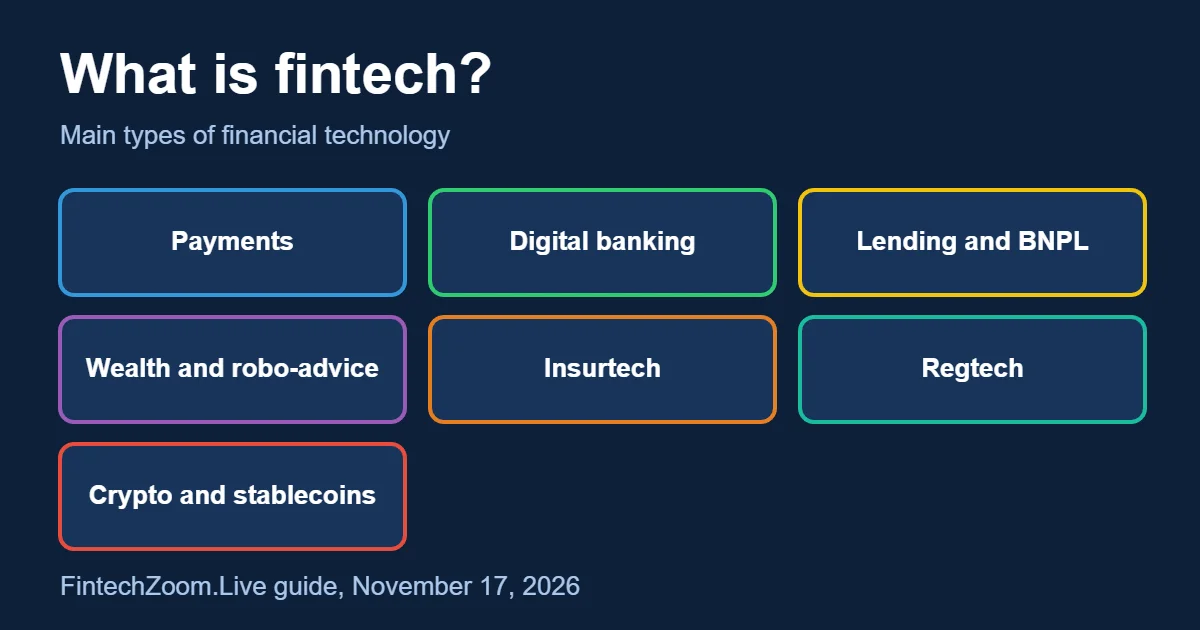
What fintech means, in one table
Fintech is a broad label, so it helps to split it by what the product does. The table lists the main types, a plain description and the authority that most often supervises that activity. Many fintech firms do not hold a banking licence themselves; they work through a licensed partner bank or obtain a narrower payments or e-money licence.
| Type of fintech | What it does | Typical supervisor (US / UK / EU) |
|---|---|---|
| Payments and money transfer | Card acceptance, mobile wallets, peer-to-peer apps, instant account-to-account transfers, cross-border remittances | State money transmitter regulators and the CFPB / FCA / national authorities under the EU payments directive |
| Digital banking (neobanks) | App-first current and savings accounts, often run through a partner bank | Partner bank’s regulator (OCC, FDIC, Fed, states) / PRA and FCA / ECB and national supervisors |
| Lending | Online personal and small-business loans, buy now, pay later (BNPL), credit scoring with alternative data | CFPB and state regulators / FCA / national authorities |
| Wealth and robo-advice | Automated portfolios, fractional shares, low-cost brokerage apps | SEC and FINRA / FCA / national securities regulators under MiFID II |
| Insurtech | Online insurance sales, usage-based pricing, faster claims handling | State insurance departments / FCA and PRA / national insurance supervisors |
| Regtech | Software for identity checks, anti-money-laundering monitoring, fraud detection and reporting | Indirect: the firms that use it remain responsible to their own regulator |
| Crypto assets and stablecoins | Exchanges, wallets, tokenised dollars used for payments and trading | OCC, state regulators, SEC or CFTC depending on the asset / FCA / national authorities under MiCA |
Investment in the sector is large but cyclical. KPMG’s Pulse of Fintech report counted US$103.1 billion of global fintech investment in the first half of 2026 (KPMG, September 2026). That is a consultancy estimate built from deal databases, so treat it as a broad measure of activity, not an exact count. On the user side, the World Bank’s Global Findex 2025 survey, conducted in 2024, found that 79 percent of adults worldwide have an account at a bank, other financial institution or mobile money provider (World Bank).
How fintech payments move
Most fintech products sit on top of older payment rails. When you tap a phone to pay, the wallet app passes a card token to the card network, which routes the payment to your card issuer for approval; settlement between banks happens later. Account-to-account apps work differently: they move money directly between bank accounts, increasingly over real-time systems that settle in seconds, at any hour.
Three public real-time systems show how different countries built this layer. The figures below are the latest available on November 17, 2026, and are in local currency.
| System | Country | Launched | Latest published activity | Source |
|---|---|---|---|---|
| FedNow Service | United States | July 20, 2023 | Q3 2026: 6,376,467 settled payments worth US$370.9 billion, average US$58,161 per payment | Federal Reserve Financial Services |
| Unified Payments Interface (UPI) | India | 2016 | October 2026: 25.47 billion transactions worth ₹31.53 lakh crore (about ₹31.5 trillion), NPCI data | MediaNama, Nov 9, 2026 |
| Faster Payment System | United Kingdom | May 27, 2008 | Pay.UK did not show current monthly figures on its statistics page when we checked | Pay.UK heritage page |
The scale gap is large. FedNow’s quarterly count is a small fraction of UPI’s monthly count, because FedNow is a wholesale service that banks join voluntarily, while UPI is built into consumer apps across India. FedNow’s average payment value is far higher, which points to business and account-funding use more than everyday retail spending. Digital Transactions, a payments trade publication, reported on July 1, 2026 that more than 1,800 banks and credit unions were enrolled in FedNow (Digital Transactions). Volume grew 27.6 percent from the previous quarter in Q3 2026, according to the Federal Reserve’s own table.
For a closer look at the companies and rails involved, see our coverage of finance app settings and our directory of fintech research resources, which lists the central bank and BIS payments data sets.
Digital banks and where your money is protected
This is the area where fintech and traditional banking differ most for users. In the US, the FDIC insures deposits up to at least $250,000 per depositor, per ownership category, at each FDIC-insured bank (FDIC). An app company is not a bank. The FDIC states that nonbank companies “are never FDIC-insured” and that money you send to one is only eligible for insurance once it is deposited at an insured bank and other conditions are met, such as records that show who owns each dollar (FDIC, Banking with third-party apps). That arrangement is called pass-through insurance. It covers the failure of the partner bank. It does not cover the bankruptcy of the app company itself.
In the UK, the Financial Services Compensation Scheme protects up to £120,000 per eligible person with UK-authorised banks, building societies and credit unions; the limit rose from £85,000 on December 1, 2025 (FSCS). Electronic money firms are a different case: they must safeguard customer funds, but e-money balances are generally not covered by FSCS deposit protection. In the EU, national deposit guarantee schemes cover €100,000 per depositor per bank under the deposit guarantee directive.
A practical check before using any app-based account: find the name of the licensed bank or e-money institution in the terms, then confirm it on the regulator’s register (FDIC BankFind in the US, the FCA register in the UK).
Lending, buy now, pay later and alternative credit
Fintech lenders use online applications and automated underwriting, sometimes drawing on bank-account data in addition to credit reports. Buy now, pay later is the best-known consumer product: a purchase is split into a few instalments, often with no interest if paid on time. In the US, the CFPB has published market reports on BNPL use and repayment, the latest in December 2025 (CFPB BNPL market report). The main risks for borrowers are the same as with any credit: missed payments, late fees and taking on several small loans that add up. Our credit card payoff calculator shows how interest builds on revolving debt, which is a useful comparison before using any short-term credit.
Investing apps and robo-advisers
Robo-advisers build and rebalance a portfolio from a questionnaire about your goals and risk tolerance. The SEC’s staff issued guidance and an investor bulletin on them in February 2017, telling investors to check what information the service uses, its fees and how much human involvement there is (SEC press release 2017-52). Low-cost brokerage apps and fractional shares lowered the cost of starting to invest; they did not lower market risk. If you are new to this, our guides on how to invest in the stock market and stock market platforms cover account types, fees and how to check a broker.
Crypto assets and stablecoins: the 2025 to 2026 rule changes
Stablecoins are crypto tokens designed to hold a fixed value, usually one US dollar, backed by reserves. Two sets of rules now apply in the largest markets.
United States. The GENIUS Act was enacted on July 18, 2025 (OCC Bulletin 2026-50). On October 21, 2026 the Office of the Comptroller of the Currency issued its final rule for the stablecoin issuers it supervises, covering reserve assets, redemption, risk management, audits, custody and capital; it takes effect on January 18, 2027. Anti-money-laundering requirements are being handled in a separate rulemaking. The Act itself takes effect on the earlier of 18 months after enactment (January 18, 2027) or 120 days after the regulators issue final rules, and it bars issuers from paying holders interest or yield for holding the coin, according to a legal analysis by Astraea Law (Astraea, updated Nov 1, 2026).
European Union. The Markets in Crypto-Assets Regulation (Regulation (EU) 2023/1114) has applied in full since December 30, 2024. Crypto firms that were operating under national rules before then could continue during a transition period that ended no later than July 1, 2026, so firms serving EU clients now need a MiCA authorisation (EUR-Lex).
Crypto prices remain volatile even where these rules apply, and a regulated stablecoin is not a bank deposit. For live prices and market context, see our crypto market page; for the policy timeline, see fintech regulation news 2026.
Open banking: sharing your bank data with apps
Open banking lets you instruct your bank to share account data with another provider, or to start a payment from your account, usually through an API instead of handing over your password. The UK and EU have required this since PSD2. The US rule is still unsettled.
- United States: the CFPB finalised its personal financial data rights rule under section 1033 of the Dodd-Frank Act on November 18, 2024 (Federal Register). In August 2025 it opened a reconsideration through an advance notice of proposed rulemaking, which its rules-under-development page still listed in October 2026 (CFPB). The codified text still shows April 1, 2026 as the first compliance date for the largest providers (eCFR), but the rule’s final shape is not settled.
- European Union: the Council published the agreed texts of the third Payment Services Directive (PSD3) and a new Payment Services Regulation on April 23, 2026. The package adds fraud-prevention rules and a single rulebook for open banking and payment conduct. Formal adoption and publication in the Official Journal were still pending in the April 29, 2026 analysis by law firm Matheson (Matheson), and the rules apply only after a further transition period.
- United Kingdom: open banking has run since 2018 under the Competition and Markets Authority order and is moving to a long-term framework overseen by the FCA.
Before connecting an app to your bank account, check what data it requests, how long it keeps access, and how to revoke it from your bank’s app. Our fintech cybersecurity guide covers fraud and account security.
Regtech and AI in financial services
Regtech tools check customer identity, screen payments against sanctions lists and flag suspicious transactions. Banks and fintech firms increasingly use machine learning for these checks and for credit and fraud models. In October 2026 the Financial Stability Board finalised sound practices for the responsible adoption of artificial intelligence by financial institutions (FSB). Regulators also run innovation programmes: the UK FCA’s regulatory sandbox lets firms test products with real consumers under supervision, and it states that the sandbox “is not regulatory exempt” (FCA). For more, see AI in finance trends 2026 and our report on AI-related finance job cuts.
Bank, digital bank or payment app: a comparison
The table compares three common ways to hold and move money. It is a general summary of US and UK rules as of November 17, 2026; individual products vary, so read the provider’s terms.
| Feature | Traditional bank account | Digital bank (app-first) | Payment or wallet app |
|---|---|---|---|
| Who holds the licence | The bank | Either the app itself (if it is a licensed bank) or a partner bank | Usually a money transmitter or e-money licence; balances may sit at partner banks |
| US deposit insurance | FDIC up to $250,000 per depositor, per ownership category, per bank | FDIC if the provider is a bank, or pass-through if conditions are met | Only pass-through on funds placed at an insured bank, if conditions are met; none against the app company failing |
| UK protection | FSCS up to £120,000 | FSCS if the provider is a UK-authorised bank | Safeguarding of e-money funds; generally no FSCS deposit cover |
| Typical strengths | Branches, full product range, long track record | Fast account opening, spending tools, low fees | Instant transfers between users, easy online checkout |
| Typical weak points | Fees and slower product updates | Fewer products; dependence on partner bank arrangements | Weaker protection for stored balances; fraud on instant payments is hard to reverse |
A worked example: keeping money in an app
Hypothetical example, for illustration only. Sara keeps $4,000 in a US payment app to split bills with flatmates. The app’s terms say balances are held “for the benefit of” users at a named partner bank. If the partner bank failed, her balance could qualify for FDIC pass-through insurance, provided the app’s records correctly show her share. If the app company itself went bankrupt, FDIC insurance would not apply, and recovering the money could depend on a bankruptcy process, as the FDIC warns. A lower-risk routine for the same need would be to keep only the amount needed for upcoming payments in the app and move the rest to an account directly at an insured bank. The numbers and the person are invented; the protections described are taken from the FDIC guidance cited above.
Risks to understand before using fintech services
- Protection gaps: deposit insurance covers bank failure, not the failure of an app company or a crypto platform.
- Fraud and scams: instant payments settle in seconds, so a payment sent to a scammer can be hard to recover. Fake banking apps and look-alike websites are common, according to the FDIC.
- Data sharing: open banking and app permissions give third parties access to transaction history; revoke access you no longer use.
- Credit risk: easy-to-use BNPL and app loans can lead to several overlapping repayments.
- Market risk: investing and crypto apps make trading easy; they do not reduce the chance of losses.
- Rule changes: US open banking and stablecoin rules, and EU payments rules, are changing during 2026 and 2027.
Where to go next on FintechZoom
This page is the starting point for our fintech coverage. Each article below goes deeper on one part of it:
- Fintech regulation news 2026: stablecoin rules, MiCA and enforcement actions.
- Fintech cybersecurity trends 2026: fraud, passkeys and account security.
- AI in finance trends 2026 and AI finance job cuts 2026.
- Finance app settings guide and best finance apps 2026.
- Fintech research resources 2026: primary data sources.
- Markets and tools: markets today, crypto market and our financial calculators.
From our desk: what we found checking this guide. Several figures that circulate about fintech did not hold up against primary sources. The FSCS limit of £85,000, still quoted on many sites, was replaced by £120,000 on December 1, 2025. The FedNow statistics page does not publish a participant count, so the “more than 1,800” figure comes from trade press, not the Federal Reserve. NPCI’s own statistics page could not be read by our tools, so the October 2026 UPI figures are taken from NPCI data as reported by MediaNama and Inc42, whose month-on-month value change differs by 0.1 percentage point (7.3 versus 7.4 percent). We did not find a CFPB notice confirming whether the April 1, 2026 open banking compliance date is being applied.
What is fintech: FAQs
What is fintech in simple words?
Fintech means financial technology: software and apps that deliver financial services such as payments, bank accounts, loans, investing, insurance and compliance checks. The term covers both new companies and the technology that traditional banks use.
What are the main types of fintech?
The main types are payments and money transfer, digital banking, lending including buy now pay later, wealth and robo-advice, insurtech, regtech for compliance, and crypto assets including stablecoins. Many products combine more than one type.
What are some examples of fintech?
Common examples are mobile wallets, peer-to-peer payment apps, app-based bank accounts, robo-advisers and online brokerage apps, buy now pay later at online checkouts, and real-time payment systems such as FedNow in the US and UPI in India.
Is my money safe in a fintech app?
It depends on how the app holds your money. In the US, app companies are never FDIC-insured themselves. Funds may get pass-through FDIC insurance if they are deposited at an insured bank and the app keeps proper ownership records, but that does not protect you if the app company itself fails. Check the partner bank named in the terms.
How is a neobank different from a traditional bank?
A neobank is an app-first provider. Some hold their own banking licence; many in the US offer accounts through a partner bank. A traditional bank holds the licence and the deposits directly and usually offers branches and a wider product range.
What is open banking?
Open banking lets you tell your bank to share your account data with another provider, or to start a payment from your account, through a secure connection instead of sharing your password. It is required in the UK and EU, while the US rule from the CFPB is under reconsideration as of November 2026.
Are stablecoins regulated?
In the US, the GENIUS Act was enacted on July 18, 2025 and the OCC issued its final rule for the issuers it supervises on October 21, 2026, effective January 18, 2027. In the EU, the MiCA regulation has applied since December 30, 2024. A stablecoin is still not a bank deposit.
How we report on fintech: we use regulators, central banks, official statistics and company filings first, label trade press and law-firm analysis as such, date every figure, and name the country and currency. Rules differ by country and change often, so check the linked regulator before acting. Read our sourcing standards.
Revision history: November 17, 2026, first edition.
Related: Fintech regulation news 2026, Fintech cybersecurity trends 2026, AI in finance trends 2026, Fintech research resources 2026, Cryptocurrencies, Financial calculators
This article is general information, not financial, investment or legal advice, and it is not a recommendation to use any product. Deposit protection, payment rules and crypto regulation differ by country and change over time. See our full disclaimer.
Sources: Financial Stability Board, Financial innovation, Federal Reserve, FedNow quarterly statistics, Digital Transactions, FedNow third anniversary, MediaNama, UPI October 2026, Pay.UK heritage, FDIC, Understanding deposit insurance, FDIC, Banking with third-party apps, FSCS, OCC Bulletin 2026-50, Astraea Law, GENIUS Act effective date, EUR-Lex, Regulation (EU) 2023/1114, Federal Register, Personal financial data rights, CFPB, Rules under development, eCFR 12 CFR 1033.121, Matheson, PSD3 and PSR, KPMG Pulse of Fintech H1 2026, SEC, robo-adviser guidance 2017, FCA regulatory sandbox, FSB, AI sound practices, World Bank Global Findex.