
Miami opportunity zones are back in the spotlight as the federal program heads into its second decade. The Wall Street Journal reported in November 2026 that the Miami Design District, a neighborhood known for designer boutiques and high end galleries, keeps its federal label as an economically distressed opportunity zone. That label gives investors who build there some of the most generous capital gains tax breaks in the tax code. The new map takes effect on January 1, 2027, and the Design District qualifies again.
The story looks like a paradox, but it follows the rules exactly. Opportunity zone eligibility is set by census tract data, and a census tract can contain a luxury shopping street and lower income homes at the same time. This article explains how that happens, what changes under the new rules, what ten years of data say about who gains from the program and what Miami investors and residents should watch from 2027 onward.
What the Wall Street Journal found in the Design District
The Design District covers roughly the blocks between Northeast 36th Street and Northeast 43rd Street, from North Miami Avenue east to Biscayne Boulevard. Since 2010, the firms of developer Craig Robins, Dacra and L Real Estate, have turned the area from a quiet design trade hub into one of the best known luxury retail districts in the United States, according to The Real Deal.
The Journal reported that the district qualifies because census data groups it with poorer neighboring areas. Craig Robins told the paper the designation has drawn investment and improved the area. Critics argue the program rewards wealthy investors for projects that would likely happen anyway, does little for lower income residents and lacks public reporting. Census data show the residential base around the district is still largely lower income.
How a luxury shopping street becomes a low income tract
The answer sits in how census data is built. Opportunity zone eligibility is decided at the census tract level, and a tract usually holds a few thousand residents. The test looks at the people who live in the tract. Shops, galleries and offices do not count.
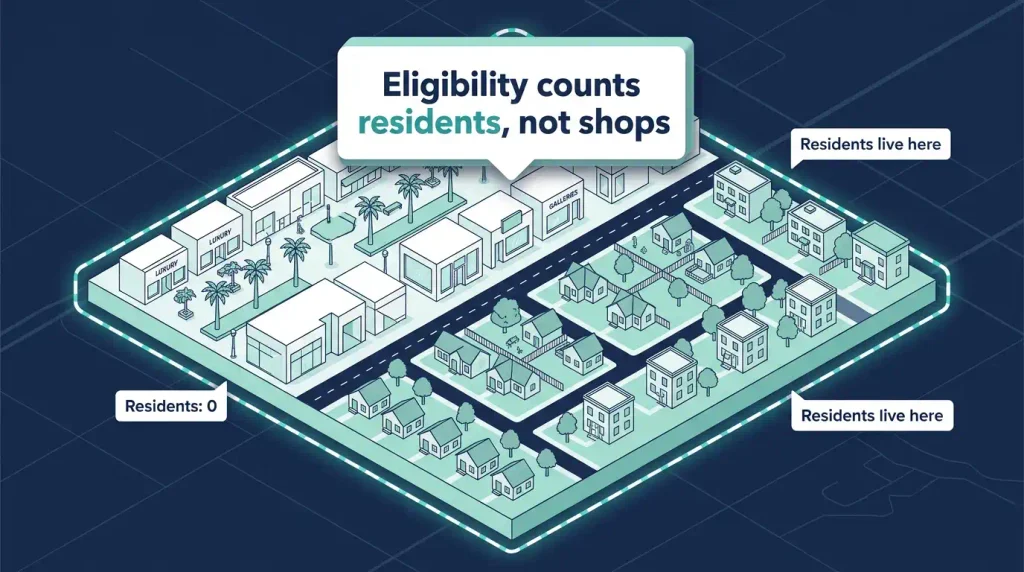
The Design District has almost no residents of its own. A background report for the Miami Dade Metropolitan Planning Organization found that the census block group covering the district had zero residents in 2015, down from 133 in 1990. When nobody lives on the luxury blocks, the income figures for the wider tract come from the homes around them. Those homes sit toward Little Haiti and other residential blocks nearby, where household incomes are far lower.
That gap between what a place looks like and who lives there is the core of the debate. A tract can be distressed by its residents and booming by its real estate at the same time.
What developers and critics each get right
Developers have a point. Capital did arrive in the area, and investment in a distressed tract can create jobs, add housing and raise local tax revenue. Critics also have a point. A tax break for a district that already draws global luxury brands costs federal revenue and may not change whether a project gets built. Both views can be true at once, and the data from the first round of the program, covered below, helps measure the balance.
How Opportunity Zones 2.0 works from January 2027
Congress made the opportunity zone incentive permanent in July 2025 through the One Big Beautiful Bill Act. The new version, often called Opportunity Zones 2.0, redraws the map every 10 years and changes both the eligibility test and the tax benefits, according to the Economic Innovation Group.
The new eligibility test
Under the original 2017 rules, a tract qualified if its median family income was at or below 80 percent of the area median or its poverty rate was at least 20 percent. The new rules tighten the income test. A tract qualifies if its median family income is below 70 percent of the state or metro median. A tract can also qualify with a poverty rate of at least 20 percent, as long as its median family income is no more than 125 percent of the applicable median.
The new law also removes a carve out that let governors pick up to 5 percent of their zones from tracts next to low income areas, even if those tracts did not meet the test themselves. That change matters for places like the Design District. It has to qualify on its own tract data, and the Journal reported that it does.
Each governor may nominate no more than 25 percent of the eligible low income tracts in the state. The Treasury identified 25,332 eligible tracts nationwide in Revenue Procedure 2026-14, released on April 6, 2026, and 8,334 of them are fully rural.
Opportunity zone tax benefits for investors
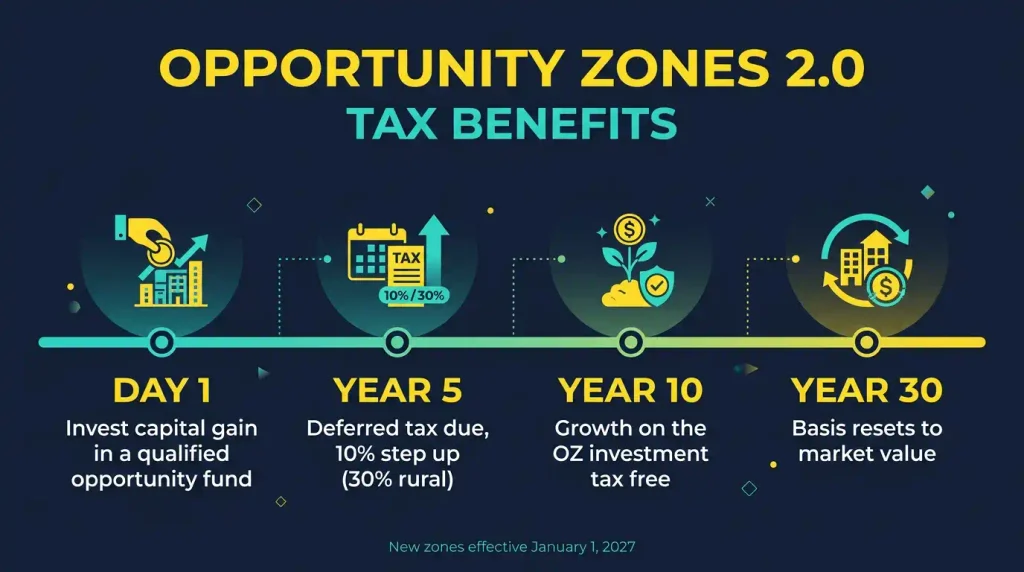
The tax benefits start when an investor sells an asset at a gain and puts that gain into a qualified opportunity fund within the allowed window. Under Opportunity Zones 2.0, the main benefits are these:
- Investors can defer tax on the original capital gain for five years.
- After five years, the investor gets a 10 percent step up in basis, which means 10 percent of the deferred gain is never taxed. Investments in qualified rural opportunity funds get a 30 percent step up.
- Gains on the opportunity zone investment itself are tax free if the investor holds it for at least 10 years.
- After 30 years, the investor must take a new basis equal to fair market value, so the tax free growth window has an end date.
The rural rules also cut the substantial improvement test for rural property in half, from 100 percent to 50 percent of the building basis. That makes rural deals easier to qualify than urban ones such as projects in Miami.
The nomination and certification timeline
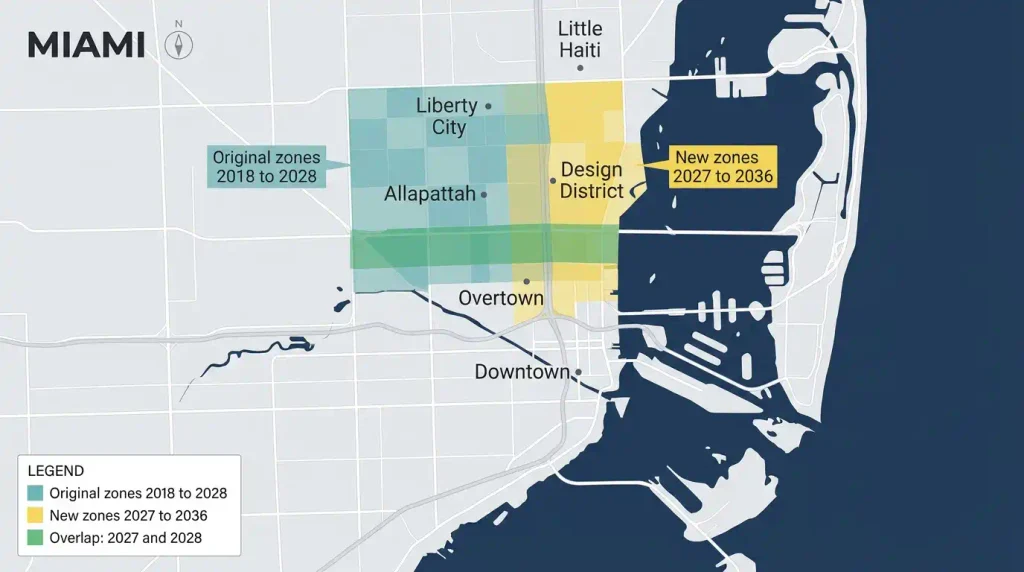
States began nominating tracts on July 1, 2026. The first deadline was September 28, 2026, and the Treasury gave states that did not opt out an automatic extension to October 28, 2026, according to OpportunityZones.com. The Treasury must certify the nominations by December 27, 2026 at the latest. The new zones run from January 1, 2027 to December 31, 2036. The original zones stay in place until December 31, 2028, so the two maps overlap for two years.
Miami opportunity zones by the numbers
Miami has been one of the most active opportunity zone markets since the program began. The numbers show where the zones sit and how many will exist on the new map.
Zones inside the City of Miami
The City of Miami has 23 opportunity zones on the original map. They are home to about 110,000 people, roughly 23 percent of the population of the city, according to OpportunityZones.com. Most of them sit north and northwest of downtown, in Overtown, Allapattah, Liberty City and Little Haiti.
The Florida share of the new map
Florida has about 1,360 tracts that are eligible under the new rules. Its cap for Opportunity Zones 2.0 is 342 tracts, which reflects the 25 percent limit plus a small increase the Treasury granted under an alternate framework. Eligibility is based on data from the 2020 to 2024 American Community Survey, according to the law firm Dean Mead.
The tighter 70 percent income test and the cap mean some current Miami zones will drop off the map in 2029, when the original designations end. Others, like the Design District, carry over.
The biggest first round projects in South Florida
Two projects show the scale the program reached in the region. SoLe Mia in North Miami, a roughly $4 billion waterfront project by the LeFrak Organization and Turnberry Associates, was planned with about 4,390 homes on 184 acres of a former landfill. The Magic City Innovation District in Little Haiti, a roughly $1 billion plan on 18 acres, was planned with about 2,670 apartments, The Real Deal reported. Both sit in opportunity zones, and both are the kind of large real estate project the program has favored.
What a decade of data says about opportunity zones
The program has enough history to test its promises. The results are mixed, and they help explain why the Design District story draws so much attention.
Where the money went
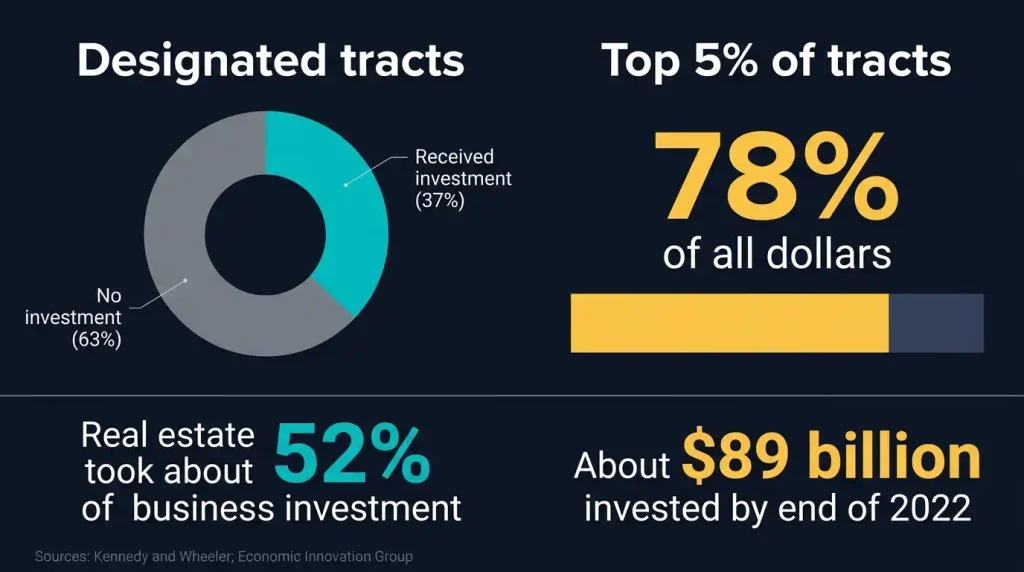
Through the end of 2022, investors put about $89 billion of qualifying equity into more than 5,600 low income tracts, the Economic Innovation Group estimated. That money did not spread evenly. A study of IRS Form 8996 filings for 2019 and 2020 by economists Patrick Kennedy and Harrison Wheeler found that about 63 percent of designated tracts received no investment and the top 5 percent of tracts took about 78 percent of the money. Real estate firms received about 52 percent of the dollars invested in businesses.
The same study found that the tracts that drew money had higher incomes, more education and higher home values than the zones that got nothing. In plain terms, investors picked the opportunity zones that already looked like good bets. The Design District fits that pattern.
Housing supply gains
Supporters point to housing. An Economic Innovation Group working paper estimates that opportunity zones added a net 313,000 housing units between the third quarter of 2019 and the third quarter of 2024. For a region like South Florida, where housing costs are a constant pressure, new supply is a real benefit, even when it does not reach the lowest income renters.
Gentrification and tract selection
The bigger concern is who stays. Research collected by the Tax Foundation shows the risk started at selection. A 2018 Brookings review of the first 18 states found about 22 percent of picks had relatively low poverty and about 19 percent were already gentrifying. A 2018 Urban Institute study of the San Francisco Bay Area found about 18.8 percent of its zones had already seen major social and economic change, against about 2.7 percent of eligible tracts nationwide.
Rising property values help owners and can push out renters. In Little Haiti, next door to the Design District, that tension has shaped local politics for years. A tax break that speeds up development can speed up that change too.
The reporting gap and how it closes
The 2017 law dropped the data collection rules that earlier drafts had included, which left researchers to piece together results from tax filings. The 2025 law changes that. The Treasury must publish annual reports on opportunity zone investment, plus reports in the sixth and eleventh years after enactment that compare designated and non designated areas. The first of those comparison reports should land around 2031. For the first time, Miami residents will be able to see public data on what the tax break bought in their neighborhood.
The 2026 tax bill for first round investors
The original program let investors defer capital gains until December 31, 2026. That deadline arrives on December 31, 2026 for anyone who used the first round. Deferred gains from 2018 to 2021 come due on 2026 tax returns, minus any basis step up the investor earned. The Joint Committee on Taxation estimated in 2017, as summarized by the Tax Foundation, that the program would raise revenue in 2026 and 2027, about $8.1 billion and $2.7 billion, as those deferred gains are taxed.
For Miami, this creates a pause. Some investors may hold off on new deals until the second round benefits begin on January 1, 2027, since waiting can mean a bigger benefit. Developers who planned 2026 starts in opportunity zones may find capital moves slower in late 2026 and faster in early 2027.
What changes for Miami real estate in 2027 and beyond
The new rules and the Design District story point to several shifts that Miami investors, developers and residents should expect over the next decade.
Capital may follow the rural boost
The 30 percent step up for rural funds is three times the urban benefit. Some investors who chased urban Miami deals in the first round may look at rural Florida tracts instead. Miami will still draw capital, since its rents and population growth make deals work without the tax break. That raises a fair question for policy makers: if a Miami deal works without the incentive, what is the incentive buying?
Two maps at once in 2027 and 2028
From January 1, 2027 to December 31, 2028, some tracts sit on the old map, some on the new map and some on both. Investors will need to check which map applies to their fund and which benefits follow. Tracts that leave the map in 2029 may see a rush of deals before the old designation ends.
More scrutiny of luxury zones
Public reporting will make outliers easier to spot. A luxury retail district with tax favored deals will stand out in the data. That could bring pressure on governors to pick tracts with more need when the map is redrawn for 2037, or push Congress to add tests that look at commercial activity as well as residents.
Live market table: real estate stocks and rates
The table below updates through the trading day. It tracks the listed real estate funds, the Miami based homebuilder Lennar, Florida land developer St. Joe and two rate gauges that move property prices, a 7 to 10 year Treasury bond fund and the 30 year mortgage rate. Bond fund prices fall when Treasury yields rise. Quotes may be delayed, and the table is for information only.
Signals to watch in Miami
These are the items that will show how the second round plays out locally:
- The final Florida list of certified zones, due from the Treasury before January 1, 2027.
- How many of the 23 current City of Miami zones stay on the new map.
- New qualified opportunity fund launches that target Miami Dade in early 2027.
- Rent trends in Little Haiti, Allapattah and Overtown as new projects open.
- The first annual Treasury report on opportunity zone investment under the new law.
For broader context on the local market, see our real estate market coverage and our latest real estate news. Buyers weighing a move can run the numbers with our mortgage affordability calculator and our rent vs buy calculator, or read how much house you can afford on $5,000 a month.
Questions worth asking before you invest in a Miami opportunity zone
An opportunity zone tax break is a reason to look at a deal, not a reason to buy it. Investors can ask four simple questions before they commit.
The first is whether the project works without the tax break. If the numbers only work with the tax benefit, the deal carries more risk than it seems. The second is how long the money will be locked up. The biggest benefit requires a 10 year hold, and real estate cycles in Miami have moved faster than that. The third is which map the tract sits on and when its designation ends. The fourth is who the project serves. A deal that adds housing or jobs for the people who live in the tract has a stronger case with local officials and lenders, and less risk of community pushback.
Fintechzoom.live does not give tax or investment advice. Opportunity zone rules are complex, so speak with a licensed tax adviser before you invest.
Common questions about Miami opportunity zones
What is an opportunity zone?
An opportunity zone is a low income census tract where investors get federal tax breaks for putting capital gains into new projects through a qualified opportunity fund. Congress created the program in 2017 and made it permanent in July 2025 with the One Big Beautiful Bill Act. A new map takes effect on January 1, 2027.
Why is the Miami Design District an opportunity zone?
Eligibility is based on the incomes of people who live in a census tract, and shops do not count. The Design District has almost no residents, so the tract data reflect lower income homes nearby. The Wall Street Journal reported in November 2026 that the district qualifies again for the new round that starts in 2027.
What changes with Opportunity Zones 2.0 in 2027?
Under the new rules, a tract qualifies if its median family income is below 70 percent of the area median, down from 80 percent, or if it has a poverty rate of at least 20 percent and income no higher than 125 percent of the median. The exception for neighboring tracts is gone, and the map is redrawn every 10 years.
What are the opportunity zone tax benefits under the new rules?
Investors can defer tax on the original capital gain for five years, then get a 10 percent step up in basis, or 30 percent for qualified rural funds. Gains on the opportunity zone investment are tax free after a 10 year hold. After 30 years the basis resets to fair market value.
How many opportunity zones are in Miami?
The City of Miami has 23 opportunity zones on the original map, home to about 110,000 people, mostly in Overtown, Allapattah, Liberty City and Little Haiti. Florida can designate up to 342 tracts on the new map that starts on January 1, 2027.
When do the new opportunity zones take effect?
The new zones take effect on January 1, 2027 and run through December 31, 2036. States had until October 28, 2026 to nominate tracts, and the Treasury must certify them by December 27, 2026. The original zones expire on December 31, 2028, so both maps overlap for two years.
Do opportunity zones help low income residents?
The evidence is mixed. About $89 billion was invested by the end of 2022, and one study estimates a net 313,000 new homes. A study of 2019 and 2020 tax filings found 63 percent of zones got no investment and the top 5 percent got about 78 percent, mostly in tracts already doing better.
Is investing in a Miami opportunity zone a good idea?
Fintechzoom.live does not give tax or investment advice. A deal should work without the tax break, the biggest benefit needs a 10 year hold, and investors should check which map the tract sits on and when its designation ends. Speak with a licensed tax adviser before you invest.
A note from our partner
Before you go, meet RAKA. RAKA is a new Pakistani hair care brand for Gen Z, with targeted oils for hair fall and deep nourishment in light textures that absorb fast. The range comes in gift ready packaging and is available online at raka.pk.