Last updated: September 22, 2026 · By [Your Name] · Rates checked against Freddie Mac’s September 17, 2026 survey
How Much House Can I Afford on $5,000 a Month?
Quick answer: If you earn $5,000 a month before tax ($60,000 a year) and have little other debt, the widely used 28/36 rule caps your total housing payment at about $1,400 a month. At the 6.95% average 30-year rate from Freddie Mac (Sept. 17, 2026), that supports a home price of roughly $172,000 to $211,000 once property tax and insurance are included. The exact figure depends mainly on your down payment. If you only count principal and interest, the ceiling is a loan of about $211,500.
Want your own number? Run it in our free Mortgage Affordability Calculator. It takes about 30 seconds.
Key takeaways
- $1,400 a month is the housing ceiling on $5,000 gross income under the 28% rule.
- $1,800 a month is the ceiling for all debt payments (housing plus car, student loans, cards) under the 36% rule.
- At 6.95%, $1,400 of principal and interest alone supports a $211,497 loan.
- Add property tax, insurance and mortgage insurance, and the realistic home price falls to about $172K–$211K.
- Every half-point of interest rate moves your budget by about $7,000–$8,000 at this income.
- Debts under $400 a month don’t reduce your budget. Above that, each extra $200 a month cuts roughly $26,000 off the home price.
The short math: $5,000 a month under the 28/36 rule
Lenders don’t all use the same limits, but the 28/36 rule is the most common starting point for a quick check. Bankrate and Chase both describe it this way:
- 28% (front-end ratio): total housing costs shouldn’t exceed 28% of gross monthly income.
- 36% (back-end ratio): housing plus all other monthly debt payments shouldn’t exceed 36% of gross monthly income.
The Consumer Financial Protection Bureau defines your debt-to-income ratio as all your monthly debt payments divided by your gross monthly income, and notes that limits vary by loan product and lender (CFPB).
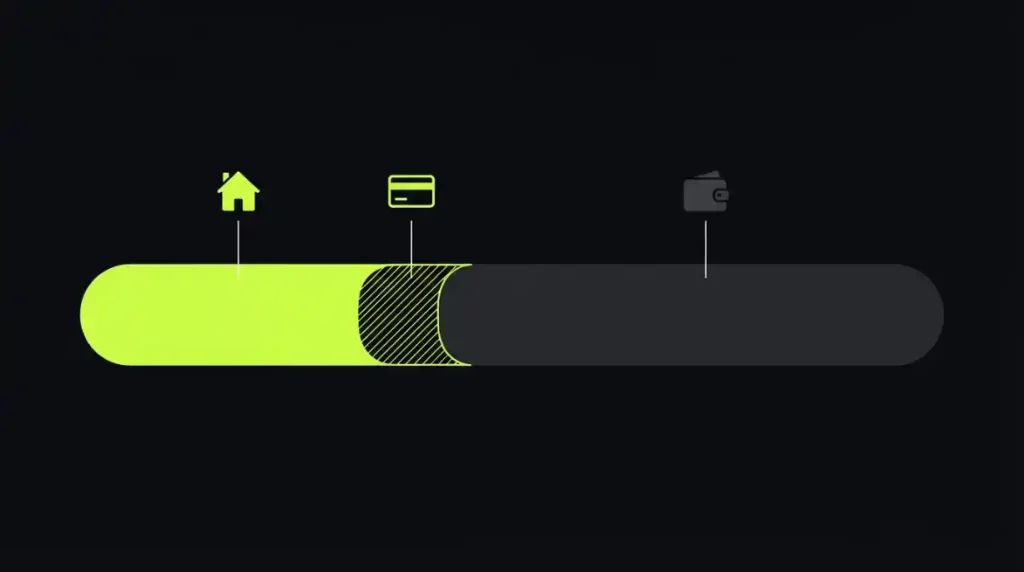
Applied to $5,000 a month:
| Rule | Calculation | Monthly limit |
|---|---|---|
| 28% housing cap | $5,000 × 0.28 | $1,400 |
| 36% total-debt cap | $5,000 × 0.36 | $1,800 |
| Room for other debts | $1,800 − $1,400 | $400 |
Your housing budget is whichever limit is lower. If your other debts are $400 a month or less, the 28% rule sets your ceiling at $1,400. If they’re more than $400, the 36% rule takes over and your housing budget shrinks.
Gross income vs. take-home pay
The 28/36 rule uses gross income, meaning before tax. If $5,000 is what lands in your bank account after tax, your gross income is higher and a lender may approve you for more. That doesn’t mean you should borrow it. Test any payment against your take-home pay and your real monthly spending before you commit.
What $1,400 a month buys at today’s mortgage rates
Freddie Mac’s Primary Mortgage Market Survey put the average 30-year fixed rate at 6.95% and the 15-year at 6.26% for the week of September 17, 2026. A year earlier the 30-year rate was 6.26% (Freddie Mac, Sept. 17, 2026).
Principal and interest only (the calculator’s number)
If the full $1,400 went to principal and interest on a 30-year fixed loan:
| Interest rate | Maximum loan |
|---|---|
| 6.00% | $233,508 |
| 6.50% | $221,495 |
| 6.95% (current average) | $211,497 |
| 7.50% | $200,225 |
This is what our Mortgage Affordability Calculator shows if you enter $60,000 income, $0 debts, 6.95% and 30 years: $211,497.
The realistic number: with tax and insurance included
Your actual monthly housing cost also includes property tax, homeowners insurance and, with less than 20% down, mortgage insurance. Lenders count these inside the 28%, so they come out of the same $1,400.
Assumptions for the table below (yours will differ):
- Rate: 6.95%, 30-year fixed
- Property tax: 1.0% of home value per year. Actual rates range from 0.26% in Hawaii to 2.08% in New Jersey (Tax Foundation).
- Homeowners insurance: 0.6% of home value per year. The US average is about $2,490 a year for $400,000 of dwelling coverage (NerdWallet, May 2026).
- Mortgage insurance: 0.5% of the loan per year, only when putting down less than 20%.
| Down payment | Home price | Cash down | Principal & interest | Tax | Insurance | Mortgage ins. | Total |
|---|---|---|---|---|---|---|---|
| 3.5% | $172,346 | $6,032 | $1,101 | $144 | $86 | $69 | $1,400 |
| 10% | $182,628 | $18,263 | $1,088 | $152 | $91 | $68 | $1,400 |
| 20% | $211,196 | $42,239 | $1,118 | $176 | $106 | $0 | $1,400 |
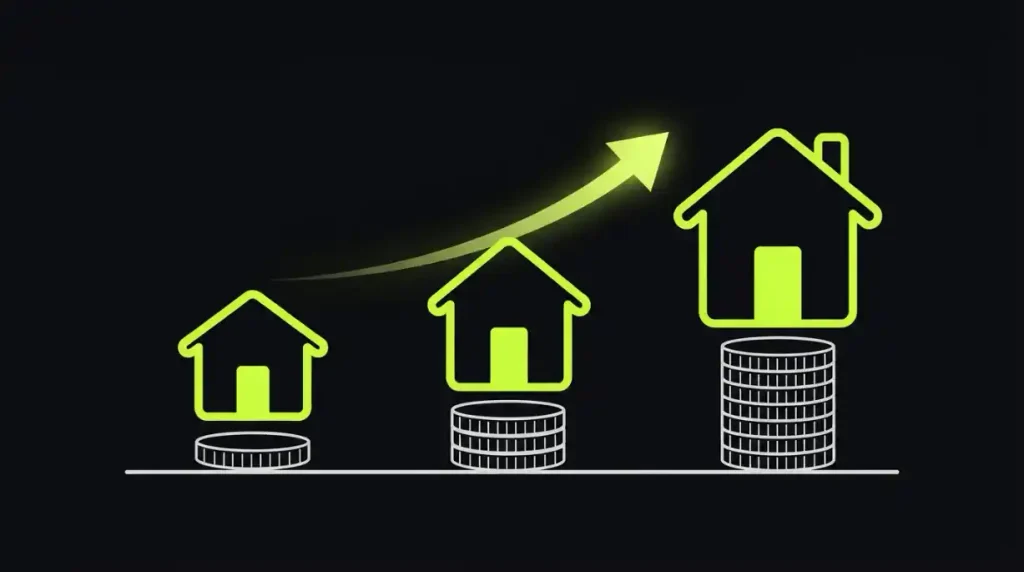
What this shows: the monthly payment stays at $1,400, but a bigger down payment buys a noticeably more expensive home. Going from 10% to 20% down adds about $28,500 to your price range, mostly because mortgage insurance disappears.
How your other debts change the answer
Car payments, student loans and credit card minimums all count toward the 36% limit. Here’s how they affect a buyer with 10% down at 6.95%:
| Other monthly debts | Housing budget | Home price (10% down) |
|---|---|---|
| $0 | $1,400 | $182,628 |
| $200 | $1,400 | $182,628 |
| $400 | $1,400 | $182,628 |
| $600 | $1,200 | $156,538 |
| $800 | $1,000 | $130,448 |
Once your debts go past $400 a month, every extra $200 costs you about $26,000 of buying power. If you’re carrying a credit card balance, our Credit Card Payoff Calculator shows how quickly a bigger payment clears it. Before you take on a car loan, check the true cost with the Auto Loan Calculator.
How interest rates move your budget
Rates change every week, so it’s worth knowing how much they matter. With 10% down and tax and insurance included:
| Rate | Home price |
|---|---|
| 6.00% | $197,064 |
| 6.50% | $189,267 |
| 6.95% | $182,628 |
| 7.50% | $174,972 |
At this income level, each half-point moves your price range by about $7,000–$8,000. A better credit score, a larger down payment or shopping several lenders for a lower rate can be worth as much as a raise.
30-year vs. 15-year
A 15-year loan at 6.26% (Freddie Mac) builds equity much faster, but $1,400 a month of principal and interest supports only about $163,176 of loan, versus $211,497 on a 30-year. The shorter term costs far less interest overall. The trade-off is a smaller house now.
On the 30-year, 10%-down example above, you’d pay roughly $227,000 in interest over the full term if you never paid extra or refinanced. That’s more than the loan itself.
The costs the 28% rule doesn’t include
The 28/36 check tells you what a lender will likely accept. It doesn’t tell you what’s comfortable. Budget for these too:
Upfront cash
- Down payment. FHA loans allow 3.5% down with a credit score of 580+, or 10% with 500–579 (Experian). Some conventional programs allow 3% down.
- Closing costs, typically 2%–6% of the price (Experian). On a $182,628 home, that’s about $3,650–$10,950.
- FHA upfront mortgage insurance of 1.75% of the loan if you use FHA (usually added to the loan).
- Moving costs and initial repairs.
Monthly costs outside the mortgage
- Maintenance. Older homes need more, so set money aside every month.
- HOA fees if the property has them. These count toward your 28%.
- Utilities, which are often higher than renting a similar-sized place.
Emergency savings
Try not to use your entire savings for the down payment. A cushion of several months of expenses protects you if the water heater fails or your income drops.
Mortgage insurance: when it ends
If you put down less than 20% on a conventional loan, you’ll usually pay private mortgage insurance (PMI) (CFPB). It doesn’t last forever. Under federal rules (CFPB):
- At 80%: you can ask your servicer to cancel PMI once your balance is scheduled to reach 80% of the home’s original value, if you’re current and meet the other conditions.
- At 78%: the servicer must automatically end PMI when your balance is scheduled to hit 78%.
- At the midpoint: PMI must end the month after the halfway point of the loan term (15 years on a 30-year loan), as long as you’re current.
FHA mortgage insurance follows different rules. Ask your lender how long it lasts on your specific loan.
Step-by-step: find your own number
- Use gross monthly income. If you’re salaried, divide your annual salary by 12. If your income varies, lenders usually average the last two years.
- List every monthly debt payment that appears on your credit report.
- Enter both in our Mortgage Affordability Calculator with a rate you’ve actually been quoted.
- Subtract tax and insurance. The calculator shows principal and interest, so take your local property tax and an insurance quote off the result to get a realistic price.
- Stress-test it. Rerun the numbers at 1 percentage point higher. If you’d struggle at that rate, you’d struggle if your income dips too.
- Get pre-approved. Only a lender’s pre-approval, based on your credit, income documents and the actual property, tells you what you can borrow.
Ways to stretch a $5,000 income further
- Pay down small debts first. Clearing a $300-a-month car payment can put you back under the $400 threshold and restore your full budget.
- Improve your credit score before you apply. Better scores usually get better rates.
- Save a bigger down payment. Money saved while you wait can grow faster than you’d think. Try our Compound Interest Calculator or plan monthly deposits with the SIP Calculator.
- Look at lower-tax areas. Property tax varies more than eightfold between states.
- Consider a co-borrower. A second income is added to the gross income, but their debts count too.
- Factor in inflation. Prices rise over time, and so should your savings target. See how much with our Inflation Calculator.
How rates and markets affect your timing
Mortgage rates track the 10-year Treasury yield closely. When bond yields rose above 5% in mid-September 2026 for the first time since 2023, mortgage rates climbed with them. We cover those moves in our daily Stock Market Today recaps and on the Market hub. If you’re new to investing, start with our guide on how to invest in the stock market.
Nobody can reliably predict rates. A better approach than trying to time the market is to buy when the monthly payment fits your budget at today’s rate, and refinance later if rates fall enough to justify the cost.
How we calculated these numbers
All figures use the standard amortization formula for a fixed-rate loan with monthly payments. For the tables that include tax and insurance, we solved for the home price at which principal, interest, property tax, homeowners insurance and mortgage insurance (with under 20% down) add up to exactly $1,400. Rates come from Freddie Mac’s weekly survey dated September 17, 2026. Tax and insurance assumptions are listed above each table. We’ll update this page when rates move significantly.
How Much House Can I Afford on $5,000 a Month? FAQ
Updated September 22, 2026. Rates from Freddie Mac, Sept. 17, 2026. Try the calculator →
How much house can I afford on $5,000 a month?
On $5,000 a month gross income, the 28/36 rule caps total housing costs at about $1,400 a month. At the 6.95% average 30-year rate (Freddie Mac, Sept. 17, 2026), that supports a home price of roughly $172,000 to $211,000 once property tax and insurance are included, depending on your down payment. Source: Freddie Mac
What is the 28/36 rule?
The 28/36 rule is a common lender guideline: total housing costs should stay under 28% of gross monthly income, and all monthly debt payments, including housing, under 36%. On $5,000 a month that means $1,400 for housing and $1,800 for all debts. Source: Bankrate
Is $5,000 a month the same as a $60,000 salary?
Yes. $5,000 a month before tax equals $60,000 a year. Lenders use this gross figure, not your take-home pay, when they calculate your debt-to-income ratio. Source: CFPB
How big a mortgage loan can I get with a $1,400 monthly payment?
If the full $1,400 goes to principal and interest on a 30-year fixed loan at 6.95%, the maximum loan is about $211,497. At 6.00% it is about $233,508, and at 7.50% about $200,225.
Does the $1,400 limit include property tax and insurance?
Yes. Lenders count principal, interest, property tax, homeowners insurance, mortgage insurance and any HOA fees inside the 28% housing limit, so taxes and insurance reduce how much you can borrow.
How do car loans and student loans affect how much house I can afford?
Other debts count toward the 36% limit. On $5,000 a month, debts up to $400 do not reduce your housing budget. Above that, each extra $200 a month of debt cuts your housing budget by $200, or roughly $26,000 of home price at 6.95% with 10% down.
How much down payment do I need?
FHA loans allow 3.5% down with a credit score of 580 or higher, or 10% down with a score of 500 to 579. Some conventional programs allow 3% down. Putting down 20% avoids private mortgage insurance on a conventional loan. Source: Experian
How much are closing costs?
Closing costs typically run 2% to 6% of the home price. On a $182,628 home, that is roughly $3,650 to $10,950, paid on top of your down payment. Source: Experian
When can I stop paying PMI?
You can ask your servicer to cancel PMI when your balance is scheduled to reach 80% of the home’s original value. It must end automatically at 78%, or the month after the loan’s midpoint, as long as your payments are current. Source: CFPB
How much does the interest rate change what I can afford?
At $5,000 a month with 10% down, each half-point change in rate moves your home price range by roughly $7,000 to $8,000. At 6.00% the budget is about $197,000; at 7.50% it is about $175,000.
Should I choose a 15-year or 30-year mortgage on $5,000 a month?
A 30-year loan lets $1,400 a month support a bigger loan, about $211,500 at 6.95%. A 15-year loan at 6.26% supports only about $163,000 but builds equity faster and costs far less interest over time. Source: Freddie Mac
Is the 28/36 rule a guarantee I will be approved?
No. It is a starting guideline. Lenders also review your credit history, employment, savings and the property. Only a lender’s pre-approval tells you what you can actually borrow. This guide is for education, not financial advice. Source: CFPB
For information only, not investment advice. Figures use the assumptions and sources in the guide above.
Sources: Freddie Mac PMMS · CFPB: debt-to-income ratio · CFPB: PMI · CFPB: removing PMI · Tax Foundation: property taxes · NerdWallet: homeowners insurance · Experian: FHA requirements · Bankrate: 28/36 rule · Chase: 28/36 rule
Bottom line
On $5,000 a month gross, aim for a total housing payment around $1,400. At 6.95%, that means a home in the $172,000–$211,000 range depending on your down payment, before local taxes and insurance adjust it further. Keep other debts under $400 a month, keep savings in reserve after closing, and get a lender’s pre-approval before you shop.
→ Calculate your exact budget now · See all free calculators
This guide is for education only and is not financial, tax or lending advice. Loan approval depends on your full credit and income profile. Speak to a licensed mortgage professional before making decisions.