Asian stock markets today, November 4, 2026: Nikkei, Hang Seng, Kospi and Sensex after the US midterms
Last revised: November 4, 2026, after the Asian close · By the FintechZoom Markets Desk, reviewed under our editorial policy
Asian stock markets today split in two. Chip-heavy Tokyo and Taipei fell as US midterm results pointed to a Democratic Congress and tougher scrutiny of AI spending, while Shanghai and Hong Kong rallied. Seoul showed how jumpy the session was: the Kospi swung from a gain of more than 3% to a loss of 4% before closing 0.6% higher. Below are the closing levels, what drove each market, trading hours in your time zone, and the case for and against Asian stocks from here.
Asian stock markets today: closing snapshot for November 4, 2026
| Index | Close | Change | Note |
|---|---|---|---|
| Nikkei 225 (Japan) | 62,188.63 | −1.4% | Fell as much as 4.8% during the day |
| Kospi (South Korea) | 5,683.80 | +0.6% | Intraday low 5,421.72 |
| Taiex (Taiwan) | 42,948.91 | −0.8% | TSMC −1.5% |
| Hang Seng (Hong Kong) | 23,919.50 | +1.7% | Tech and healthcare led |
| Shanghai Composite (China) | 3,686.17 | +2.2% | Best day in the region |
| S&P/ASX 200 (Australia) | 8,834 | −0.6% | Day after an RBA rate hike |
| Sensex (India) | 77,301.40 | +0.5% | Fifth straight gain |
| Nifty 50 (India) | 23,960.60 | +0.6% | IT the only losing sector |
Sources: Associated Press, Upstox (Nikkei and Kospi), Focus Taiwan, ad-hoc-news (Hang Seng, checked against TradingView), ABC News (ASX), Upstox (India). The live charts below include CFD and US-listed ETF proxies that keep trading after the local close, so their prices can differ from the closing levels in this table. News and education only, not investment advice.
Live Asian market charts and most active stocks
What moved Asian markets on November 4
The US election and the AI trade
Democrats won majorities in both chambers of Congress. Investors read that as a risk to the companies spending most heavily on AI, and Asia holds many of their suppliers. In Tokyo, SoftBank Group, an OpenAI investor, fell 3.2% and memory maker Kioxia 5.4% (AP). In Taipei, TSMC slipped 1.5% and foreign investors sold a net NT$149.9 billion of Taiwan shares (Focus Taiwan). Samsung Electronics lost 0.7% and SK Hynix 0.1%.
The early reaction was much worse than the close. Early in the Asian session the Kospi was down 3.6% and the Nikkei 3.5% (The National). Both pared losses as US stock futures stabilized.
Why China and Hong Kong went the other way
Mainland and Hong Kong stocks have less exposure to US AI spending and had already fallen hard. Shanghai stocks ended October more than 15% below their May 2026 peak, and on November 2 the People’s Bank of China said about 100 billion yuan ($15 billion) would go into a new program that could support the market (AP, Nov 2). On November 4 the Shanghai Composite rose 2.2% and the Hang Seng 1.7%, with drug developers and gold stocks leading in Hong Kong.
India keeps climbing
The Sensex rose for a fifth session. Media, real estate and metals stocks led. IT services, which earns much of its revenue from US clients, was the only Nifty sector to fall, down 1.5%. Foreign institutions bought a net ₹6,836.81 crore of Indian shares on November 3 (Upstox).
For the US side of the same story, see our US stock market today page.
Japan: Nikkei 225 and the Bank of Japan
The Nikkei 225 is weighted by share price, so a handful of high-priced chip and technology stocks move it more than their size suggests. That is why it fell further than the broader market on November 4.
The Bank of Japan raised its policy rate to about 1.25% in September, effective September 24 (BOJ). On October 30 it held at that level by an 8-to-1 vote; the dissenting member wanted 1.5%. It also decided to speed up sales of its exchange-traded fund holdings to about ¥860 billion a year from January 2027, up from about ¥330 billion (BOJ statement). The next meeting is December 17 and 18 (BOJ schedule).
The yen firmed slightly on November 4, with the dollar falling to ¥158.13 from ¥158.69. A weak yen raises the value of overseas earnings for exporters such as Toyota and Sony. More about the index on our Nikkei 225 page.
China, Hong Kong and Taiwan
The Shanghai Composite tracks all stocks on the Shanghai exchange and is dominated by banks, energy and state-linked companies. The Hang Seng covers the largest Hong Kong-listed companies, including Chinese technology groups such as Tencent and Alibaba. Policy support from Beijing tends to move both more than US politics does. Follow the Hong Kong benchmark on our Hang Seng index today page.
Taiwan’s Taiex is heavily weighted toward TSMC, the world’s largest contract chipmaker, so it behaves more like a semiconductor index than a broad economy gauge. On November 4 it traded between 41,855.82 and 43,741.54, a range of more than 4%, on turnover of NT$1.11 trillion (Focus Taiwan).
Australia and the RBA
On November 3 the Reserve Bank of Australia raised its cash rate target by 0.25 percentage point to 4.85%, on a 6-to-3 vote. The board said underlying inflation is broad-based and expected to stay above 3% over the coming year (RBA). The ASX 200 fell 0.6% the next day (ABC News). The next RBA decision is due December 7 to 8 (RBA schedule). See our ASX 200 today page.
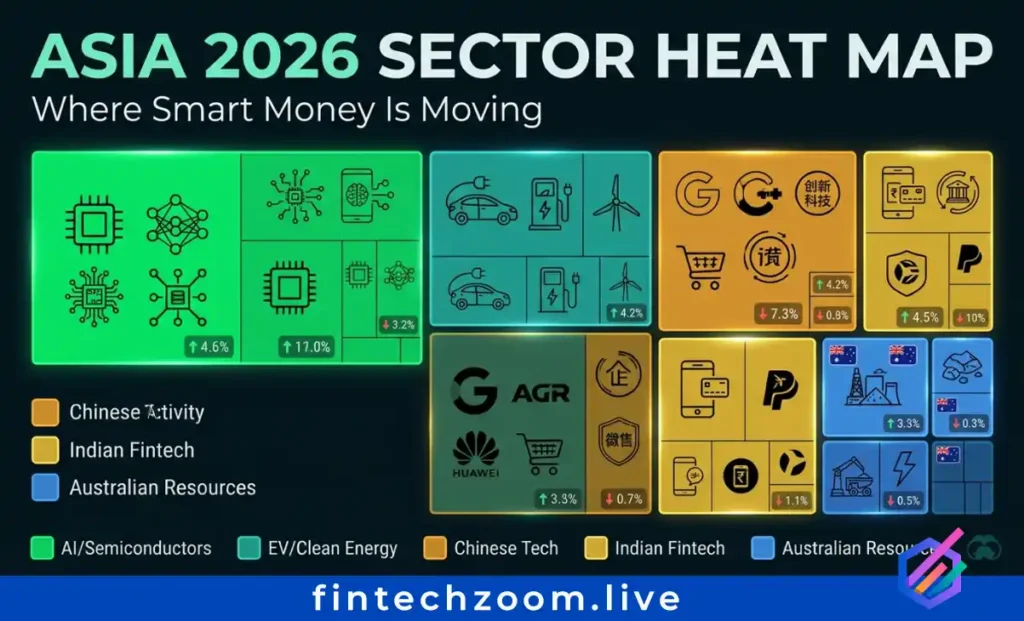
The graphic beside this section is an illustration of Asian market sectors, not live data.
Asian stock market hours in your time zone
Asia trades while Europe and the Americas sleep. Times below apply from November 1, 2026, when US clocks went back, until March 2027. Sydney is on daylight saving (UTC+11) until April 2027.
| Market | Local hours | UTC | Dubai | New York (ET) |
|---|---|---|---|---|
| Sydney (ASX) | 10:00 to 16:00 | 23:00 to 05:00 | 03:00 to 09:00 | 6:00 p.m. to midnight |
| Tokyo (JPX) | 9:00 to 11:30, 12:30 to 15:30 | 00:00 to 06:30 | 04:00 to 10:30 | 7:00 p.m. to 1:30 a.m. |
| Seoul (KRX) | 9:00 to 15:30 | 00:00 to 06:30 | 04:00 to 10:30 | 7:00 p.m. to 1:30 a.m. |
| Taipei (TWSE) | 9:00 to 13:30 | 01:00 to 05:30 | 05:00 to 09:30 | 8:00 p.m. to 12:30 a.m. |
| Shanghai and Shenzhen | 9:30 to 11:30, 13:00 to 15:00 | 01:30 to 07:00 | 05:30 to 11:00 | 8:30 p.m. to 2:00 a.m. |
| Hong Kong (HKEX) | 9:30 to 16:00, no lunch break | 01:30 to 08:00 | 05:30 to 12:00 | 8:30 p.m. to 3:00 a.m. |
| India (NSE, BSE) | 9:15 to 15:30 | 03:45 to 10:00 | 07:45 to 14:00 | 10:45 p.m. to 5:00 a.m. |
Sources: JPX, HKEX and the other exchanges’ published hours. Times in New York fall on the previous evening. Hong Kong’s 12:00 to 13:00 slot is now an extended morning session with continuous trading.
The major Asian indexes at a glance
| Index | What it holds | Weighting |
|---|---|---|
| Nikkei 225 | 225 large Tokyo-listed companies | Share price |
| Hang Seng | The largest Hong Kong-listed companies | Free-float market value, capped |
| Shanghai Composite | All stocks listed in Shanghai | Market value |
| Kospi | All common stocks on Korea’s main board | Market value |
| Taiex | All common stocks on the Taiwan Stock Exchange | Market value |
| Sensex and Nifty 50 | 30 and 50 large Indian companies | Free-float market value |
| S&P/ASX 200 | 200 largest Australian-listed companies | Free-float market value |
Compare these with US and European benchmarks on our world stock market indices page.
Oil and currencies: the outside forces
Japan, South Korea and India import most of their oil, so energy prices hit their trade balances and inflation directly. Brent crude was about $103.84 a barrel on November 4 (AP), and since the Iran war began it has swung roughly between $70 and $120 (AP). A strong US dollar also pulls foreign money out of Asian markets; a weaker dollar after the midterms would help the region if it lasts. Our forex market today page tracks the yen, yuan and rupee.
Bull case and bear case for Asian stocks
Both columns use published data from early November 2026. Neither is a forecast.
| Bull case | Bear case |
|---|---|
| Markets recovered most of the election-night losses within hours; the Kospi closed higher after falling 4% | Japan, Taiwan and Korea depend on AI chip demand, which now faces political risk in the US |
| Beijing is adding market support, including a program of about 100 billion yuan | Shanghai was still more than 15% below its May peak at the end of October |
| India’s Sensex has risen five sessions in a row, with foreign buyers returning | Rates are rising in Japan and Australia, and the BOJ will sell its ETF holdings faster from 2027 |
| A weaker US dollar after the election would ease pressure on Asian currencies | Brent above $100 strains oil importers such as Japan, Korea and India |
What would change the picture
These are conditions to watch, not predictions. Nvidia’s results on November 17 will show whether AI spending holds up, with the biggest effect on Taipei, Seoul and Tokyo. Mild US inflation on November 10 would lower the odds of a Fed hike and usually supports Asian currencies. The Bank of Japan meets on December 17 and 18; another rate rise would strengthen the yen and could weigh on exporters. Further stimulus from Beijing would favor Shanghai and Hong Kong.
Asian market calendar: dates to watch
| Event | Date | Markets most affected |
|---|---|---|
| US October jobs report | Fri, Nov 6 | Whole region, via the dollar and Fed expectations |
| US October CPI | Tue, Nov 10 | Whole region |
| Nvidia earnings | Tue, Nov 17 | Taiwan, South Korea, Japan chip stocks |
| RBA decision | Dec 7 to 8 | Australia |
| Fed decision | Wed, Dec 9 | Whole region |
| Bank of Japan decision | Dec 17 to 18 | Japan, the yen |
How to follow or invest in Asian markets
Most investors outside Asia use funds that track a country or the whole region, or US-listed shares (ADRs) of large Asian companies. Direct access to local exchanges usually needs an international broker. Currency moves can add to or wipe out local gains: a 10% rise in the Nikkei is worth less to a dollar-based investor if the yen falls 10% in the same period. Spread exposure across countries rather than betting on one market. Our guides to ETFs and how to invest in the stock market explain the basics.
From our desk: what we found checking this update
Early reports on November 4 described a different market from the one that closed. One 6:47 a.m. CET summary had the Kospi down 1.2% and the Nikkei down 2.9%; another had the Kospi down 3.6%. By the close the Kospi was up 0.6%. We publish closing levels with their source and treat intraday figures as snapshots. While rebuilding this page we also found that several of its embedded charts pointed at the wrong securities, including a Canadian company and a US stock heat map. We replaced them with the correct Asian indexes and removed old buy ratings and price targets, which we don’t publish.
Asian stock markets today: FAQs
What time do Asian stock markets open?
Sydney opens first at 10:00 a.m. local time (23:00 UTC), followed by Tokyo and Seoul at 9:00 a.m. (00:00 UTC), Hong Kong and Shanghai at 9:30 a.m. (01:30 UTC) and India at 9:15 a.m. (03:45 UTC). In Dubai, Tokyo opens at 04:00 and India at 07:45.
How did Asian markets react to the 2026 US midterm elections?
Unevenly. On November 4 the Nikkei fell 1.4% and the Taiex 0.8% as AI and chip stocks sold off, while the Shanghai Composite rose 2.2% and the Hang Seng 1.7%. The Kospi swung from a 4% loss to close 0.6% higher.
Why did the Nikkei fall on November 4, 2026?
Investors sold AI-linked stocks after Democrats won both chambers of Congress. SoftBank Group fell 3.2% and Kioxia 5.4%. The Nikkei is price-weighted, so high-priced tech stocks have a large effect on it.
Which Asian markets depend most on the AI chip trade?
Taiwan, South Korea and Japan. TSMC dominates the Taiex, Samsung Electronics and SK Hynix are the largest stocks on the Kospi, and chip-equipment and tech groups carry heavy weight in the Nikkei.
What is the Bank of Japan’s interest rate?
About 1.25%. The BOJ raised it in September 2026 and held it on October 30 by an 8-to-1 vote. Its next meeting is December 17 and 18.
Why did the RBA raise rates in November 2026?
The Reserve Bank of Australia lifted its cash rate to 4.85% on November 3 because underlying inflation is broad-based and expected to stay above 3% for the coming year. The vote was 6 to 3.
Does the Hong Kong stock market close for lunch?
No. HKEX now trades continuously from 9:30 a.m. to 4:00 p.m., with the old lunch hour run as an extended morning session. Shanghai and Shenzhen still break from 11:30 a.m. to 1:00 p.m.
How can I invest in Asian stocks from outside Asia?
Through country or regional funds, US-listed shares (ADRs) of large Asian companies, or an international broker with access to local exchanges. Currency moves affect your return as much as the index does.
How often is this page updated?
Each Asian trading day, with the time of the latest revision at the top. Every figure shows its date and source.
How we report Asian markets
Closing levels come from wire reports and exchange data, checked against live index charts. Policy rates come from the central banks’ own statements, and trading hours from the exchanges. We don’t publish price targets or buy and sell ratings. Read our editorial policy, or contact us to report an error.
Revision history: November 4, 2026, full rewrite with closing levels after the US midterms, BOJ and RBA decisions, trading hours in UTC, Dubai and New York time, bull and bear case, corrected live charts and updated FAQs; buy ratings and price targets removed. April 18, 2026, previous edition.
Related: markets today · European stock markets today · stock futures · Nvidia (NVDA) stock
Disclaimer: This page is for news and education only. It is not investment advice or a recommendation to buy or sell any security. Investing in foreign markets carries currency, political and liquidity risks, including loss of principal. See our full disclaimer.
Sources: AP, Asian markets, Nov 4 · Upstox, Nikkei and Kospi · Focus Taiwan, Taiex close · ABC News, ASX close · BOJ statement, Oct 30 · RBA decision, Nov 3 · AP, Nov 2
Also read
US stock market today covers how Wall Street is reacting to the midterms, US trading hours in your time zone and the dates that move global markets.
FintechZoom.Live covers stocks, crypto, commodities, forex and bonds with live TradingView charts and dated, sourced analysis. Browse the newest market articles on our blog.

Curated Editorial Insights Across FintechZoom’s Core Verticals: Thought-provoking analysis in Markets, Business Strategy, Crypto Innovation, Personal Finance, Economic Policy, and Lifestyle Wealth, designed to challenge conventional thinking, deepen financial literacy, and empower readers to make smarter, forward-looking decisions.