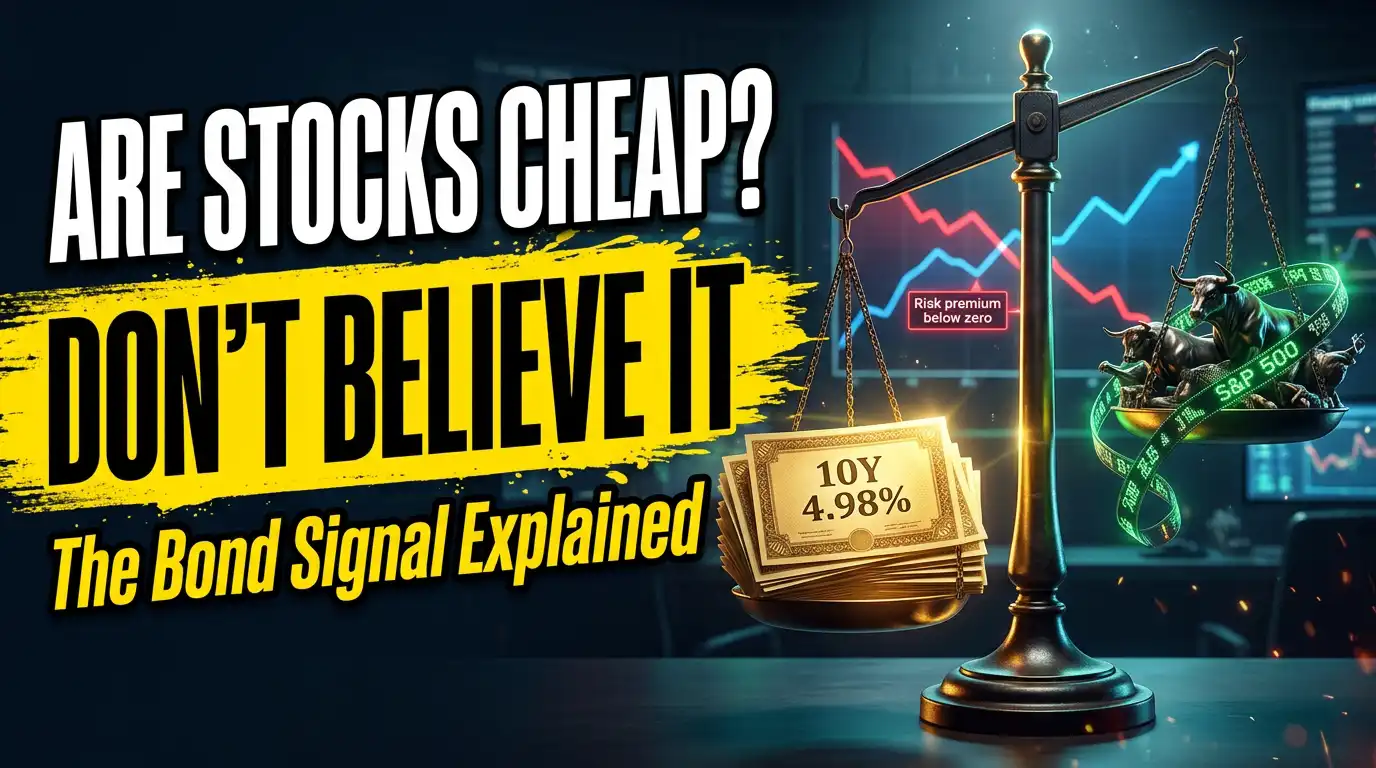
Are stocks cheap heading into 2027? One popular bond measure says yes. The Wall Street Journal ran a story in November 2026 under the headline that a bond measure says stocks are cheap and readers should not believe it. The measure compares the earnings yield on the S&P 500 with the yield on the 10 year Treasury note, and on forward estimates stocks come out slightly ahead of bonds. This article checks that signal against the full set of numbers from October 2026.
A short note from our partner first. RAKA is a Pakistani hair care label made for Gen Z, with targeted oils for hair fall and deep nourishment. The oils are light, they spread fast and they come in gift ready packaging. You can shop the range at raka.pk.
The answer to whether stocks are cheap depends on which earnings you trust, which bond yield you pick and how far you think profit forecasts can run. Each choice moves the result by more than a full percentage point. That is enough to flip the verdict from cheap to expensive.
The bond measure that says stocks are cheap
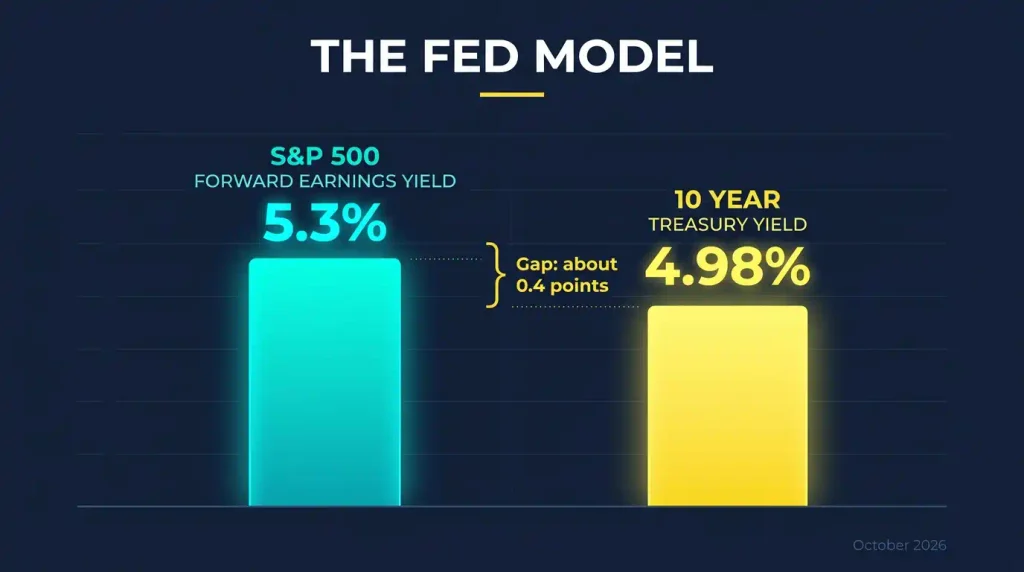
The bond measure behind the cheap stocks claim is usually called the Fed model. It is a simple comparison of two yields. The first is the earnings yield on the S&P 500, which is company earnings divided by the index price. The second is the yield on the 10 year Treasury note. When the earnings yield is higher than the bond yield, stocks look cheap next to bonds. When it is lower, bonds look like the better deal.
How the Fed model works
The gap between the two yields is a rough version of the equity risk premium. That premium is the extra return investors expect for owning stocks over safe government bonds. Stocks carry more risk, so investors usually want a premium of several points. A thin or negative premium means investors are paid little or nothing extra for that risk.
The Fed model is popular because it is fast. It needs two numbers that anyone can look up. Its weakness is that both numbers depend on choices, and the choices are where the cheap stocks claim gets shaky.
What the forward numbers show in October 2026
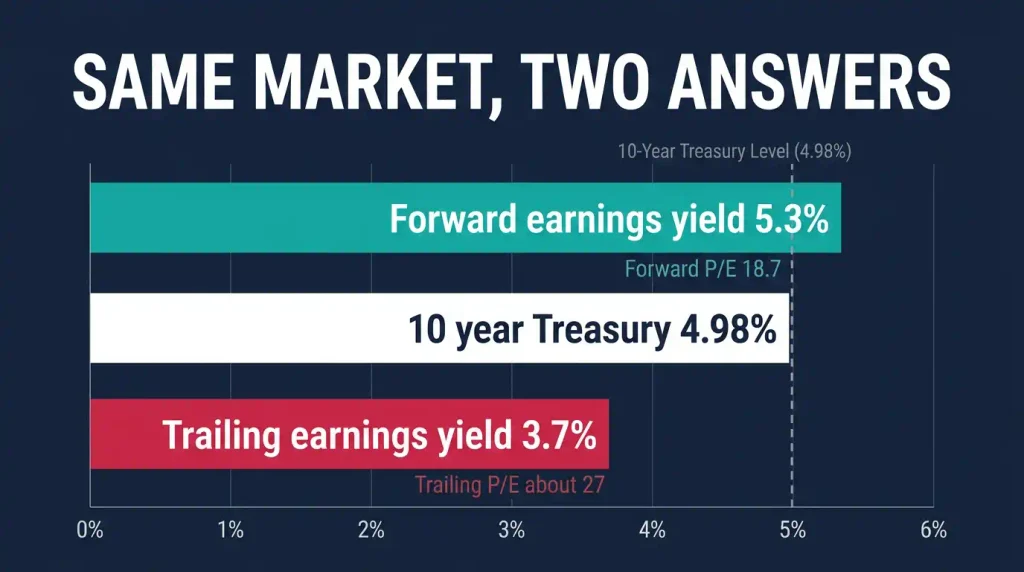
The cheap stocks case rests on forward earnings. FactSet reported on October 23, 2026 that the S&P 500 traded at about 18.7 times forward 12 month earnings. That is below the 5 year average of 19.8 and the 10 year average of 19.1. A forward P/E ratio of 18.7 gives a forward earnings yield of about 5.3 percent.
The 10 year Treasury yield was 4.98 percent on October 29, 2026, according to Federal Reserve data. It slipped to 4.94 percent on October 30. On those numbers the forward earnings yield beats the bond yield by roughly 0.4 percentage points. Add a forward P/E ratio below its long run averages, and the bond measure says stocks are cheap.
Why the forward earnings yield looks too good
A forward P/E ratio is only as good as the earnings forecast under it. In late 2026 that forecast is unusually large.
Earnings growth of 33 percent carries the whole case
FactSet showed analysts expecting earnings growth of 33.1 percent for calendar 2026 and 16.0 percent for calendar 2027. Third quarter 2026 earnings were on track for growth of 29.5 percent, the third quarter in a row above 25 percent. Growth that strong makes forward earnings big, and big forward earnings make the forward P/E ratio small.
The risk is plain. If profits grow less than forecast, the forward P/E ratio was never 18.7 at all. A 2027 that delivers half the expected 16 percent growth would leave the S&P 500 more expensive than the forward figure shows, even if prices stand still.
Smaller beats in the third quarter
The third quarter reporting season gave an early hint. About 83 percent of companies that had reported by October 23 beat their earnings estimates, above the 5 year average of 78 percent. The size of those beats was small, though. Companies beat by about 2.1 percent on average, well below the 5 year average of 7.5 percent. More companies are clearing the bar, but by a thinner margin.
Which sectors drive the growth
The growth is not spread evenly. Energy, information technology, communication services and materials lead earnings growth in 2026. Health care is the only sector with a year over year decline. Energy profits can swing hard with oil prices, and Charlie Bilello tied recent price increases to war driven inflation in his October 2026 market review. Part of the earnings surge may reflect higher prices more than higher volumes. Inflation lifts nominal profits, and it also lifts bond yields.
The trailing equity risk premium tells a different story
Trailing earnings are the profits companies have already reported. They carry no forecast risk, and on trailing earnings the picture flips.
A negative premium at the October peak
The S&P 500 closed at a record 7,818.93 on October 6, 2026. At that level the index traded at roughly 27 times trailing earnings, an earnings yield of about 3.7 percent, according to TokenPost. The 10 year Treasury yield had hit 5.31 percent the day before. That gave a trailing equity risk premium of about minus 1.6 percentage points. Lance Roberts described the premium as the thinnest in a generation.
Yields came down later in October and so did stock prices. Using the trailing earnings yield of about 3.7 percent and the October 29 Treasury yield of 4.98 percent, the premium is still about minus 1.3 points. On trailing numbers, bonds pay more than stocks.
A record low dividend yield
Dividends point the same way. The dividend yield on the S&P 500 fell to 1.07 percent on October 2, 2026, an all time low according to Bilello. The 3 month Treasury bill yielded 4.18 percent on October 29. Cash in a short term government bill pays close to four times the dividend yield on the stock index.
Real yields make bonds a real alternative
Critics of the Fed model point to a mismatch. Company earnings rise with inflation over time, so the earnings yield behaves like a real return. The 10 year Treasury yield is a nominal return. A fairer test compares the earnings yield with the real yield on Treasury Inflation Protected Securities, known as TIPS.
TIPS yields near their highest since 2008
The 10 year TIPS yield was 2.63 percent on October 29, 2026. Bilello noted that the 10 year real yield reached its highest level since 2008 in October, and that the 30 year TIPS yield hit 3.37 percent, the highest real yield in more than 20 years.
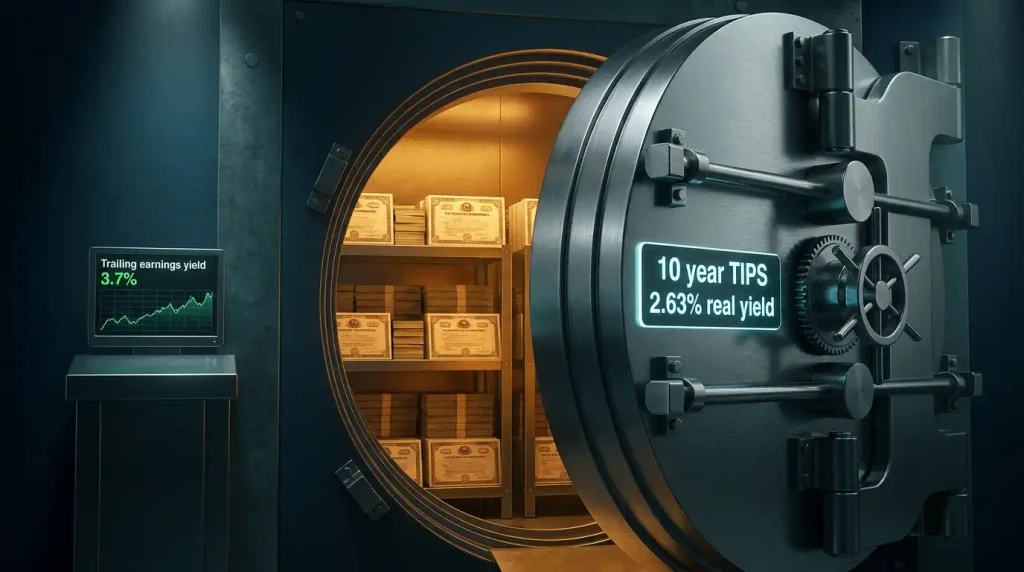
Against TIPS, the result depends again on which earnings you use. The forward earnings yield of about 5.3 percent beats the TIPS yield by about 2.7 points. The trailing earnings yield of about 3.7 percent beats it by only about 1.1 points. An investor can lock in a real return of 2.63 percent for 10 years with almost no credit risk. A stock market that offers about one point more on reported profits leaves little room for error.
The Fed and the path of rates
Policy adds another layer. On October 28, 2026 the Federal Reserve held its policy rate range at 3.75 to 4.00 percent, and two officials favored an increase. Long yields sit well above the policy rate, with the 30 year Treasury at 5.32 percent on October 29. A higher policy rate in 2027 would push bond yields up and squeeze the equity risk premium further.
How bond yields pull on stock prices
Bond yields matter to stock prices for two reasons. The first is competition for money. When a 10 year Treasury note pays close to 5 percent with almost no default risk, a stock has to offer a good reason to take on more risk. In 2021 the 10 year yield sat near 1.5 percent, and many investors felt there was no alternative to stocks. That idea, often shortened to TINA, does not fit a market where a bond pays more than the trailing earnings yield on the S&P 500.
The second reason is the discount rate. A stock price is the present value of profits a company is expected to earn for many years. Investors discount those future profits back to the present using a rate tied to bond yields. When yields rise, each future dollar of profit is worth less in present terms, and fair stock prices fall unless earnings grow faster. Long dated growth stocks feel this the most, since more of their value sits far in the future.
Bond yields moved a lot in a short time in the fall of 2026. The 10 year yield was 5.29 percent on September 30, touched 5.31 percent on October 5 and ended October near 4.94 percent. A swing of about 35 basis points in one month is enough to move the Fed model reading from negative to positive on forward numbers. That speed is one more reason to treat a single reading with care.
What history says about thin risk premiums
A thin premium does not set a date for a fall, but history gives some context. During the dot com peak of 1999 and 2000, the equity risk premium briefly turned negative, and the S&P 500 later lost nearly half its value over two years, according to a review by ECM Source. From 2010 to 2015 the premium at times topped 500 basis points. In 2021 it was about 300 basis points, with the 10 year yield near 1.5 percent and the S&P 500 near 22 times earnings.
In April 2026 the same review put the premium at roughly 30 to 35 basis points, near its thinnest outside the late 1990s. By October the trailing measure had gone below zero. That is the setting in which the forward Fed model says stocks are cheap.
Are stocks cheap for investors heading into 2027
The fair answer is that stocks look cheap only on the most hopeful set of numbers. Forward earnings, a nominal bond yield and a 33 percent growth year all have to hold for the bond measure to say cheap. On reported earnings, on dividends and against real yields, stocks look fully priced or expensive next to bonds.
That does not mean prices must fall in 2027. Earnings could grow as fast as analysts expect, and yields could keep easing from their October highs. It does mean the margin of safety is thin. When someone asks whether stocks are cheap, the honest reply in late 2026 is that they are cheap only if the forecasts come true, and expensive on the profits companies have already earned.
Four ways to run the bond measure
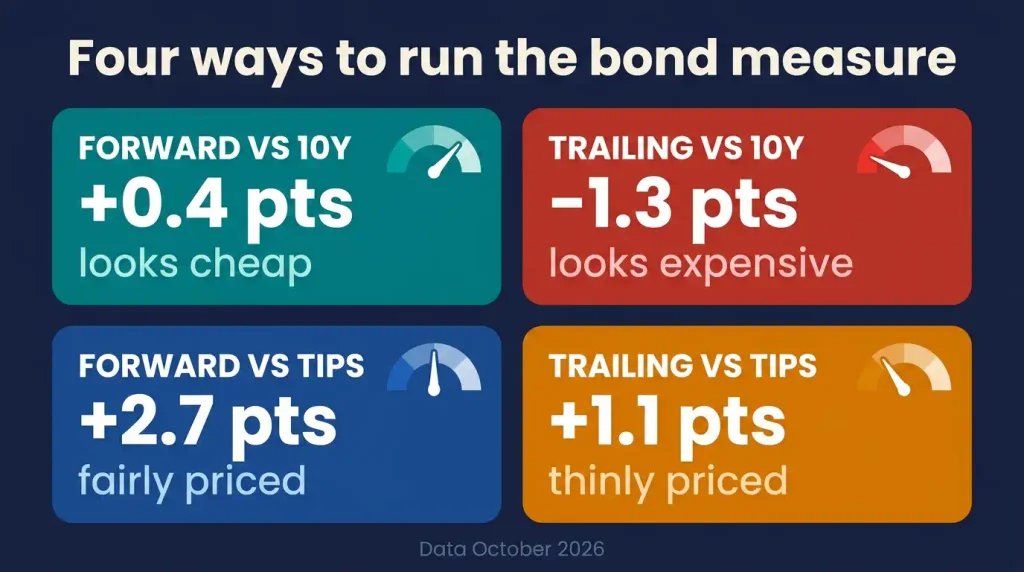
The same bond measure gives four different answers in October 2026, depending on the inputs:
- Forward earnings yield of about 5.3 percent against the 10 year Treasury yield of 4.98 percent gives a premium of about 0.4 points, and stocks look a little cheap.
- Trailing earnings yield of about 3.7 percent against the 10 year Treasury yield gives a premium of about minus 1.3 points, and stocks look expensive.
- Forward earnings yield against the 10 year TIPS yield of 2.63 percent gives a premium of about 2.7 points, and stocks look fairly priced.
- Trailing earnings yield against the 10 year TIPS yield gives a premium of about 1.1 points, and stocks look thinly priced.
Only one of the four readings says stocks are cheap, and it is the one that leans hardest on forecasts. Investors who ask whether stocks are cheap should look at all four before they decide.
Signals to watch in 2027
These are the numbers that will decide whether the cheap stocks reading holds up:
- The gap between the forward earnings yield and the 10 year Treasury yield, which was about 0.4 points at the end of October 2026.
- Fourth quarter 2026 results and any cuts to the 16.0 percent growth forecast for 2027.
- The size of earnings beats, which fell to about 2.1 percent in the third quarter.
- The 10 year TIPS yield, which was 2.63 percent on October 29, 2026.
- Federal Reserve decisions after the October 28 meeting, where two officials favored a rate increase.
- The dividend yield on the S&P 500, which set a record low of 1.07 percent on October 2, 2026.
How investors can use the bond measure
The bond measure works best as one input among several. Investors who rely on it can run it both ways, on forward and on trailing earnings, and against both nominal and real yields. When the four results disagree, the safer reading is the one that needs the fewest forecasts to come true.
Yields above 4 percent on short bills and near 5 percent on 10 year notes also give investors a choice they did not have in 2021. Readers comparing the two can check our pages on Treasury bond rates, our latest stock market report and the best ETFs to buy in 2026. New investors can start with our notes on how to invest in the stock market and the stock market overview.
Fintechzoom.live does not give investment advice. Speak with a licensed adviser before you change how your money is split between stocks and bonds.
Common questions about whether stocks are cheap
Are stocks cheap in 2026?
Only on forward earnings. FactSet put the S&P 500 at about 18.7 times forward earnings on October 23, 2026, an earnings yield of about 5.3 percent, above the 10 year Treasury yield of 4.98 percent on October 29. On trailing earnings the yield was about 3.7 percent, below the bond yield, so stocks look expensive on reported profits.
What is the Fed model?
The Fed model compares the earnings yield on the S&P 500 with the yield on the 10 year Treasury note. When the earnings yield is higher, stocks look cheap next to bonds. When it is lower, bonds look better. The gap between the two is a rough measure of the equity risk premium.
What is the equity risk premium in late 2026?
It depends on the inputs. On October 6, 2026 the trailing earnings yield of about 3.7 percent sat below a 10 year yield of 5.31 percent, a premium of about minus 1.6 points. On forward earnings at the end of October the premium was about plus 0.4 points. In April 2026 it was roughly 30 to 35 basis points.
Why does the forward P/E ratio make stocks look cheap?
A forward P/E ratio divides the index price by expected earnings for the next 12 months. Analysts expected S&P 500 earnings growth of 33.1 percent in 2026 and 16.0 percent in 2027, so expected profits are large and the forward P/E ratio is small. If earnings growth falls short, the real P/E ratio is higher than 18.7.
What is the difference between forward and trailing earnings yield?
The trailing earnings yield uses profits companies have already reported over the past 12 months. The forward earnings yield uses analyst forecasts for the next 12 months. In October 2026 the trailing yield was about 3.7 percent and the forward yield about 5.3 percent, a gap caused by fast expected earnings growth.
Why compare stocks with TIPS yields?
Company earnings tend to rise with inflation, so the earnings yield acts like a real return. The 10 year TIPS yield is also a real return, which makes the comparison fairer. The 10 year TIPS yield was 2.63 percent on October 29, 2026, about 1.1 points below the trailing earnings yield and 2.7 points below the forward yield.
How do higher bond yields affect stock prices?
Higher bond yields hurt stock prices in two ways. Safe bonds compete with stocks for money, and higher yields raise the discount rate used to value future profits. The 10 year Treasury yield moved from 5.31 percent on October 5, 2026 to 4.94 percent on October 30, enough to change the Fed model reading.
Should investors move money from stocks to bonds?
Fintechzoom.live does not give investment advice. In late 2026 short Treasury bills yielded about 4.18 percent and 10 year notes close to 5 percent, so bonds offer a real alternative to stocks. The right mix depends on goals, time horizon and risk tolerance, so speak with a licensed adviser before you change it.