US stock market today, November 4, 2026: election reaction, market hours and what to watch
Last revised: November 4, 2026, 8:00 a.m. ET, before the open · By the FintechZoom Markets Desk, reviewed under our editorial policy
The US stock market today opens the morning after the midterm elections. Democrats won control of the House and the Senate, Nasdaq-100 futures fell as much as 2.4% overnight, and most of that drop had been recovered by 7:00 a.m. Eastern. This page gives the November 3 close, the pre-market picture, the case for and against US stocks, and the practical details of trading hours, holidays, circuit breakers and settlement.
News and education only, not investment advice. Prices move quickly; check live quotes before acting.
US stock market today: snapshot for November 4, 2026
| Market | Latest | 2026 so far | As of |
|---|---|---|---|
| S&P 500 | 7,568.92 (+0.4%) | +10.6% | Nov 3 close |
| Nasdaq Composite | 25,372.01 (+0.8%) | +9.2% | Nov 3 close |
| Dow Jones Industrial Average | 51,786.72 (−0.4%) | +7.7% | Nov 3 close |
| Russell 2000 | 2,812.45 (+0.2%) | +13.3% | Nov 3 close |
| S&P 500 futures | Down as much as 1.4% overnight, then up about 0.9% | n/a | Nov 4, 5:25 to 7:00 a.m. ET |
| 10-year Treasury yield | About 4.92% | n/a | Early Nov 4 |
| Brent crude | About $102.80 a barrel | n/a | Early Nov 4 |
| Fed funds target range | 3.75% to 4.00% | n/a | Held Oct 28 |
Sources: Associated Press (index closes), Reuters and Yahoo Finance (futures), TipRanks (yield and oil), Federal Reserve. Live charts follow below, and our markets today page covers bonds, gold, the dollar and bitcoin.
What is moving US stocks on November 4
The election result
Democrats won majorities in both chambers of Congress. Overnight, Nasdaq-100 futures fell as much as 2.4% and S&P 500 futures 1.4%, led by the largest AI spenders, before buyers returned (Reuters via Yahoo Finance). Traders are weighing tighter rules for AI and data centers, including the moratorium on new data center construction pledged by Texas governor-elect Gina Hinojosa, against a divided government in which large new laws are harder to pass. Nvidia and Micron were down more than 1% before the open.
Earnings: AMD up, Apple down
AMD reported record third-quarter revenue of $13.4 billion, up 45%, with data center sales up 97%, and guided to about $17 billion for the fourth quarter (AMD). The shares were up about 6% before the open. Apple closed 1.9% lower on November 3 after guiding to a gross margin of 45% to 46%, below the 46.5% analysts expected. Across the S&P 500, third-quarter earnings are tracking 30.2% growth, with 82% of companies beating estimates (FactSet, Oct 30).
Rates, inflation and oil
The Federal Reserve held its target range at 3.75% to 4.00% on October 28, with two officials voting for a hike (Federal Reserve). On November 3, futures priced a 79% chance of a December increase (Reuters via Kitco). Consumer prices rose 3.7% in the year to September, with energy up 20.4% (BLS), and Brent has stayed above $100 during the conflict with Iran. ADP private payrolls (forecast about 70,000) are due at 8:15 a.m. ET and the ISM services index (forecast 54.7) at 10:00 a.m. ET.
Read the full story list on our stock market news today page.
US stock market today: sectors and breadth
Gains in 2026 have spread beyond the largest technology companies. On November 2, eight of the 11 S&P 500 sectors rose while technology and energy fell, and about 61% of S&P 500 stocks traded above their 50-day moving averages, up from 20% a month earlier (Charles Schwab, Nov 3). Small caps are ahead too: the Russell 2000 is up 13.3% for the year against 10.6% for the S&P 500.
The weak spot is chips and AI. On November 3 the Nasdaq-100 was 10% below its October 6 peak, with 51% of its members down 20% or more from their highs. The PHLX Semiconductor Index fell 3.4% on November 2 to its lowest level since late April.
Why a few stocks still steer the index
The S&P 500 is weighted by market value. Its ten largest companies made up 37.9% of the index in June 2026, up from 22.8% in September 2019 (ChartRow, from index fund filings). When Nvidia, Microsoft, Apple or Alphabet move several percent, the index follows even if most other stocks go the opposite way. The equal-weight S&P 500, which gives each member the same weight, is a useful second check on how the average stock is doing.
Also read
Stock market news today covers the midterm reaction, AMD’s results and the Fed outlook in more detail, updated each trading day.
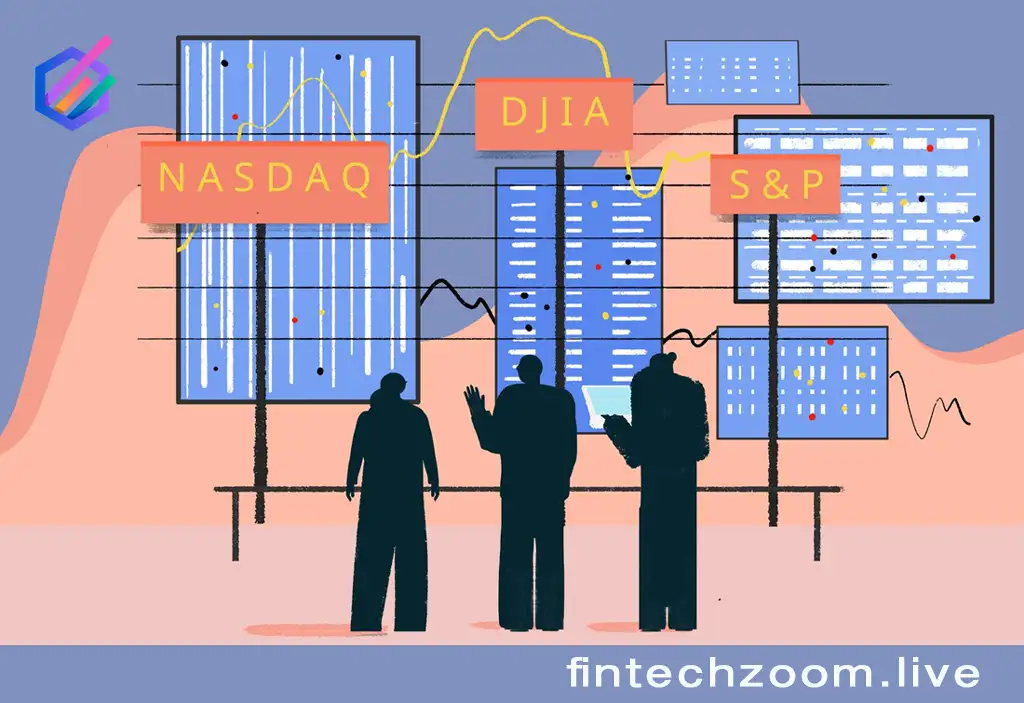
The major US stock indexes explained
| Index | What it holds | Weighting |
|---|---|---|
| S&P 500 | About 500 large US companies across 11 sectors | Float-adjusted market value |
| Dow Jones Industrial Average | 30 large, established companies | Share price |
| Nasdaq Composite | More than 3,000 stocks listed on Nasdaq, heavy in technology | Market value |
| Nasdaq-100 | The 100 largest non-financial Nasdaq companies | Modified market value |
| Russell 2000 | About 2,000 smaller US companies | Float-adjusted market value |
A 500-point drop in the Dow sounds large, but with the index near 51,800 it is less than 1%. Compare moves in percentages. Because the Dow is price-weighted, a high-priced stock moves it more than a larger company with a lower share price. Our world stock market indices page compares US benchmarks with Europe and Asia.
Bull case and bear case for US stocks
The evidence on November 4 points both ways. Both columns below use published data; neither is a forecast.
| Bull case | Bear case |
|---|---|
| S&P 500 third-quarter earnings are up about 30% from a year earlier | Futures price a 79% chance the Fed raises rates in December, and the 10-year yield is near 4.9% |
| AMD’s data center sales nearly doubled, so AI chip demand is still growing | Inflation is 3.7%, pushed up by a 20.4% rise in energy prices |
| Breadth has improved: about 61% of S&P 500 stocks are above their 50-day averages | The Nasdaq-100 is in a correction, and half its members are in bear markets |
| Futures recovered most of the overnight election losses within hours | A Democratic Congress raises the risk of AI and data center rules, and of investigations into large tech companies |
| Small caps lead in 2026, so buying is not limited to the largest companies | The ten largest companies are close to 38% of the S&P 500, so a slump in a few can drag the whole index |
What would change the picture
These are conditions to watch, not predictions. A weak October jobs report on November 6 or a mild October CPI on November 10 would lower the odds of a December hike, which tends to help interest-rate-sensitive stocks such as small caps and housing. A hot CPI print, especially if energy costs spread into core prices, would raise them. Nvidia’s results on November 17 are the next big test of whether AI spending holds up after the election. If oil falls back below $100, inflation pressure would ease from the source that has driven it most in 2026.
Time horizon changes the question
For a trader, today’s session depends on the election reaction and the morning’s data. For a long-term investor, the questions are earnings growth, valuations and whether rates rise again. Daily moves say little about the next ten years. Our guide to how to invest in the stock market covers diversification and risk, and the compound interest calculator shows how time affects returns.
US stock market hours, pre-market and after-hours
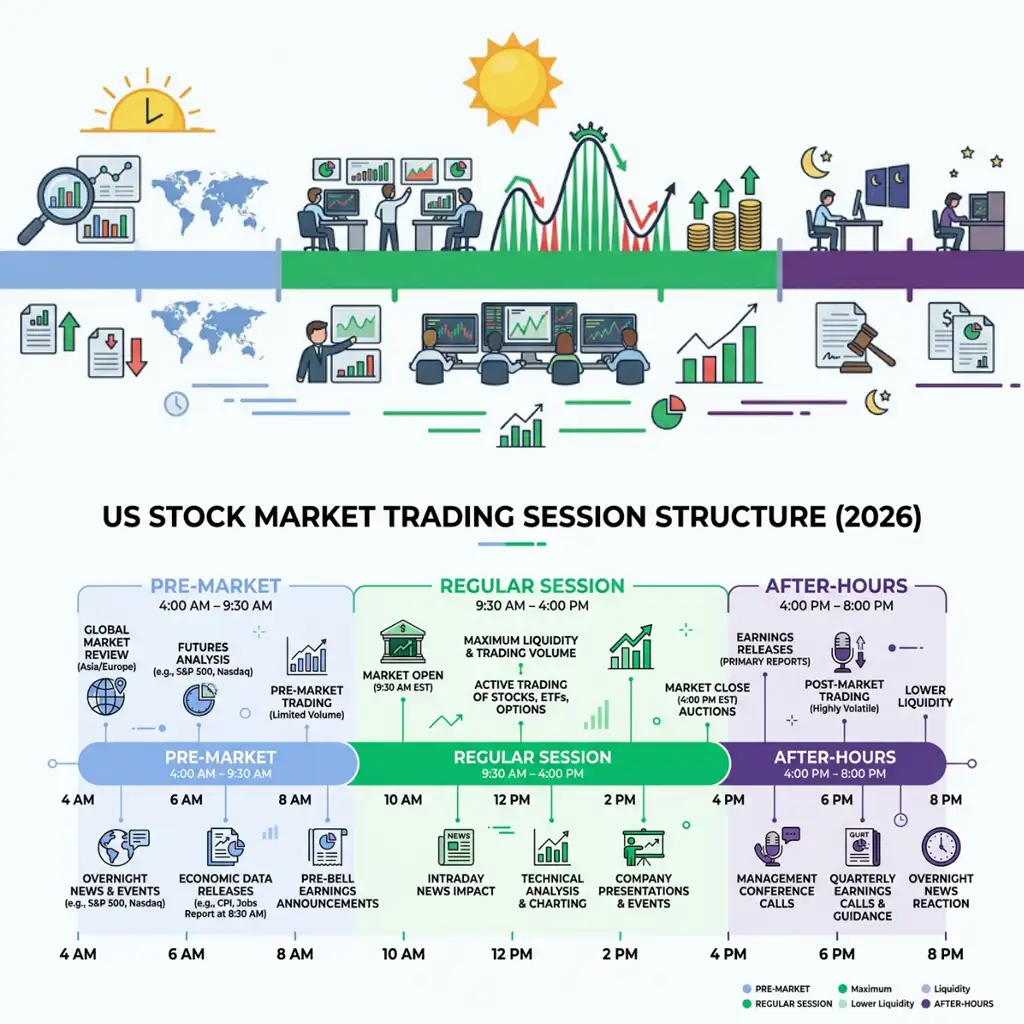
| Session | Time (ET) | What to expect |
|---|---|---|
| Pre-market | From 4:00 a.m. on Nasdaq; NYSE pre-opening from 6:30 a.m. | Thin volume, wide spreads, reactions to overnight news |
| Regular session | 9:30 a.m. to 4:00 p.m., Monday to Friday | Most volume, opening and closing auctions |
| After-hours | 4:00 to 8:00 p.m. | Most earnings reports, sharp single-stock moves |
Sources: NYSE hours and calendars, Nasdaq system hours. Brokers set their own extended-hours windows, and some offer overnight trading.
US clocks went back on November 1, 2026, so until they go forward on March 14, 2027 the 9:30 a.m. ET open is 14:30 in London, 18:30 in Dubai and 20:00 in India. Prices outside regular hours can swing on small volume. Use limit orders rather than market orders, and read our stock futures guide to judge the open before 9:30.
Also read
Stock futures trade nearly around the clock. Our guide explains how to read Dow, S&P 500 and Nasdaq futures before the US open.
Is the US stock market open today? Holidays for the rest of 2026
Yes. Wednesday, November 4, 2026 is a normal trading day; Election Day is not an exchange holiday. Remaining closures and early closes, from the NYSE calendar:
| Date | Holiday | Market status |
|---|---|---|
| Thu, Nov 26, 2026 | Thanksgiving Day | Closed |
| Fri, Nov 27, 2026 | Day after Thanksgiving | Early close, 1:00 p.m. ET |
| Thu, Dec 24, 2026 | Christmas Eve | Early close, 1:00 p.m. ET |
| Fri, Dec 25, 2026 | Christmas Day | Closed |
| Fri, Jan 1, 2027 | New Year’s Day | Closed |
| Mon, Jan 18, 2027 | Martin Luther King Jr. Day | Closed |
| Mon, Feb 15, 2027 | Washington’s Birthday | Closed |
Circuit breakers and settlement
If the S&P 500 falls 7% (Level 1) or 13% (Level 2) from the previous close before 3:25 p.m. ET, trading across US markets stops for 15 minutes. A 20% fall (Level 3) halts trading for the rest of the day (Investor.gov). Since May 28, 2024, most US stock trades settle one business day after the trade date, known as T+1 (SEC investor bulletin).
US market calendar: dates to watch
| Event | Date | Why it can move stocks |
|---|---|---|
| ADP payrolls and ISM services | Wed, Nov 4 | Early read on hiring and the service economy |
| October jobs report | Fri, Nov 6, 8:30 a.m. ET | Whether hiring recovers from September’s +29,000 |
| October CPI | Tue, Nov 10, 8:30 a.m. ET | Whether energy costs spread into core prices |
| Nvidia earnings | Tue, Nov 17 | The largest test of AI spending this quarter |
| Thanksgiving closure | Thu, Nov 26 | Thin trading around the holiday |
| Fed decision | Wed, Dec 9 | Hold or hike, plus new economic projections |
From our desk: checking this morning’s numbers
Several sources we checked for this update disagreed with themselves. One live page showed S&P 500 futures up 0.96% in its ticker while its text, written earlier, said 0.2%. A morning market note had Apple down about 4% early on November 3; it closed down 1.9%. A competing “US market today” page showed a 0.66% fall in the Dow next to an upward arrow. We publish a number only with its time and source, and we prefer official releases from the companies, the Fed and the BLS over secondhand summaries. Before you react to a figure, check when it was taken.
US stock market today: FAQs
Is the US stock market open today?
Yes. On Wednesday, November 4, 2026, the NYSE and Nasdaq are open from 9:30 a.m. to 4:00 p.m. ET. The next full closure is Thanksgiving, Thursday, November 26.
What time does the US stock market open in my time zone?
The regular session opens at 9:30 a.m. ET. Until March 14, 2027 that is 14:30 in London, 18:30 in Dubai and 20:00 in India. The close at 4:00 p.m. ET is 21:00 in London.
Why are US stocks moving today, November 4, 2026?
Mainly the midterm result. Democrats won both chambers of Congress, which raised the risk of AI and data center regulation. Nasdaq-100 futures fell as much as 2.4% overnight and then recovered most of the loss. AMD’s record quarter is supporting chip stocks.
How is the US stock market doing in 2026?
At the November 3 close, the S&P 500 was up 10.6% for the year, the Nasdaq Composite 9.2%, the Dow 7.7% and the Russell 2000 13.3%. The Nasdaq-100 was 10% below its October 6 peak.
Will the Fed raise interest rates in December 2026?
It’s not certain. On November 3, futures priced a 79% chance of a hike at the December 8 to 9 meeting. The October jobs report on November 6 and CPI on November 10 could change those odds.
What is the difference between the Dow, the S&P 500 and the Nasdaq?
The Dow tracks 30 large companies and is weighted by share price. The S&P 500 tracks about 500 large companies weighted by market value. The Nasdaq Composite holds more than 3,000 Nasdaq-listed stocks and leans heavily toward technology.
Can I trade US stocks before the open or after the close?
Yes, through brokers that offer extended hours. Nasdaq’s pre-market starts at 4:00 a.m. ET and after-hours runs to 8:00 p.m. ET. Volume is lower and spreads wider, so limit orders are safer than market orders.
What happens if the US stock market falls sharply in one day?
Circuit breakers apply. A 7% or 13% fall in the S&P 500 before 3:25 p.m. ET pauses trading for 15 minutes, and a 20% fall closes the market for the rest of the day.
How often is this page updated?
Each US trading day, with the time of the latest revision at the top. Every figure shows its date and source.
How we report the US market
Index closes come from the Associated Press, company figures from the companies’ own releases, rates from the Federal Reserve, economic data from the BLS, and trading hours and holidays from the exchanges. Pre-market figures always show the time of the quote. We don’t publish price targets or buy and sell calls. Read our editorial policy, or contact us to report an error.
Revision history: November 4, 2026, full rewrite with the election reaction, breadth data, bull and bear case, hours in other time zones, holidays, circuit breakers and updated FAQs. June 2, 2026, previous edition.
Related: stock market overview · Treasury bond rates today · Nvidia (NVDA) stock · stock trading for beginners
Disclaimer: This page is for news and education only. It is not investment advice or a recommendation to buy or sell any security. Investing involves risk, including loss of principal. See our full disclaimer.
Sources: AP, Nov 3 close · Reuters, futures after the midterms · AMD Q3 2026 results · FOMC statement, Oct 28 · Reuters, Fed pricing, Nov 3 · FactSet, Oct 30 · BLS CPI · Schwab market update, Nov 3 · NYSE hours and holidays
FintechZoom.Live covers stocks, crypto, commodities, forex and bonds with live TradingView charts and dated, sourced analysis. Browse the newest market articles on our blog.

Curated Editorial Insights Across FintechZoom’s Core Verticals: Thought-provoking analysis in Markets, Business Strategy, Crypto Innovation, Personal Finance, Economic Policy, and Lifestyle Wealth, designed to challenge conventional thinking, deepen financial literacy, and empower readers to make smarter, forward-looking decisions.