How to Invest in the Stock Market in 2026: A Step-by-Step Guide for Beginners
Last revised: November 4, 2026 · First published: March 28, 2026 · By the FintechZoom Markets Desk, reviewed under our editorial policy
How to invest in the stock market comes down to five decisions: which account to use, which broker, what to buy, how much to put in each month, and what you will do when prices fall. This guide walks through each one with 2026 contribution limits, the costs that eat into returns, and what decades of research say about the habits that help or hurt ordinary investors.
For education only, not personal financial advice. Investing involves risk, including loss of the money you invest. The SEC’s Investor.gov explains how stock markets work.
How to invest in stocks: the short version
- Build an emergency fund and pay off high-interest debt first. Money you may need within about five years usually doesn’t belong in stocks.
- Use tax-advantaged accounts where you can. For 2026 the IRS limits are $7,500 for an IRA and $24,500 for a 401(k).
- For most beginners, a low-cost index fund is a simpler starting point than picking individual stocks: over 15 years, about 90% of actively managed US large-cap funds trailed the S&P 500.
- Keep costs low. A 1% annual fee can cut a 30-year result by about a quarter compared with a 0.03% fee.
- Invest regularly and trade rarely. In a study of 66,465 US households, the most active traders earned 11.4% a year against 17.9% for the market.
What investing in the stock market means
Buying a share makes you a part-owner of a company. Your return comes from two sources: dividends the company pays out, and changes in the share price, which over long periods tend to follow the company’s profits. When you buy an index fund, you own small pieces of hundreds or thousands of companies at once.
Over long periods, US stocks have beaten cash and bonds, with large swings along the way. From 1928 through 2025 the S&P 500, including dividends, returned about 10.0% a year compounded, against 4.5% for 10-year Treasury bonds and 3.4% for Treasury bills. The worst single year was 1931, at −43.8% (NYU Stern, Damodaran data). The past decade has been unusually strong, at about 14.7% a year from 2016 to 2025, which is not a guide to the next one.
Where the market stands in November 2026
The S&P 500 closed at 7,568.92 on November 3, 2026, up 10.6% for the year (AP). Conditions are less forgiving than in recent years: the Federal Reserve raised rates to 3.75% to 4.00% in September, consumer prices rose 3.7% in the year to September, and the 10-year Treasury yield is near 4.9%. Technology makes up about 37% of the S&P 500’s market value, so an S&P 500 fund is more concentrated in a few large companies than its name suggests. For the latest numbers, see our markets today page and stock market overview.
None of this tells you when to start. It is a reason to diversify and to invest only money you can leave alone through a fall.
How to invest in the stock market: 6 steps
Step 1: Get your finances ready
Before you buy stocks, set aside an emergency fund in cash and pay down high-interest debt such as credit cards. Paying off a card that charges 20% interest is a guaranteed 20% return, which no stock offers. Money you need within about five years is usually better kept in cash or short-term bonds.
Step 2: Choose the right account
The account decides how your gains are taxed. These are the US limits for 2026:
| Account | Tax treatment | 2026 limit | Good fit for |
|---|---|---|---|
| 401(k), 403(b), TSP | Pre-tax (or Roth) contributions through your employer | $24,500; $32,500 if 50 or older | Anyone with a workplace plan, especially with an employer match |
| Roth IRA | Contributions after tax; qualified withdrawals tax-free | $7,500; $8,600 if 50 or older | Those who expect a similar or higher tax rate later |
| Traditional IRA | Contributions may be deductible; withdrawals taxed | $7,500; $8,600 if 50 or older | Those who want a deduction now |
| Taxable brokerage account | No tax break; gains taxed when you sell | No limit | Money beyond retirement-account limits, or goals before retirement |
Roth IRA eligibility phases out between $153,000 and $168,000 of income for single filers and between $242,000 and $252,000 for married couples filing jointly. Workers aged 60 to 63 can add a special 401(k) catch-up of up to $11,250 (IRS, November 13, 2025). If your employer matches 401(k) contributions, contributing at least enough to get the full match is usually the first step.
Step 3: Pick a broker
Most large US brokers charge no commission on stock and ETF trades and let you buy fractional shares, so you can start with a small amount. Compare fund fees, account fees, the research tools offered and how the broker handles cash. Check that the firm is a member of SIPC, which protects up to $500,000 per customer, including $250,000 in cash, if a member broker fails. SIPC does not cover market losses (SIPC). Our stock market platforms review compares options.
Step 4: Decide what to buy
Most beginners choose between three approaches:
| Approach | What you own | Effort | Main risk |
|---|---|---|---|
| Broad index funds or ETFs | Hundreds or thousands of companies | Low | You take the full market’s ups and downs |
| Target-date funds | A mix of stock and bond funds that grows safer over time | Lowest | Fees vary; one allocation for everyone of your age |
| Individual stocks | Shares of companies you choose | High | One company’s problems can hit you hard |
For anyone learning how to invest in stocks, the evidence favors starting with index funds. Over the 15 years to December 2025, 89.9% of actively managed US large-cap funds trailed the S&P 500, and over 20 years, 92.9% did (S&P Dow Jones Indices, SPIVA year-end 2025). Learn more in our guides to the Vanguard Total Stock Market Index Fund and the best ETFs for 2026.
What fees cost you
Say you invest $10,000 and it earns 7% a year before fees for 30 years. With a 0.03% annual fee, typical of large index ETFs, you end with about $75,500. With a 1.00% fee, you end with about $57,400, roughly $18,000 less. This is an illustration with an assumed return, not a forecast.
Step 5: Place your order
| Order type | What it does | When to use it |
|---|---|---|
| Market order | Buys or sells right away at the best available price | Large, heavily traded stocks and ETFs during market hours |
| Limit order | Executes only at your price or better | Most situations; essential for thinly traded shares |
| Stop order | Becomes a market order once a set price is hit | Limiting losses, knowing a fast drop can fill well below the stop |
| Stop-limit order | Becomes a limit order once a set price is hit | When you want price control, accepting the order may not fill |
Regular US trading hours are 9:30 a.m. to 4:00 p.m. Eastern Time. Our stock trading for beginners guide covers orders in more depth.
Step 6: Automate and keep investing
Set up an automatic monthly contribution. As an illustration, $200 a month for 30 years is $72,000 in contributions; at an assumed 5% a year it would grow to about $166,000, and at 7% to about $244,000. Returns are never guaranteed, and you can model your own numbers with our compound interest calculator.
Also read
Our review of stock market platforms for 2026 compares brokers on fees, tools and account types, so you can choose where to open your first account.
How to analyze a stock before you buy
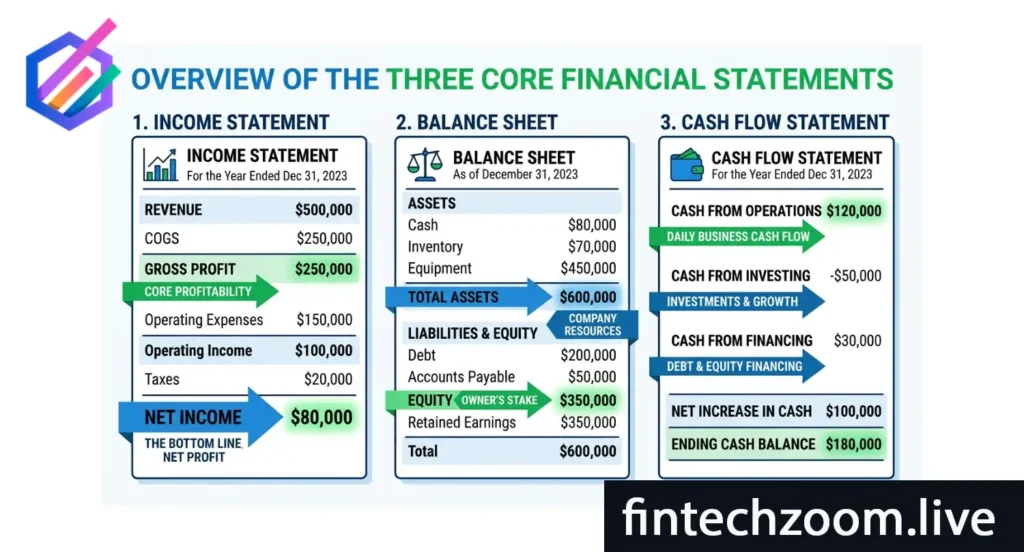
If you decide to buy individual companies, start with three documents that every US public company files with the SEC: the income statement, the balance sheet and the cash flow statement.
The income statement
Shows revenue, costs and profit for a quarter or a year. Look for revenue that grows steadily and profit margins that hold up. Compare gross, operating and net margins with similar companies, not just with the company’s own past.
The balance sheet
Shows what the company owns and what it owes. Debt is easier to carry when earnings are rising and harder when interest rates go up, as they did in 2026. Compare debt with cash and with the company’s earnings.
The cash flow statement
Tracks the cash that actually comes in and goes out. Free cash flow, operating cash flow minus capital spending, is what a company can use to pay dividends, buy back shares or invest without borrowing. Filings for every US public company are free on SEC EDGAR.
Reading charts
Some investors also use price charts, such as 50-day and 200-day moving averages or the relative strength index (RSI), to judge trends. These describe past trading, not a company’s value, and work best as a check alongside the numbers above. AI research tools can summarize filings quickly, but check any figure they give you against the filing itself.
Build a diversified portfolio
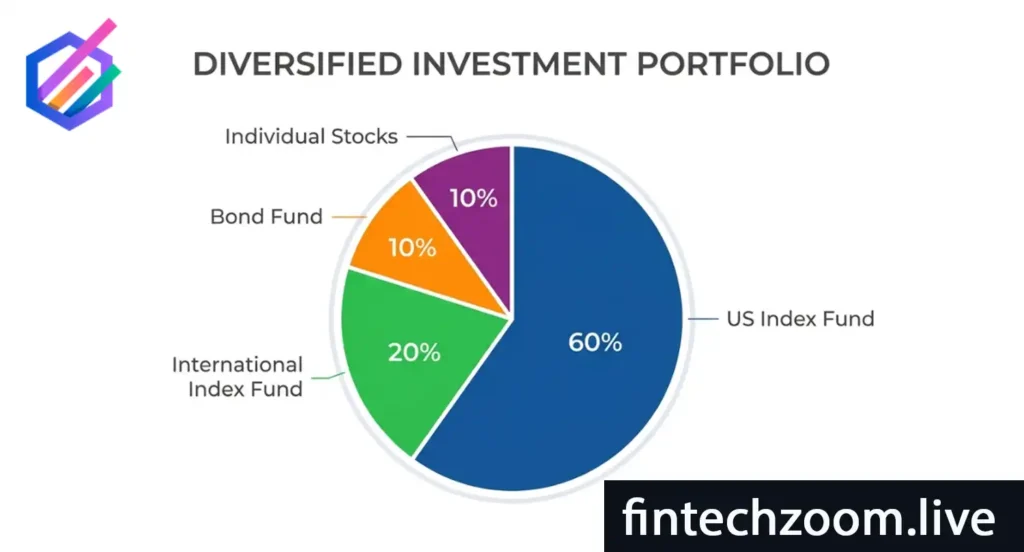
Owning several stocks is not the same as being diversified. Spread your money across:
- Sectors, because technology, healthcare, banks and energy react differently to the same news.
- Company size, with small and mid-sized companies alongside large ones. Our Russell 2000 today page tracks small caps.
- Countries, through an international index fund, so your savings don’t depend on one economy.
- Asset types, with bonds and cash for money you may need sooner. See Treasury bond rates today.
The chart below shows one example mix for illustration. The right mix depends on your age, goals and how much of a fall you can live with.
Also read
Our guide to the Vanguard Total Stock Market Index Fund (VTSAX and VTI) explains how a single fund can hold almost the whole US stock market.
Managing risk
Expect falls, and plan for them
Stock markets fall often and sometimes sharply. The S&P 500 lost 43.8% in 1931 and fell by more than half from 2007 to 2009. Decide before you invest how you will act in a 20% or 30% drop. Selling after a fall locks in the loss.
Limit any single holding
Keep any one company to a small share of your portfolio, so a collapse in that stock can’t wreck your plans.
The arithmetic is simple: a holding worth 5% of your portfolio that halves costs you 2.5% of the total. A holding worth 25% that halves costs you 12.5%.
Dollar-cost averaging vs. investing a lump sum
Dollar-cost averaging means investing a fixed amount on a schedule, such as $200 a month. If you invest from each paycheck, you are already doing it. If you have a lump sum, research from Vanguard covering 1976 to 2022 found that investing it all at once beat spreading it out about 68% of the time, because markets rise more often than they fall. Spreading it out reduced the regret of investing just before a drop, and both approaches beat holding cash.
Trade less
Frequent trading tends to hurt returns. Brad Barber and Terrance Odean studied 66,465 US households from 1991 to 1996: the most active traders earned about 11.4% a year, while the market returned 17.9% (Journal of Finance, 2000).
7 mistakes beginners make
- Investing money needed soon, then being forced to sell in a downturn.
- Putting too much into one stock, sector or theme.
- Trying to time the market by waiting for a dip that may come after prices have risen further.
- Ignoring fees, which compound against you every year.
- Choosing the wrong account and paying tax you could have legally avoided.
- Chasing last year’s best-performing fund or stock.
- Treating tips from social media or AI tools as advice without checking the facts.
Investing from the UK
UK residents usually start with a stocks and shares ISA. You can put up to £20,000 a year across all your ISAs in the 2026 to 2027 tax year, and gains and income inside an ISA are free of UK tax (GOV.UK). If an authorised UK investment firm fails, the Financial Services Compensation Scheme protects up to £85,000 per person, per firm. Like SIPC, it does not cover market losses.
How to invest in the stock market: FAQs
How much money do I need to start investing in stocks?
Many US brokers have no account minimum and offer fractional shares, so you can start with a few dollars. Investing regularly and keeping costs low count for more than the starting amount.
What is the best way for beginners to start investing in stocks?
For most beginners, a low-cost, broadly diversified index fund held in a tax-advantaged account, with automatic monthly contributions. Over 15 years, about 90% of active US large-cap funds trailed the S&P 500.
Should I open a Roth IRA or a taxable brokerage account first?
If you qualify, a Roth IRA lets investments grow tax-free and allows qualified withdrawals without tax. The 2026 limit is $7,500, or $8,600 if you are 50 or older. If your employer matches 401(k) contributions, capturing the match usually comes first.
Is now a good time to invest in the stock market?
No one can reliably time the market. In November 2026 rates are rising and valuations are near their 10-year average, according to FactSet’s forward P/E of 18.7. Investing on a fixed schedule takes the timing decision out of your hands.
How much can I expect to earn?
There is no guaranteed return. The S&P 500 returned about 10% a year compounded from 1928 to 2025, with years as bad as −43.8%. Future returns can be higher or lower.
What is the difference between a stock and an ETF?
A stock is a share in one company. An exchange-traded fund holds a basket of securities, often hundreds of stocks, and trades on an exchange like a single share.
Is my money protected if my broker goes bust?
At a SIPC-member broker, missing cash and securities are protected up to $500,000, including $250,000 in cash. In the UK, FSCS covers up to £85,000 per person per firm. Neither covers falls in market value.
How long should I keep my money invested?
Stocks suit goals that are at least about five years away. Over shorter periods, a market fall may not have time to recover before you need the money.
How we built this guide
Contribution limits come from the IRS, fund performance from S&P Dow Jones Indices, long-run returns from NYU Stern professor Aswath Damodaran’s annual data, and investor behavior research from the Journal of Finance and Vanguard. Market figures come from the Associated Press and FactSet, with dates shown. Examples use assumed returns and are not forecasts. Read our editorial policy, or contact us to report an error.
Revision history: November 4, 2026, full rewrite with 2026 IRS limits, SPIVA year-end 2025 data, current market conditions and a UK section. June 1, 2026, previous update. March 28, 2026, first published.
Related: penny stocks guide · stock futures · retirement and FIRE calculators
Disclaimer: This guide is for information and education only. It is not investment, tax or legal advice, and it is not a recommendation to buy or sell any security. Investing involves risk, including loss of principal. Consider speaking with a licensed financial adviser. See our full disclaimer.
FintechZoom.Live covers stocks, crypto, commodities, forex and bonds with live TradingView charts and dated, sourced analysis. Browse the newest market articles on our blog.

Curated Editorial Insights Across FintechZoom’s Core Verticals: Thought-provoking analysis in Markets, Business Strategy, Crypto Innovation, Personal Finance, Economic Policy, and Lifestyle Wealth, designed to challenge conventional thinking, deepen financial literacy, and empower readers to make smarter, forward-looking decisions.