Best ETFs to Buy in 2026

ETFs to buy

Best ETFs to Buy in 2026 - Top Picks, Expert Forecasts & Buy-or-Sell Guides for Smarter Investing

Best ETFs to buy in 2026 represent the most efficient vehicle for retail and institutional investors seeking diversified exposure across growth sectors, dividend income, and bond stability. Exchange-traded funds have fundamentally transformed portfolio construction, offering instant diversification with intraday liquidity at costs that continue compressing toward zero. Whether you are tracking Magnificent 7 giants like NVIDIA and Microsoft or hunting high-momentum opportunities in AI, crypto, and EV disruptors, this definitive guide breaks down the best ETFs to buy in 2026 with price forecasts, buy-or-sell signals, and data-driven portfolio recommendations.

Best ETFs to Buy Live Data

What Is an ETF and Why They Dominate in 2026

An exchange-traded fund (ETF) is an investment vehicle that pools capital to track an index, sector, commodity, or asset basket while trading on exchanges like individual stocks. Unlike mutual funds that price once daily after market close, ETFs offer real-time pricing and trading flexibility that aligns with modern investor demands.
The ETF structure provides three distinct advantages over traditional mutual funds. First, cost efficiency — the average ETF expense ratio has compressed to 0.16% compared to 0.44% for mutual funds. Second, tax efficiency — ETFs utilize in-kind creation and redemption mechanisms that minimize capital gains distributions. Third, transparency — most ETFs disclose holdings daily rather than quarterly.

ETF vs Mutual Fund Comparison

FeatureETFsMutual Funds
Expense RatioAs low as 0.03% (VOO, VTI)Average 0.44%
TradingIntraday on exchangesEnd-of-day pricing only
Tax EfficiencyIn-kind redemption minimizes gainsFrequent capital gains distributions
Minimum InvestmentOne share (~$25-$700)Often $1,000-$3,000
TransparencyDaily holdings disclosureQuarterly disclosure
ETFs have become the preferred vehicle for Magnificent 7 exposure in 2026’s volatile rate environment because they allow precise sector allocation without single-stock risk. With the Federal Reserve holding rates at 3.75% after three cuts between September and December 2025
 
, investors require tools that balance growth potential with downside protection. ETFs deliver this balance through instant diversification across hundreds or thousands of holdings.

How to Invest in ETFs – Step-by-Step Guide for Beginners

Starting your ETF investment journey requires three foundational decisions: brokerage selection, account type optimization, and strategy implementation.
Choose the right brokerage and account type. Commission-free trading has become standard at major brokerages including Fidelity, Schwab, and Vanguard. For tax-advantaged growth, prioritize Roth IRAs if you expect higher future tax brackets or Traditional IRAs for immediate deductions. Taxable brokerage accounts offer flexibility but require tax-loss harvesting discipline.
Dollar-cost averaging versus lump-sum strategies. Historical data suggests lump-sum investing outperforms dollar-cost averaging 66% of the time over 12-month periods. However, in volatile 2026 markets with AI bubble concerns and geopolitical uncertainty, monthly contributions smooth entry points and reduce timing risk. Consider splitting large windfalls: deploy 50% immediately and dollar-cost average the remainder over 6-12 months.
Building your first ETF portfolio using the core-satellite model. Allocate 60-80% to broad-market core holdings (VTI, VOO, or SPY) that capture total market returns at minimal cost. Reserve 20-40% for satellite positions targeting specific themes — AI semiconductors (SMH), dividend growth (SCHD), or international diversification (VXUS). This structure maintains diversification while allowing tactical tilts toward high-conviction sectors.

Best Index ETFs to Buy in 2026 – SPY, VOO & QQQ Face-Off

The S&P 500 and NASDAQ-100 ETFs remain the cornerstone of 2026 portfolios, but subtle differences in cost structure and composition create distinct risk-return profiles.
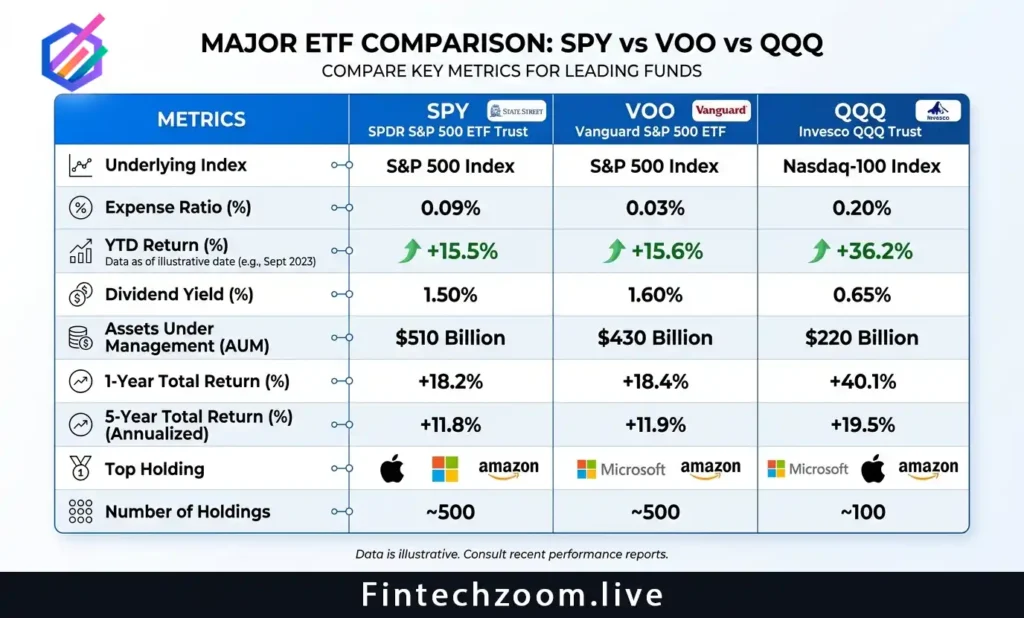
SPY versus VOO versus QQQ ETF comparison table 2026

SPY vs VOO vs QQQ Comparison

MetricSPYVOOQQQ
Expense Ratio0.0945%0.03%0.18%
AUM$623.6B$1.42T$372.5B
YTD Return (2026)-4.34%-4.34%-5.86%
52-Week Change+26.03%+26.06%+33.57%
Dividend Yield1.14%1.19%0.49%
Beta (3-Year)1.001.001.11
Top HoldingsMagnificent 7 (~32%)Magnificent 7 (~32%)Tech-heavy (~50%)
Magnificent 7 weighting breakdown. All three ETFs hold Apple, Microsoft, NVIDIA, Amazon, Alphabet, Meta, and Tesla, but QQQ concentrates these positions more heavily. QQQ’s technology sector allocation exceeds 50% compared to roughly 32% in SPY and VOO. This concentration amplified 2025 gains but increases volatility — QQQ’s beta of 1.11 indicates 11% higher volatility than the broad market.
Buy-or-sell signals and price targets. Analysts note QQQ experienced its largest inflow-to-outflow reversal in history, with $8.5 billion entering in December 2025 followed by $7 billion exiting by February 2026 . Contrarian investors view this exodus as a buying opportunity, particularly given QQQ’s growth-adjusted PEG ratio of ~1.3x versus the S&P 500’s 1.47x. Buy signal: QQQ below $600 with PEG under 1.35x. Price target: $650-680 by year-end if AI capex remains strong.
VOO offers the purest S&P 500 exposure at the lowest cost structure. With $1.42 trillion in assets and 0.03% expense ratio, it serves as the optimal core holding for buy-and-hold investors. SPY maintains superior liquidity for active traders but costs three times more annually.
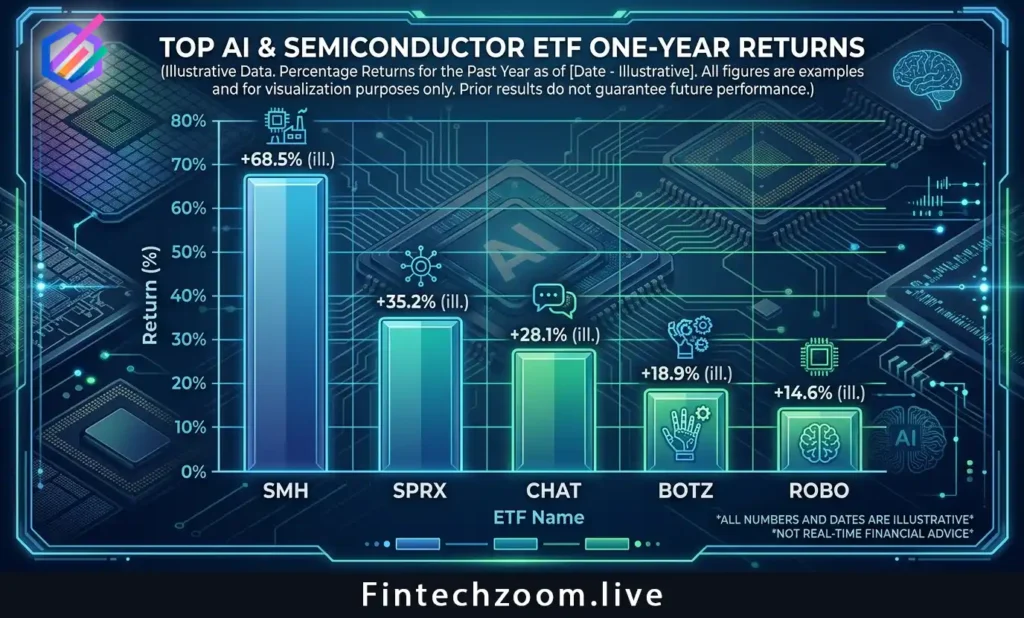
AI ETF performance chart 2026 showing top performing artificial intelligence funds

Best Tech & AI ETFs for Explosive 2026 Growth

Artificial intelligence continues driving capital allocation in 2026, with semiconductor and pure-play AI ETFs leading performance charts. MIT Institute professor Daron Acemoglu estimates AI will contribute 1% to U.S. GDP over the next decade, while Goldman Sachs projects 7% global GDP impact

Top AI ETF Performers (One-Year Returns)

ETFTickerOne-Year ReturnExpense RatioFocus Area
Spear Alpha ETFSPRX+126.64%0.75%AI Infrastructure
VanEck SemiconductorSMH+119.7%0.35%Semiconductors
Roundhill Generative AICHAT+111.7%0.75%Generative AI
iShares SemiconductorSOXX+119.7%0.34%Chip Makers
WisdomTree AI FundWTAI+87.39%0.45%AI Innovation
VanEck Semiconductor ETF (SMH) stands out for its direct exposure to AI chip leaders. With NVIDIA, Taiwan Semiconductor, Broadcom, and Applied Materials comprising top holdings, SMH captures the entire AI hardware value chain . The fund’s 116.7% 52-week gain reflects insatiable demand for GPUs and data center infrastructure. At 0.35% expense ratio, SMH costs one-third of actively managed alternatives while delivering superior returns.
ARK Innovation ETF (ARKK) offers actively managed exposure to disruptive innovation including robotics, AI, and fintech. Despite a challenging -12.23% YTD performance in 2026, ARKK maintains 49.78% 52-week gains and targets companies at the forefront of breakthrough technologies. The 0.75% expense ratio reflects active management costs, making this suitable only for investors with high risk tolerance and 5+ year time horizons.
Buy-or-sell verdict: SMH maintains BUY status above $400 with stop-loss at $350. The AI capex cycle shows no signs of slowing as hyperscalers continue building data center capacity. ARKK warrants HOLD for existing positions but requires careful position sizing given 2.64 beta and volatility.

Best Dividend ETFs & Bond ETFs for Income in 2026

Income-focused investors face a transformed landscape in 2026. The Federal Reserve’s rate cuts between September and December 2025 brought the benchmark from 4.5% to 3.75%, creating both opportunities and risks for fixed-income allocation.

Top Dividend ETFs for 2026

ETFTickerDividend YieldExpense RatioYTD Return
Schwab US Dividend EquitySCHD3.44%0.06%+12.71%
Vanguard High Dividend YieldVYM~3.0%0.06%+16.2%
Vanguard Dividend AppreciationVIG~1.9%0.05%+15.2%
SCHD has emerged as the premier dividend ETF for 2026, delivering 12.71% YTD returns while maintaining a 3.44% yield. The fund screens for companies with consistent dividend growth and fundamental strength, resulting in a portfolio tilted toward quality large-cap value names. With 0.06% expense ratio and $84.8 billion in assets, SCHD offers institutional-grade income exposure at retail costs.

Bond ETF Categories and Recommendations

Long-duration Treasury ETFs like TLT (iShares 20+ Year Treasury Bond ETF) present the highest-octane rate-cut trade available. With $45.2 billion in assets and 0.15% expense ratio, TLT offers roughly 4.8% current yield. However, duration cuts both ways — TLT’s five-year return remains negative 24.6% following the 2022-2023 rate hiking cycle. Buy signal: 10-year Treasury yield above 4.0% with Fed pause confirmed.
Total bond market ETFs including BND (Vanguard Total Bond Market ETF) provide diversified exposure across government, corporate, and mortgage-backed securities. At 0.03% expense ratio and 3.91% yield, BND serves as the optimal core bond holding for balanced portfolios.
Portfolio allocation recommendations: Income investors should consider 40% SCHD (dividend growth), 30% BND (core bonds), 20% TLT (rate-cut upside), and 10% international bonds (BNDX) for currency diversification.

Crypto, EV & Sector ETFs to Watch in 2026

Thematic ETFs targeting emerging sectors require careful evaluation of hype cycles versus fundamentals. Two categories dominate 2026 conversations: cryptocurrency exposure and electric vehicle disruption.
Bitcoin and Ethereum ETF updates. Spot Bitcoin ETFs launched in 2024 continue accumulating assets, though TD Cowen analysts suggest select crypto equities may outperform pure ETF exposure in 2026. Their analysis assumes Bitcoin reaches $140,000 by late 2026 and Ethereum approaches $3,650. For investors seeking crypto exposure without wallet complexity, ETFs like BITO (Bitcoin futures) provide regulated access, though futures-based structures introduce contango costs.
EV disruptor ETFs face a challenging environment as the sector matures. While Tesla remains a Magnificent 7 component, pure-play EV manufacturers like Lucid and Rivian have experienced significant volatility. Broad sector ETFs such as DRIV (Global X Autonomous & Electric Vehicles ETF) offer diversified exposure across the entire EV value chain including legacy automakers, charging infrastructure, and battery suppliers rather than concentrating in high-risk startups.
Sector ETFs with 2026 catalysts:
  • VGT (Vanguard Information Technology ETF): 0.09% expense ratio, $121.3 billion AUM, 41.9% 52-week gains despite -7.3% YTD dip. Maintains broad tech exposure beyond just AI.
  • SMH (VanEck Semiconductor ETF): As detailed above, the premier AI hardware play.
  • XLI (Industrial Select Sector SPDR): 17.8% YTD performance driven by infrastructure spending and reshoring trends.

Vanguard ETF List 2026 – Best Low-Cost Picks

Vanguard’s mutual ownership structure continues driving expense ratio compression across the industry. In February 2025, Vanguard slashed fees on over 85 funds as part of its 50th anniversary, cementing its position as the cost leader.

Top Vanguard ETFs for 2026

ETFTickerExpense RatioCategory52-Week Performance
Vanguard S&P 500 ETFVOO0.03%Large Blend+26.06%
Vanguard Total Stock MarketVTI0.03%Total Market+26.84%
Vanguard Growth ETFVUG0.04%Large Growth+24.1%
Vanguard Russell 1000 GrowthVONG0.07%Large Growth+22.3%
Vanguard Dividend AppreciationVIG0.05%Dividend Growth+15.2%
Vanguard Total Bond MarketBND0.03%Core Bond+1.67%
Vanguard Russell 1000 Growth Fund ETF (VONG) deserves special attention for 2026. With 0.07% expense ratio (reduced from 0.08% in February 2025), VONG holds approximately 390 equity positions including all Magnificent 7 stocks within its top 10 allocations
 
. The fund has delivered double-digit annual returns since 2019 except for the 2022 downturn.
Vanguard Mega Cap Growth ETF (MGK) offers concentrated exposure to the largest growth companies with 66 holdings and 70% technology allocation. The 0.07% expense ratio and 13-year track record since 2007 provide stability for investors seeking mega-cap focus.
How Vanguard ETFs compare to active alternatives. While active ETFs charge 0.50-0.75% annually, Vanguard’s index products capture 95%+ of market returns at 5-10% of the cost. For investors without strong convictions about specific active managers, Vanguard’s passive lineup provides the optimal risk-adjusted foundation.

Key ETF Metrics Every Investor Must Know

Understanding three critical metrics separates sophisticated ETF investors from the crowd: expense ratios, liquidity profiles, and tax efficiency mechanisms.
Expense ratio explained. This annual fee expressed as a percentage of assets directly reduces returns. A 0.03% expense ratio on a $10,000 investment costs $3 annually; a 0.75% ratio costs $75. Over 20 years, this difference compounds substantially — a $100,000 portfolio growing at 8% annually yields $466,000 with 0.03% fees versus $401,000 with 0.75% fees. Every basis point matters.
ETF liquidity and trading volume analysis. Daily trading volume impacts bid-ask spreads and execution quality. SPY averages 88.6 million shares daily with penny spreads — ideal for large trades. Smaller ETFs may exhibit wider spreads, requiring limit orders rather than market orders. Always check average volume before entering positions; sub-$10 million daily volume warrants caution for significant allocations.
Tax efficiency guide for 2026. ETFs utilize in-kind creation and redemption that allows authorized participants to exchange creation units for underlying securities rather than cash. This mechanism eliminates the need to sell securities and realize capital gains when investors redeem shares. The result: ETFs distribute significantly fewer capital gains than equivalent mutual funds. In 2026’s uncertain tax environment, this structural advantage preserves more after-tax returns.

Our 2026 ETF Portfolio Recommendations & Actionable Buy-or-Sell Signals

Constructing a resilient 2026 portfolio requires balancing growth, income, and stability while maintaining costs below 0.10% weighted average expense ratio.
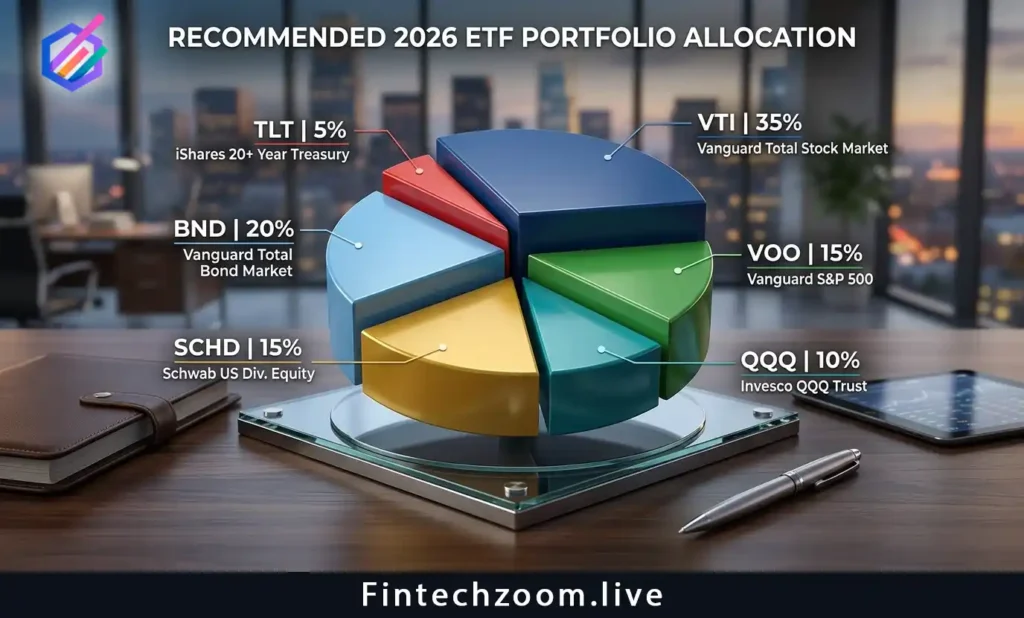
Recommended ETF portfolio allocation 2026 pie chart

Core Portfolio (60/40 Blend)

AllocationETFTickerPosition SizeRationale
Core EquityVanguard Total Stock MarketVTI35%Broadest diversification at 0.03% cost
Large-Cap CoreVanguard S&P 500 ETFVOO15%Magnificent 7 exposure at lowest fee
Growth SatelliteInvesco QQQ TrustQQQ10%Tech concentration with PEG advantage
Dividend IncomeSchwab US Dividend EquitySCHD15%3.44% yield, 0.66 beta for stability
Core BondsVanguard Total Bond MarketBND20%3.91% yield, duration hedge
Rate-Cut PlayiShares 20+ Year TreasuryTLT5%Duration exposure for Fed cuts
Weighted average expense ratio: 0.055%

High-Conviction Satellite Picks

  • AI/Semiconductors: SMH (5-10% allocation) — Buy above $400, stop-loss $350
  • Active Innovation: ARKK (2-5% allocation) — Speculative only, position size limits essential
  • International: VXUS (10% allocation) — Diversification outside U.S. concentration
Monthly rebalancing calendar. Review allocations on the first trading day of each month. Rebalance when any position drifts 5% or more from target. Tax-advantaged accounts allow rebalancing without consequences; taxable accounts should utilize new contributions to adjust allocations rather than realizing gains.
Stop-loss guidance. Set trailing stops at 15% below 50-day moving averages for growth positions (QQQ, SMH, ARKK). Core holdings (VTI, VOO, SCHD) require no stops for long-term investors — volatility represents opportunity, not risk.

Risks & How to Mitigate Them in 2026

ETF investing in 2026 presents distinct risks requiring active management despite the passive nature of the underlying vehicles.
Interest-rate sensitivity. Bond ETFs face inverse price pressure if the Federal Reserve resumes hiking. TLT’s 20+ year duration makes it particularly vulnerable — a 1% rate increase could drive 15-20% price declines. Mitigation: Ladder bond maturities using BSV (short-term) through TLT (long-term) rather than concentrating in duration extremes.
Sector concentration risk. QQQ’s 50%+ technology weighting and SMH’s single-sector focus create vulnerability if AI spending cycles slow. The February 2026 $7 billion QQQ outflow demonstrates how quickly sentiment shifts. Mitigation: No single sector ETF should exceed 15% of total portfolio. Maintain VTI or VOO as the 30%+ anchor.
Liquidity events. While ETFs themselves are liquid, underlying holdings may freeze during market stress. High-yield bond ETFs (HYG, JNK) experienced dislocations during 2020 that exceeded NAV discounts. Mitigation: Avoid ETFs holding illiquid assets (junk bonds, small-cap emerging markets) during periods of market stress.
Portfolio hedging strategies. For investors seeking downside protection, consider:
  • Inverse ETFs (SH, PSQ) for temporary hedging — avoid long-term holds due to decay
  • VIX ETFs (VXX, UVXY) for volatility exposure — strictly short-term trading instruments
  • Gold ETFs (GLD, IAU) for crisis hedging — 5-10% allocation maximum

Conclusion & Call-to-Action

The best ETFs to buy in 2026 combine rock-bottom expense ratios, transparent holdings, and structural tax efficiency that mutual funds cannot match. From the foundational trio of VTI, VOO, and QQQ to specialized plays like SMH for AI exposure and SCHD for dividend growth, ETFs provide the building blocks for any investment objective.
Your edge starts here at FintechZoom.Live. Subscribe for zero-delay ETF alerts, live market dashboards, and weekly buy-or-sell updates covering the stocks and ETFs that matter most in 2026. Whether you are an income seeker, growth hunter, or Magnificent 7 believer, our data-driven ETF clusters deliver the semantic-rich insights retail investors need before the market moves.

Key Takeaways

  • SPY, VOO, and QQQ remain the core building blocks for 2026 portfolios, with VOO offering the lowest expense ratio at 0.03% and QQQ providing superior growth-adjusted valuations at ~1.3x PEG
  • AI and semiconductor ETFs dominate performance charts — VanEck Semiconductor ETF (SMH) delivered 116.7% 52-week returns while maintaining 0.35% expense ratio
  • Dividend seekers should prioritize SCHD with its 3.44% yield and 0.06% expense ratio, outperforming in the current rate environment
  • Bond ETFs present tactical opportunities as the Federal Reserve maintains rates at 3.75% with potential cuts on the horizon
  • The global ETF market projects 21% CAGR growth through 2026, driven by active ETF adoption and thematic product innovation

Analyze, Adapt, and Thrive in the Digital Finance Era

Navigate the intersection of capital and code with expert analysis on emerging market trends and disruptive technologies. Our content delivers actionable intelligence on everything from decentralized finance to AI-driven investing, empowering you to leverage innovation for sustainable growth. Dive into the data-driven insights that are actively redefining the global financial landscape.

Curated Editorial Insights Across FintechZoom’s Core Verticals: Thought-provoking analysis in Markets, Business Strategy, Crypto Innovation, Personal Finance, Economic Policy, and Lifestyle Wealth, designed to challenge conventional thinking, deepen financial literacy, and empower readers to make smarter, forward-looking decisions.