
The US stock market today is the single largest equity marketplace on the planet. It commands roughly 42% of total global equity market capitalization, a staggering figure for one country. Whether you are a first-time investor opening a brokerage account or a seasoned portfolio manager reviewing your morning dashboard, understanding what each major index measures and what it does not measure is the foundation of every sound investment decision. This comprehensive guide covers the NYSE, NASDAQ, S&P 500, Dow Jones Industrial Average, and Russell 2000 in precise detail, explains the economic data calendar that moves markets, and provides a structured framework for interpreting the US stock market today at every session, pre-market, regular hours, and after-hours.
In 2026, the US stock market today continues to serve as both a barometer of national economic health and a gateway for global capital flows. Understanding how its component indices interact, and where each fits within your broader investment strategy, is more important than ever.
When analysts and financial journalists refer to the US stock market today, they typically begin with the New York Stock Exchange (NYSE), the largest stock exchange in the world by the total market value of its listed companies. The NYSE today hosts companies with a combined market capitalization exceeding \$25 trillion, representing the backbone of American corporate enterprise.
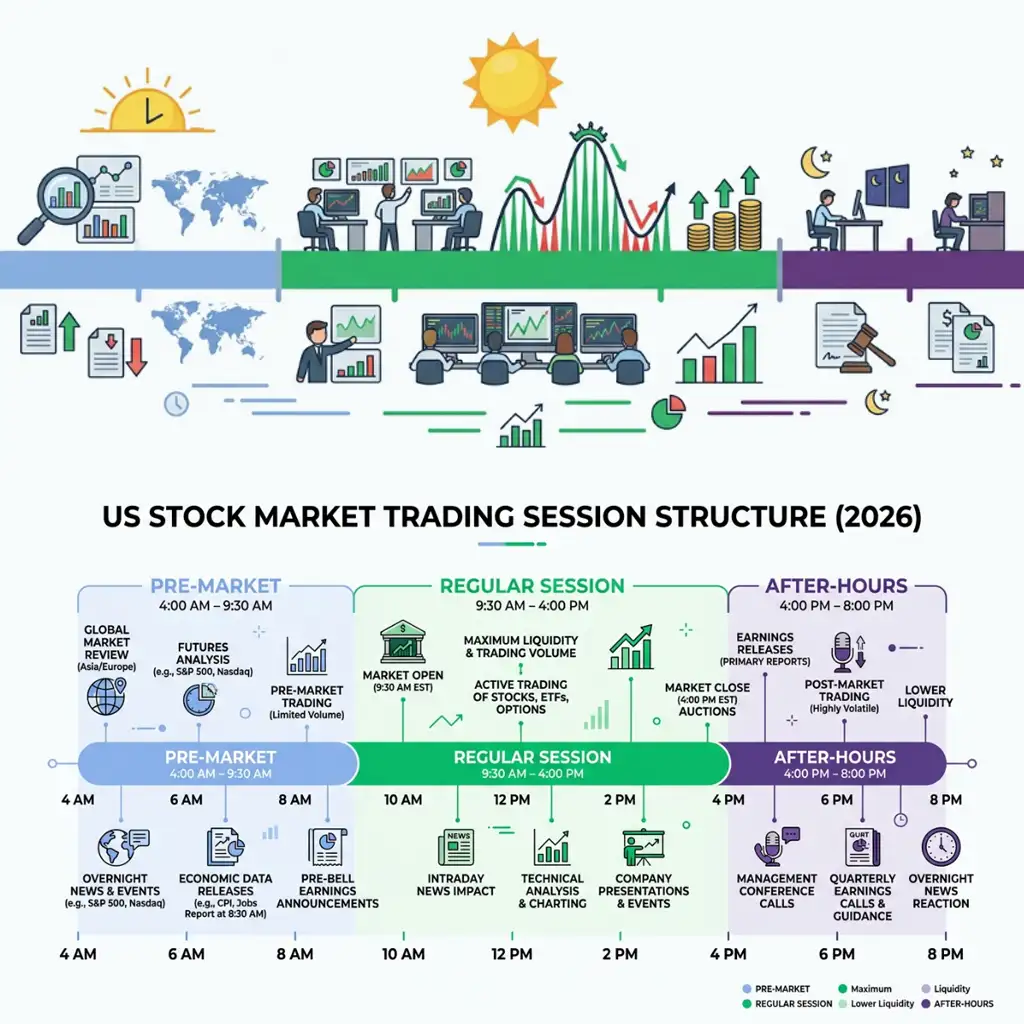
NYSE market hours today follow a clear and consistent schedule that every investor should memorize. The pre-market session runs from 4:00 AM to 9:30 AM Eastern Time. The main regular trading session runs from 9:30 AM to 4:00 PM Eastern Time. Finally, after-hours trading extends from 4:00 PM to 8:00 PM Eastern Time. Most high-impact institutional activity occurs during the regular session, but pre-market and after-hours price movements can signal how stocks will open or confirm the market’s reaction to earnings releases.
The NYSE uses a hybrid trading model that combines electronic order matching with human oversight. Designated Market Makers (DMMs) are stationed on the physical trading floor in Lower Manhattan and are obligated to provide additional liquidity during periods of extreme volatility. This hybrid approach distinguishes the NYSE from fully electronic exchanges and provides a stabilizing mechanism during market stress events, such as circuit-breaker episodes.
NYSE-listed companies tend to be larger, operationally mature, and subject to rigorous listing standards that include minimum revenue thresholds, market capitalization floors, and strict corporate governance requirements. Meeting these NYSE listing criteria has historically been interpreted by institutional investors as a signal of corporate credibility. For investors monitoring the US stock market today, NYSE-listed companies form the bedrock of most blue-chip portfolios.
The NYSE Composite Index tracks all NYSE-listed companies using market-cap weighting and provides the broadest read of large-cap US equity performance. However, the S&P 500, which draws many of its components from NYSE-listed stocks, remains the more widely referenced benchmark among professional investors.
The NASDAQ Composite today live tracks more than 3,000 companies listed on the NASDAQ exchange. However, when most financial professionals and retail investors refer to “the NASDAQ,” they mean the NASDAQ 100, an index that tracks the 100 largest non-financial companies listed on NASDAQ, weighted by market capitalization.
The NASDAQ 100 is overwhelmingly technology-oriented. Its ten largest holdings, Apple, Microsoft, NVIDIA, Alphabet (Google), Amazon, Meta, Tesla, Broadcom, Netflix, and ASML, collectively account for approximately 55% of the total index weight. This extreme top-heavy concentration means that the NASDAQ Composite today live effectively functions as a daily performance report on Big Tech. When two or three of these megacap companies experience significant price moves, the entire NASDAQ index moves materially.
Many retail investors who believe they hold a diversified portfolio actually have significant, overlapping Big Tech exposure through multiple ETFs that track the NASDAQ 100 or similar tech-heavy indices. On any given day when reviewing the US stock market today, it is worth checking whether an index move is being driven by broad participation or by a handful of mega-cap stocks. The NASDAQ’s concentration risk is both its strength during bull markets and its greatest vulnerability during technology sector corrections.
The table below clarifies the key structural differences between the five major US indices. Understanding these distinctions is critical to accurately interpreting US stock market today data.
Index | Companies | Weighting | Best Describes | Key Limitation |
Dow Jones (DJIA) | 30 | Price-weighted | Blue-chip health | Only 30 stocks; outdated weighting |
S&P 500 | 500 | Market-cap | Broad US economy | Top 10 = ~30% weight |
NASDAQ 100 | 100 | Market-cap | Tech & growth | Heavy Big Tech concentration |
Russell 2000 | 2,000 | Market-cap | Small-cap US economy | High volatility, lower liquidity |
NYSE Composite | All NYSE | Market-cap | Large-cap US broadly | Less followed than S&P 500 |
The Dow Jones Industrial Average today is the most widely cited stock market number in the world. It appears in every major news broadcast, on every financial homepage, and in conversation among investors and non-investors alike. It is also, from a methodology perspective, one of the most structurally flawed major indices that exists.
The Dow uses price weighting, which means that a company with a higher per-share stock price has a greater influence on the index’s daily movement, regardless of that company’s actual economic size. Consider the disparity: UnitedHealth Group, one of the highest-priced Dow components, has roughly eight times the index influence of Coca-Cola, despite Coca-Cola being a larger global consumer brand by many non-price metrics. This does not reflect economic reality.
Despite this structural flaw, the Dow Jones Industrial Average today remains the dominant sentiment signal for retail investors. A headline reading “Dow falls 600 points” moves retail investor mood and media coverage significantly more than an equivalent percentage move in the S&P 500. Professional traders and institutional portfolio managers use the S&P 500 as their primary benchmark for the US stock market today, but the Dow continues to anchor public perception of market direction.
The S&P 500 index today live is the definitive performance benchmark used by virtually every professional investor. Its 500 constituent companies span all major sectors of the US economy and represent the majority of total US market capitalization. When institutional portfolio managers report returns to clients, they measure their performance against the S&P 500, not the Dow Jones, and not the NASDAQ. Like the NYSE Composite, the S&P 500 index today live uses market-cap weighting. Larger companies command greater index influence. Apple, Microsoft, NVIDIA, Amazon, and Meta together account for roughly 25% of the
total index weight, which means a significant portion of any given day’s index move can be attributed to just five companies. When headlines state “the US stock market today rose 1.2%,” as much as 0.3 to 0.5 percentage points of that gain may have come from two or three mega-cap stocks.
Tracking S&P 500 sectors today gives investors a more granular and actionable read than the headline index number alone. The eleven S&P 500 sectors, Technology, Healthcare, Financials, Consumer Discretionary, Consumer Staples, Industrials, Energy, Utilities, Real Estate, Materials, and Communication Services, often move in divergent directions on the same day. A day where the S&P 500 rises 0.5% but the Technology sector falls 1.5% while Energy rises 3% tells a very different economic story than a broad-based rally.
📌 Pro Tip: Always check S&P 500 sector performance alongside the headline index number. The breadth of participation, how many sectors are rising versus falling, is a more reliable indicator of underlying market health than the index number alone. |
The Russell 2000 today tracks 2,000 small-cap US companies that are predominantly domestically focused. Unlike the S&P 500 and NASDAQ, which include significant overseas revenue exposure from multinational corporations, Russell 2000 companies derive the majority of their revenue from within the United States. This domestic orientation makes the Russell 2000 one of the most sensitive and reliable leading indicators of US economic conditions.
When the Russell 2000 today outperforms the S&P 500 on a sustained basis, it typically signals improving expectations for domestic economic growth. Institutional investors rotate into small-cap stocks when they anticipate a strengthening US economy, lower domestic interest rates, or both. Conversely, when the Russell 2000 lags the S&P 500 significantly, as it has during several periods of global macro uncertainty, it signals that investors are concerned about the health of the domestic US economy in particular, even when mega-cap multinational S&P 500 companies hold steady on international revenue.
In 2026, the Russell 2000 today faces competing forces. The prospect of continued interest rate normalization by the Federal Reserve would reduce borrowing costs for small-cap companies, which are more heavily dependent on floating-rate debt than large-cap counterparts, and would provide a meaningful earnings tailwind. However, ongoing economic uncertainty and elevated credit spreads have kept institutional investors cautious about adding small-cap risk. Monitoring the Russell 2000’s performance relative to the S&P 500 on a weekly basis remains one of the most practical tools for reading the US stock market today
The US market news today is structured around a predictable calendar of government economic data releases. Knowing this calendar in advance allows investors to anticipate when the US stock market today is most likely to experience elevated volatility, and to plan their trading activity accordingly.
The economic data releases that carry the greatest capacity to move the US stock market today are: Non-Farm Payrolls, CPI Inflation, Retail Sales, the FOMC interest rate decision, and GDP (advance estimate). Understanding the typical market impact of each is essential for any investor who monitors the US stock market today regularly.
Data Release | Frequency | Market Impact | When Released |
Non-Farm Payrolls | Monthly | Very High | First Friday of month, 8:30 AM ET |
CPI Inflation | Monthly | Very High | Mid-month, 8:30 AM ET |
Retail Sales | Monthly | High | Mid-month, 8:30 AM ET |
FOMC Decision | 8× per year | Very High | Wednesday afternoon, 2:00 PM ET |
ISM Manufacturing PMI | Monthly | Medium | First business day, 10:00 AM ET |
GDP (Advance Estimate) | Quarterly | High | Last week of Jan, Apr, Jul, Oct |
The fastest market reaction to economic data releases occurs in the fixed income market. US Treasury yields typically adjust within seconds of a data release. Equity markets, which process multiple layers of implication from each data point, typically reprice over one to three minutes. Options market implied volatility, measured through the VIX, can shift meaningfully in the hours before a major scheduled release as investors hedge their exposure.
The US stocks pre-market today session runs from 4:00 AM to 9:30 AM Eastern Time. During this window, S&P 500 and NASDAQ 100 futures contracts provide a clear, real-time signal of where the market is likely to open relative to the previous day’s closing prices. When S&P 500 futures are trading up 0.7% from the prior close, most index-tracking ETFs and their constituent stocks will open approximately 0.7% higher. Stocks with specific news, earnings beats or misses, analyst rating changes, significant merger or acquisition announcements, will deviate materially from the index direction.
⚠️ Critical Pre-Market Warning: Never use market orders during the pre-market trading session. Bid-ask spreads are substantially wider than during regular market hours, and order book depth is significantly thinner. The price at which your order executes can be meaningfully worse than the price you see quoted. Always use limit orders in pre-market and after-hours sessions. |
The US market after hours today session runs from 4:00 PM to 8:00 PM Eastern Time. The majority of S&P 500 companies report their quarterly earnings results either after the regular market close or before the next morning’s open. The after-hours session is where the initial, unfiltered investor reaction to those results occurs.
After-hours price moves are directionally informative but structurally unreliable as precise pricing indicators. Thin trading volume in this session means that a single large institutional order can move a stock’s price by several percentage points in either direction, producing exaggerated moves that partially reverse when full institutional participation resumes at the regular session open. Use after-hours movements in the US market after hours today to understand the general direction and sentiment around an earnings report. Do not treat after-hours prices as a definitive read on fair value.
A structured approach to the US market forecast this week begins each Sunday evening. Before the week starts, professional investors run through a consistent preparation checklist that reduces reactive decision-making and improves execution quality throughout the week. Here is the framework used by institutional traders and independent investors who monitor the US stock market today seriously.
Identify all high-impact economic data releases scheduled for the week. Mark the dates and times of Non-Farm Payrolls, CPI, FOMC decisions, or GDP releases. These are the sessions most likely to produce outsized volatility in the US stock market today and require pre-planned responses rather than real-time improvisation.
List every company in your portfolio reporting earnings this week. Develop written scenarios for both a positive and a negative result before the report is released. Investors who enter an earnings report with a pre-planned response framework make significantly better decisions than those who react emotionally to surprise results in the US market after hours today session.
The CBOE Volatility Index (VIX) measures the options market’s implied expectation of near-term volatility for the S&P 500 index today live. A VIX below 15 indicates a calm, low-anxiety market environment. A VIX between 20 and 30 signals elevated uncertainty. A VIX above 30 indicates genuine market stress. The VIX reading entering each week shapes how aggressively you should act on new information in the US stock market today. High-VIX environments reward patience and precision over decisive action.
After each major economic data release during the week, evaluate the US economic data market impact on your existing positions and your watchlist. Economic data surprises, where the actual number deviates significantly from consensus expectations, produce the most meaningful single-session moves in the US stock market today. Tracking how your target stocks respond to macro surprises provides valuable information about their sensitivity to economic conditions.
✅ Weekly Preparation Habit: Investors who spend 30–45 minutes every Sunday evening reviewing the economic calendar, identifying earnings reports, and checking the VIX consistently make better trading decisions during the week than those who rely on real-time reactive analysis during market hours. This single habit can transform how you interact with the US stock market today. |
The US stock market today is not a single number, it is a collection of interconnected indices, each measuring a different dimension of American economic performance. The NYSE represents large-cap corporate maturity and stability. The NASDAQ Composite today live captures the performance of technology and growth-oriented innovation. The Dow Jones Industrial Average today, despite its methodological limitations, remains the dominant sentiment signal for retail investors. The S&P 500 index today live is the professional benchmark that every serious investor uses to contextualize performance. And the Russell 2000 today provides the most direct and reliable read on the health of the domestic US economy’s smaller businesses.
Tracking the US stock market today effectively means moving beyond headline numbers and developing a structured framework for interpreting what each index, each sector, and each session’s trading activity is communicating about the economy. Use the US stocks pre-market today session to understand how the market is positioned before the open. Use the regular session to execute with the benefit of full market liquidity. Use the US market after hours today session to assess earnings reactions directionally. And use your Sunday evening review of the US market forecast this week to build the context that transforms reactive decisions into planned, deliberate ones.
Whether you are monitoring NYSE market hours today, tracking Dow Jones industrial average today for its sentiment value, or using Russell 2000 today as a domestic economic barometer, the US stock market today offers more information per hour than any other financial market in the world. Your competitive edge as an investor lies not in accessing more data, it lies in developing a deeper understanding of what each data point actually means.
⚠️ Final Risk Reminder: The US stock market can fall sharply and remain lower for extended periods. The index history includes multi-year drawdowns of 30–55%. Never invest capital you may need within the next two to three years. Diversification across asset classes, not just within equities, remains the most reliable long-term risk management strategy. |

Curated Editorial Insights Across FintechZoom’s Core Verticals: Thought-provoking analysis in Markets, Business Strategy, Crypto Innovation, Personal Finance, Economic Policy, and Lifestyle Wealth, designed to challenge conventional thinking, deepen financial literacy, and empower readers to make smarter, forward-looking decisions.