2026 is characterized as a “show me” year for AI, a transition from narrative-driven valuation expansion to evidence-based stock selection. Markets now reward companies demonstrating AI revenue contribution and margin improvement rather than those merely announcing AI initiatives. This shift favors established players with measurable AI business lines over speculative names trading on future potential.
AI spending growth at 70% annually over the past two years has been structural rather than cyclical, according to Goldman Sachs analysis. Unlike prior technology investment waves that proved cyclical, rising and falling with economic conditions. AI capex appears driven by permanent shifts in compute requirements for machine learning, generative AI, and autonomous systems. This structural characterization, if accurate, supports sustained investment in infrastructure plays even through economic soft patches.
Sector Rotation Risk for Nasdaq FintechZoom Investors
Capital rotation from high-growth Nasdaq names into Dow-heavy sectors, industrials, financials, healthcare, has created the current index divergence. This movement reflects relative valuation considerations: when AI and technology stocks appear fully priced while economic growth remains solid, capital naturally seeks lower-beta alternatives offering better risk-adjusted returns.
The rotation carries specific implications for Nasdaq investors. Mid-tier technology stocks, those outside the Magnificent Seven, face broader risk-off pressure as institutional investors reduce overall technology exposure. These companies lack the balance sheet strength and diversified revenue streams that protect mega-caps during drawdowns, making them more vulnerable to sustained selling pressure.
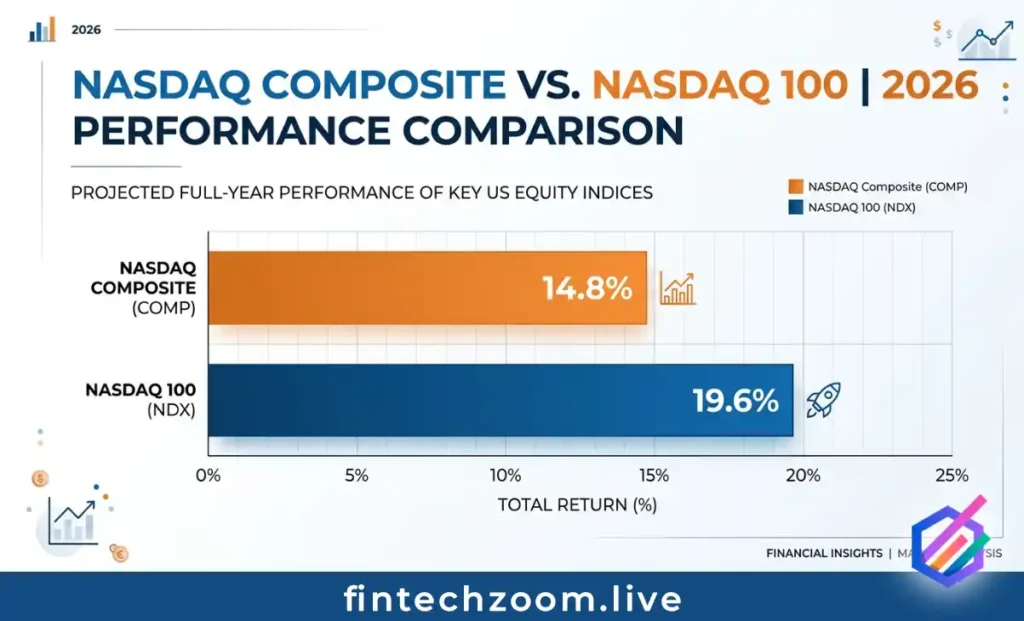
Investors must also distinguish between Nasdaq Composite exposure, which includes thousands of stocks across the market capitalization spectrum, and Nasdaq 100 exposure, which concentrates in the largest non-financial companies. The Composite offers broader diversification but includes smaller companies with higher volatility and lower liquidity. The Nasdaq 100 provides mega-cap stability but greater concentration risk in a handful of names.
Fintech, AI, and Emerging Nasdaq Sectors
Beyond traditional technology, Nasdaq-listed companies are pioneering AI-driven analytics and autonomous finance capabilities. Agentic AI, systems that make decisions and execute actions without direct human intervention, is projected to grow from $2.1 billion in financial services today to $80.9 billion by 2034. Early applications include automated Know Your Customer (KYC) triage, transaction reconciliation, risk flag surfacing, and loan approval processes.
Open finance extends open banking principles beyond payments to encompass loans, investments, insurance, and wealth management. Over 132 million users already benefit from open finance services worldwide, with 470 million using open banking. This data ecosystem enables personalized financial products that respond to real-time life events, creating opportunities for Nasdaq-listed fintech infrastructure providers.
Blockchain-based asset tokenization represents another emerging theme. JPMorgan’s Onyx platform settles billions in tokenized collateral daily, while BlackRock launched its first tokenized fund on a public blockchain. By 2026, significant fractions of U.S. Treasury bonds, commercial real estate, and private equity are expected to trade as digital tokens, potentially creating new revenue streams for financial infrastructure companies.
Nasdaq FintechZoom Historical Performance and What It Signals for 2026
How the Nasdaq Has Performed Over Time
The Nasdaq Composite has delivered approximately 17% average annual returns over the past decade, a performance that reflects both genuine technology sector growth and multiple expansion as interest rates declined from post-financial crisis highs. This historical average provides context for evaluating current year-to-date performance: the -4% decline in early 2026, while disappointing, represents normal volatility within a long-term uptrend rather than structural breakdown.
Recent annual returns show this pattern: 2024 delivered approximately 23% gains, 2025 added roughly 18%, and 2026 opened at 22,708 before retracing to current levels. The current bull market turned three years old in late 2025, placing it within the historical window where sustained advances are probable. Carson Group research indicates that bull markets reaching three years tend to extend to an average of eight years, based on data extending back to 1950.
This historical pattern provides probabilistic context rather than predictive certainty. Each market cycle operates within unique conditions, current factors including AI transformation, Federal Reserve policy normalization, and geopolitical fragmentation differ substantially from prior periods. However, the historical tendency for bull markets to persist beyond three years suggests that current weakness may represent correction within ongoing advance rather than cycle termination.
What History Says About Nasdaq FintechZoom in 2026
If the Nasdaq Composite matches its 10-year average 17% annual return from current levels, year-end 2026 would require approximately 21% appreciation from the April starting point. Wall Street’s technology sector consensus of 33% advance would comfortably achieve this target, even allowing for some underperformance in other sectors. The mathematical alignment between historical averages and analyst projections provides a plausible path to year-end targets near 27,000.
Risk factors center on “AI exhaustion”, the possibility that markets shift from current optimism to skepticism about near-term monetization before companies demonstrate actual revenue impact. Inflation persistence at 2.7%, above the Federal Reserve’s 2% target, constrains monetary policy flexibility and maintains pressure on growth stock valuations. These factors could delay or diminish the projected advance without necessarily reversing the long-term trend.
Nasdaq FintechZoom Investment Strategy for 2026
How to Use Nasdaq FintechZoom Data for Portfolio Decisions
Effective Nasdaq investing requires integrating multiple data streams into coherent decision frameworks. Forward P/E ratios for the Nasdaq 100 against historical averages provide valuation context, current levels suggest the index trades at a premium to long-term averages but below peak 2021 multiples. Monitoring this metric helps identify periods of excessive optimism or unwarranted pessimism.
Hyperscaler capex announcements serve as leading indicators for semiconductor demand. When major cloud providers guide capital expenditure growth above consensus, as occurred when 2026 guidance moved from 19% to 60%, this signals sustained demand for Nvidia and related infrastructure plays. Conversely, capex cuts or delays would warrant reassessment of AI supply chain positions.
Sector rotation signals appear in relative performance between the Dow and Nasdaq. Sustained Dow outperformance indicates institutional preference for value over growth, suggesting defensive positioning within technology allocations. When Nasdaq outperformance resumes, this typically signals risk appetite recovery and growth stock revaluation.
Stocks Worth Considering Based on Nasdaq FintechZoom Analysis
Nvidia remains the consensus top pick for AI infrastructure exposure, with Morgan Stanley’s semiconductor team highlighting the company’s $300 billion-plus backlog visibility and three-year supply agreements with prepayment terms. This demand certainty, combined with 58% projected earnings growth for fiscal 2027, provides fundamental support that transcends near-term volatility.
MercadoLibre has emerged as a “monster growth stock” recommendation from multiple analyst teams, offering Latin American e-commerce and fintech exposure with less AI valuation sensitivity. Applied Digital (APLD) provides AI infrastructure exposure at a lower market capitalization and price point, potentially offering higher beta for risk-tolerant investors.
Fintech names including PayPal, CrowdStrike, and Block offer exposure to embedded finance growth with lower keyword competition and search volume than mega-cap technology, potentially providing entry points before broader market recognition. These positions require selective evaluation of competitive positioning and regulatory exposure rather than thematic allocation.
Risk Management on Nasdaq FintechZoom Positions
Primary 2026 risks include Strait of Hormuz disruptions sustaining oil above $110 per barrel, Federal Reserve policy missteps that maintain restrictive conditions longer than necessary, and tariff retaliations affecting technology supply chains. Each could trigger renewed Nasdaq pressure independent of company-specific fundamentals.
Upside catalysts include Middle East de-escalation reducing energy costs and inflation pressure, AI capex beats from major semiconductor companies demonstrating demand sustainability, and exhaustion of value rotation as defensive sectors reach stretched valuations. Investors should maintain flexibility to adjust positioning as these scenarios develop.
Position sizing discipline requires avoiding over-concentration in any single AI narrative stock. Even Nvidia, with its exceptional demand visibility, faces competitive threats from AMD and custom silicon initiatives by hyperscalers seeking to reduce dependency on external suppliers. Diversification across the AI supply chain, semiconductors, data centers, networking equipment, software, reduces single-point-of-failure risk.
FAQ — Nasdaq FintechZoom Questions Answered
Q1: What is Nasdaq FintechZoom? Nasdaq FintechZoom refers to real-time Nasdaq index coverage and analysis provided on fintech-focused platforms, combining live price data, earnings context, and market intelligence for retail and professional investors. These platforms aggregate traditional financial data with alternative signals and interpretive analysis.
Q2: What is the Nasdaq FintechZoom price today? As of early April 2026, the Nasdaq Composite trades around 21,879 and the Nasdaq 100 around 24,960. Prices change in real time; current figures should be verified through live data feeds.
Q3: What is the Nasdaq FintechZoom forecast for the end of 2026? Multiple models project the Nasdaq Composite reaching 25,000 to 27,000 by year-end 2026, with the Nasdaq 100 forecast ranging from approximately 25,035 to 34,615 depending on AI earnings delivery and Federal Reserve policy trajectory.
Q4: Why is the Nasdaq down while the Dow Jones is at all-time highs? This divergence reflects sector rotation. Investors are moving capital from high-growth, rate-sensitive technology stocks into more stable industrials and financial companies that dominate the Dow. Rising Treasury yields compress Nasdaq tech valuations while supporting value stock performance.
Q5: Is 2026 a good year to invest in Nasdaq tech stocks? Wall Street analysts describe 2026 as a “show me” year for AI. Companies that prove AI generates real revenue and margin improvements are likely to outperform. Blanket AI optimism has faded; stock selection matters more than index-level exposure.
Q6: What are the biggest Nasdaq FintechZoom stocks to watch in 2026? Nvidia leads analyst picks based on its $300 billion-plus backlog and 58% forecasted earnings growth. Other key names include Microsoft, Meta, Alphabet, MercadoLibre, PayPal, and CrowdStrike.
Q7: What is the difference between the Nasdaq Composite and the Nasdaq 100? The Nasdaq 100 tracks the 100 largest non-financial companies, heavily weighted toward mega-cap technology. The Nasdaq Composite covers thousands of stocks, providing broader exposure to mid-tier technology and fintech companies.
Q8: How does the Federal Reserve affect the Nasdaq FintechZoom index? The Nasdaq is more sensitive to interest rate changes than the Dow or S&P 500. Higher rates increase the discount applied to future earnings, compressing growth stock valuations. The Federal Reserve projects one rate cut in 2026, with the median federal funds rate ending at 3.4%.
Nasdaq FintechZoom Outlook: Key Takeaways for Investors
Nasdaq FintechZoom data places the Composite at approximately 21,879 in early April 2026, with year-end targets ranging from 25,000 to 27,000-plus based on Wall Street consensus. The index faces genuine headwinds: AI valuation scrutiny, tariff residue affecting supply chains, and geopolitical oil price pressure above $100 per barrel. These factors explain current underperformance relative to the Dow Jones Industrial Average and broader market indices.
Structural AI capital expenditure of $700 billion in 2026, representing 36% year-over-year growth, provides fundamental demand support for core technology holdings. Hyperscaler commitment to three-year infrastructure buildouts with prepayment terms indicates confidence that extends beyond quarterly earnings cycles. This spending creates revenue visibility for semiconductor and data center companies that may offset near-term valuation compression.
Sector rotation from growth to value is a 2026 reality that demands portfolio adaptation. Investors maintaining heavy Nasdaq exposure should ensure diversification across market capitalizations and subsectors rather than concentrating in a handful of mega-cap AI names. The divergence between Nasdaq and Dow performance may persist until either AI monetization accelerates—supporting growth stock revaluation—or economic conditions deteriorate, triggering defensive flight that affects all equity sectors.
Platforms offering real-time Nasdaq FintechZoom analysis provide retail investors access to institutional-grade data and interpretive context previously restricted to professional trading desks. Sub-100ms latency, alternative data integration, and AI-driven signal processing enable decision-making that competes with traditional Wall Street advantages. For investors willing to develop analytical capabilities matching these tools, current market conditions present opportunity within volatility.
Key Takeaways for Nasdaq Investors in 2026:
The Nasdaq Composite needs approximately 21% appreciation by year-end to match its 10-year average annual return of 17%, a target Wall Street analysts consider achievable given technology sector consensus forecasts of 33% growth.
AI infrastructure spending will reach $700 billion in 2026, creating structural demand for semiconductor and data center stocks despite near-term valuation compression.
The Federal Reserve projects one quarter-point rate cut in 2026 with the median federal funds rate ending at 3.4%, maintaining pressure on growth stock multiples through at least the first half of the year.
Sector rotation has created historic divergence: the Nasdaq trades 17.5% below recent highs while the Dow Jones Industrial Average has declined only 3.9%, reflecting capital flight from high-beta tech into industrials and financials.
Real-time data platforms now deliver sub-100ms latency to retail investors, democratizing access to institutional-grade market intelligence that was previously restricted to professional trading desks.