CAC 40 Today

CAC 40 Today

CAC 40 Today: Live Price, French Market Analysis & 2026 Forecast – Buy or Sell Before the Next Move?

CAC 40 today trades at approximately 8,260 as of April 12, 2026, showing resilience after hitting an all-time high near 8,642 earlier this year. France’s flagship index, tracking the 40 largest Euronext Paris companies, delivers real-time exposure to luxury, energy, pharmaceuticals, and industrial growth. With ECB policy at an inflection point, French GDP stabilizing, and sector rotation accelerating, this FintechZoom.Live guide cuts through market noise with live data, expert 2026 price predictions, and actionable buy-or-sell insights for retail and institutional investors seeking their next edge.

What Is the CAC 40 and Why It Matters for Smart Investors in 2026

The CAC 40 represents France’s premier equity benchmark, comprising 40 blue-chip companies selected by free-float market capitalization and liquidity metrics from the Euronext Paris exchange. Unlike broader European indices, this concentration delivers targeted exposure to France’s economic champions across luxury goods, energy transition, aerospace, and financial services.
LVMH commands the largest single weighting at approximately 11-12% of the index, followed by TotalEnergies, Sanofi, Schneider Electric, and L’Oréal. This composition creates distinct risk-return characteristics compared to German or UK benchmarks. The index employs a free-float capitalization-weighted methodology with quarterly reviews by an independent steering committee, ensuring constituent quality and relevance.
For 2026, three macro drivers dominate the investment thesis. First, French GDP growth is projected to accelerate to 0.9% according to European Commission forecasts, up from 0.7% in 2025, supported by recovering private consumption and rebounding business investment as interest rates decline. Second, EU policy coordination around defense spending and industrial competitiveness creates tailwinds for aerospace and industrial constituents including Airbus and Safran. Third, luxury export strength remains pivotal, with Chinese demand recovery potentially driving outsized gains for LVMH and Hermès despite recent volatility.
Smart investors track the CAC 40 now because it offers diversification beyond US mega-cap concentration, euro-denominated exposure for currency hedging, and dividend yields historically superior to US benchmarks. The index’s 3-4% aggregate yield appeals to income-focused portfolios, while its cyclical tilt provides beta to global growth recovery. FintechZoom.Live delivers real-time price widgets, semantic keyword tracking, and zero-delay updates to capture these movements as they develop.

CAC 40 Live Price Today + Interactive Chart Breakdown

As of April 12, 2026, CAC 40 futures contracts for April delivery trade at 8,271.0, representing a 4.50% advance from recent lows. The cash index has established a trading range between year-to-date lows near 7,505 and the all-time high of 8,642 recorded earlier in 2026. Current positioning suggests consolidation within this band as markets digest conflicting signals from monetary policy and energy markets.
Technical analysis reveals critical support zones at 7,600-7,700, representing the demand floor that has contained selling pressure through recent volatility. A sustained break below 7,600 would structurally weaken the bullish case, while violation of 7,200 would signal trend reversal. Resistance targets cluster at 8,600 for initial breakout confirmation, with extended objectives at 8,900-9,000 assuming macro tailwinds persist.
Moving average configurations show price action hovering near the 50-day exponential moving average, with the 200-day trendline ascending from lower levels providing longer-term support. Momentum indicators including RSI have recovered from oversold conditions below 30 registered in March 2026, suggesting potential for continued mean reversion. MACD histograms indicate building bullish momentum on daily timeframes, though weekly charts remain neutral pending definitive range resolution.
Weekly performance metrics show the index recovering from March lows near 7,900, with monthly volatility averaging 10.45% over 66-day measurement periods. Volume patterns indicate accumulation on dips into the 7,700-7,800 zone, while distribution has characterized rallies above 8,400. Chart patterns investors should monitor include the ascending triangle formation developing since February, with horizontal resistance near 8,400 and rising trendline support connecting higher lows.

CAC 40 vs. DAX, FTSE 100 & Global Benchmarks – Where to Allocate in 2026

Performance Comparison
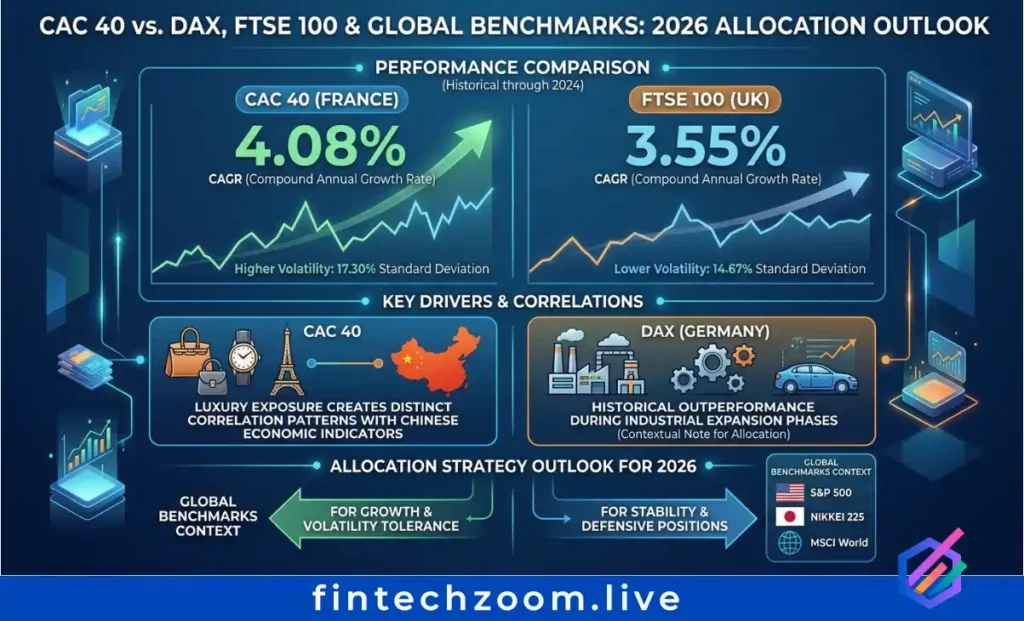
Historical data through 2024 shows the CAC 40 delivering a compound annual growth rate of 4.08% versus the FTSE 100 at 3.55%, though with higher volatility (17.30% standard deviation versus 14.67%). The German DAX has outperformed in certain periods, particularly during industrial expansion phases, while the CAC 40’s luxury exposure creates distinct correlation patterns with Chinese economic indicators.
placeholder
2024 performance saw the FTSE 100 advance 14.9% while the CAC 40 gained only 0.92%, illustrating the divergence between UK commodity-heavy composition and French luxury-industrial mix. However, 2023 saw CAC 40 surge 20.14% versus FTSE 100 at 10.12%, demonstrating the index’s sensitivity to risk-on environments.
Valuation Metrics
French equities trade at forward P/E ratios near 16.8x according to March 2026 data, below the 19.3x registered for German markets and substantially cheaper than US benchmarks above 25x. This valuation gap provides margin of safety for international allocators concerned about US concentration risk. Dividend yields favor the CAC 40 at 3-4% aggregate versus US indices near 1.5%.
Currency and Macro Considerations
Euro exposure through the CAC 40 offers diversification for USD-denominated portfolios, particularly if ECB policy diverges from Federal Reserve trajectory. French manufacturing competitiveness relative to Germany has improved marginally as energy cost differentials narrow, though structural productivity gaps remain per OECD analysis.
Portfolio Allocation Guidance
For balanced EU exposure, a 40% DAX / 35% CAC 40 / 25% FTSE 100 weighting captures German industrial strength, French luxury-energy diversification, and UK commodity-defensive characteristics. Risk-tolerant investors might overweight CAC 40 to 45% if bullish on luxury recovery and ECB easing. Conservative allocators should underweight to 25% given French fiscal uncertainty and luxury volatility.

Best Ways to Invest in CAC 40 – ETFs, Stocks & Strategies

Top CAC 40 ETFs for 2026
The Amundi CAC 40 UCITS ETF (formerly Lyxor) stands as the primary vehicle for index exposure, with €4.39 billion in assets under management and physical replication methodology. The fund tracks the CAC 40 Total Return Index with exceptional precision, posting just 0.03% tracking error over one-year periods. The distributing share class offers income-focused investors access to underlying dividend flows, while the accumulating class suits growth-oriented portfolios. Ongoing charges total 0.25%, competitive for European equity exposure.
For ESG-focused allocations, the Amundi CAC 40 ESG UCITS ETF applies sustainability screens while maintaining benchmark correlation. Leveraged traders can access the Lyxor CAC 40 Daily (2x) Leveraged UCITS ETF for amplified exposure, though volatility decay requires active management.
Direct Stock Selection
Buy-now candidates include TotalEnergies for energy exposure and 4.2% yield support, Schneider Electric for electrification and AI infrastructure themes, and Sanofi for defensive pharmaceutical positioning. Entry levels of €68-70 for TotalEnergies, €140-145 for Schneider, and €82-85 for Sanofi offer favorable risk-reward.
Decision Matrix
Momentum investors should await breakout confirmation above 8,400 before establishing long positions. Value-oriented strategies can accumulate on weakness toward 7,700-7,800 support. Dividend-focused portfolios benefit from laddered entry across TotalEnergies, LVMH, and Sanofi to capture 3-4% aggregate yields. Growth investors should concentrate on Airbus, Safran, and Schneider Electric for multi-year industrial cycles.
Risk Management
Stop-loss levels should be set 5-7% below entry points, with position sizing limiting single-stock exposure to 5% of portfolio maximum. International investors must consider French withholding tax on dividends (30% standard rate, reduced to 15% for treaty countries) and currency hedging decisions for euro exposure. Diversification across at least 8-10 CAC 40 constituents reduces single-stock concentration risk while maintaining index correlation.

French Economy & Global Factors Shaping CAC 40 in 2026

GDP and Policy Snapshot
French economic output faces a transition year in 2026. The European Commission projects 0.9% real GDP growth, accelerating from 0.7% in 2025, as private consumption rises 0.6% and investment rebounds after two years of decline. Inflation is expected to edge up from energy base effects but remain contained at 1.6% by 2027 per OECD forecasts.
Fiscal consolidation presents a headwind, with the government deficit targeted at 4.9% of GDP in 2026, down from 5.5% in 2025. Revenue-increasing measures including extended taxes on large enterprises and high earners, combined with spending freezes on pensions and benefits, will weigh on domestic demand. Public debt is projected to rise to 120% of GDP by 2027 despite consolidation efforts.
Sector Deep-Dives
Luxury exports depend critically on Chinese demand recovery. LVMH and Kering experienced 4.3% and 2.8% single-day declines on March 13, 2026, on waning global demand fears, illustrating sector sensitivity. Energy transition investments benefit TotalEnergies and Schneider Electric, though oil price volatility creates earnings uncertainty. Pharmaceutical innovation at Sanofi offers defensive characteristics with pipeline optionality.
Geopolitical Risk Matrix
The Iran conflict has demonstrated the CAC 40’s vulnerability to energy shocks, with Brent crude surging above $114 in March 2026. France imports approximately 70% of its energy, making the index sensitive to Middle East supply disruptions. US tariff policies and trade tensions present additional external risks, while Chinese demand sustainability remains the critical variable for luxury performance.
FintechZoom.Live Insight
Real-time news flow analysis shows the CAC 40 responds disproportionately to ECB policy communications, French budget negotiations, and Chinese economic data releases. Our platform tracks these catalysts to provide advance positioning signals for active traders and long-term allocators alike.

Actionable Investor Checklist – CAC 40 Buy or Sell Verdict April 2026

Signal Scorecard
Bullish factors include attractive valuation at 16.8x forward earnings, dividend yield support at 3-4%, technical base formation at 7,600-7,700, and potential for ECB policy pivot if energy prices moderate. Bearish factors encompass French fiscal consolidation drag, luxury demand uncertainty, geopolitical energy risks, and technical resistance at 8,400 requiring significant catalysts to overcome.
Trading Plans by Risk Profile
Conservative investors should maintain 5-10% CAC 40 allocation through Amundi ETF, adding on weakness below 7,800. Moderate risk profiles can target 15-20% exposure with 60% ETF / 40% individual stock split, focusing on TotalEnergies and Sanofi for stability. Aggressive traders might concentrate in leveraged ETF products or individual luxury/industrial names, using 7,700 stop-loss and 8,600 profit targets.
Portfolio Construction
Core holding: Amundi CAC 40 UCITS ETF (40% of French allocation). Satellite picks: TotalEnergies (20%), Schneider Electric (15%), Sanofi (15%), LVMH (10%). This construction balances index beta with sector-specific alpha opportunities while maintaining liquidity and risk control.
Final Verdict
CAC 40 today presents a tactical buying opportunity for patient investors. The index has retreated 5.2% from all-time highs, offering improved entry points relative to early 2026 extremes. Accumulation strategies should prevail over momentum chasing, with 7,700-7,800 representing optimal entry zones and 8,400 defining the first resistance challenge. Long-term allocators benefit from valuation discount to US markets and superior dividend yields, while accepting euro and French-specific political risks.

Conclusion & CTA

The CAC 40 today offers a compelling intersection of valuation support, dividend yield, and macro recovery potential for 2026. With the index trading near 8,260, investors face a tactical decision: accumulate on consolidation for breakout potential toward 8,600-9,000, or await clearer resolution of ECB policy and French fiscal trajectories. Our analysis favors disciplined accumulation at current levels, with strict risk management and diversified implementation through both ETF and individual stock channels.
Key forecasts suggest 8,200-8,400 as the probable trading range for year-end 2026, with upside toward 9,000 achievable if luxury demand recovers and ECB maintains accommodative posture. Downside protection exists at 7,600-7,700 technical support, limiting catastrophic risk for patient capital.
Explore related FintechZoom.Live clusters for complete European equity coverage: DAX 40 analysis for German industrial exposure, FTSE 100 for UK commodity-defensive positioning, Magnificent 7 for US mega-cap comparison, and our EV stocks and AI leaders sectors for thematic growth exposure. Your edge starts here, live. Subscribe for daily CAC 40 alerts and 2026 forecast updates to capture every market move before it develops.
placeholder

CAC 40 Forecast 2026–2027: Price Predictions & Bull/Bear Scenarios

Consensus Analyst Targets
Professional forecasters have established a wide target range for year-end 2026, spanning 7,800 on the bearish extreme to 9,000+ for bullish scenarios. This dispersion reflects genuine uncertainty around ECB policy trajectory, French fiscal consolidation effectiveness, and global luxury demand sustainability.
Bull Case: 8,500–9,000 Target
The optimistic scenario requires several conditions to align. ECB easing rather than tightening would provide liquidity support, with French GDP potentially beating 0.9% consensus if private consumption accelerates faster than projected. Luxury demand rebound from China, supported by stimulus measures, would drive LVMH and Hermès outperformance. AI and industrial tailwinds benefiting Schneider Electric, Thales, and Airbus would sustain earnings momentum. In this configuration, the index could challenge 9,000 by year-end 2026.
Bear Case: 7,500–7,800 Downside
Risk factors include sustained geopolitical tensions keeping energy prices elevated and pressuring consumer discretionary spending. A sharper-than-expected luxury slowdown from China would disproportionately impact the index given sector weightings. French political uncertainty surrounding budget negotiations could delay investment recovery. If the ECB delivers two rate hikes as currently priced by markets, financial sector credit risks and economic slowing could drive index retrenchment toward 7,500.
FintechZoom.Live Proprietary Model
Our three-scenario framework assigns probability weightings based on current market pricing and macro indicators. The base case (50% probability) targets 8,200-8,400, reflecting modest GDP growth and stable earnings. The bull case (30% probability) requires policy and demand tailwinds for 8,800-9,000. The bear case (20% probability) acknowledges geopolitical and policy risks at 7,600-7,800.
Key Catalysts Calendar
Q2 2026 earnings season (April-May) will provide critical data on luxury demand trends and industrial order books. French parliamentary budget negotiations through June will clarify fiscal trajectory. ECB meetings in June, September, and December carry heightened importance given the March 2026 pivot toward rate hike pricing.

Top CAC 40 Components Driving Performance in 2026

Tier 1 Heavyweights
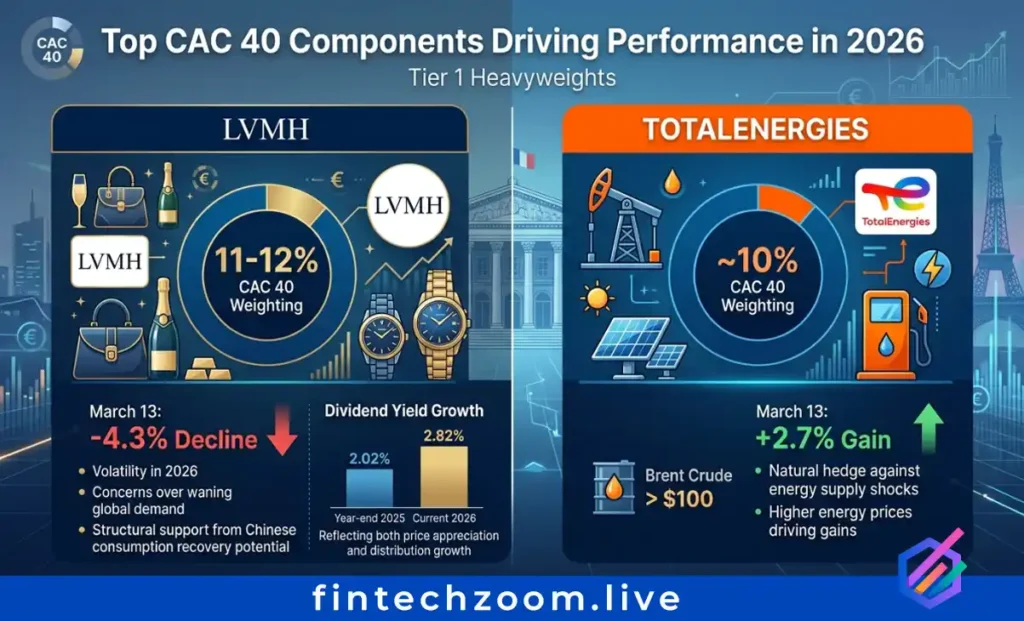
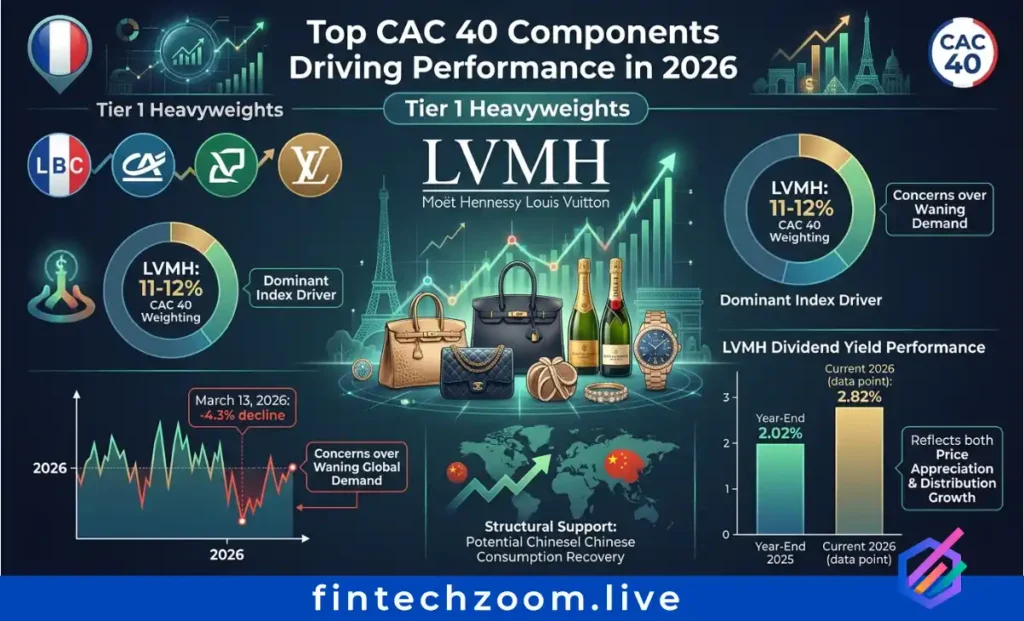
LVMH remains the dominant index driver with its 11-12% weighting, though the stock has experienced volatility in 2026. The luxury giant declined 4.3% on March 13 amid waning global demand concerns, yet maintains structural support from Chinese consumption recovery potential. Current dividend yield stands at 2.82%, up from 2.02% at year-end 2025, reflecting both price appreciation and distribution growth.
placeholder
TotalEnergies provides energy sector exposure with approximately 10% index weighting. The stock gained 2.7% on March 13 as Brent crude surged above $100, demonstrating its role as a natural hedge against energy supply shocks. Goldman Sachs raised its price target from €68 to €75 in March 2026 while maintaining a neutral rating. The shares offer a 4.23% dividend yield with 67% payout ratio coverage, making them attractive for income-focused strategies.
Sanofi contributes pharmaceutical stability with defensive characteristics and pipeline optionality. Schneider Electric captures AI and energy transition themes through electrification and automation solutions. Airbus and Safran represent the aerospace-industrial complex, with defense spending increases across Europe supporting multi-year growth cycles.
2026 Winners and Losers
Sector rotation has favored industrials and energy early in 2026, while luxury and financials have faced headwinds. Airbus gained 2.8% and Safran 2.9% on January 2 alone, leading the industrial advance. Conversely, banking stocks including BNP Paribas, Société Générale, and Crédit Agricole declined 1.5-1.9% in mid-March as ECB rate hike expectations introduced credit risk concerns.
Société Générale deserves special mention after soaring 153% in 2025, though momentum has moderated in 2026 as rate outlook uncertainty increased. The stock’s volatility illustrates the sensitivity of French financials to monetary policy trajectory.
Buy-or-Sell Signals
LVMH shows technical support near €130 with resistance at €165; accumulation on weakness toward €140 appears prudent for long-term luxury exposure. TotalEnergies benefits from energy price momentum with support at €65 and upside toward €80 if crude remains elevated. Sanofi offers defensive positioning with limited downside near €80 and potential for pipeline-driven breakouts above €100.

Key Takeaways

  • Current Level: CAC 40 futures indicate pricing near 8,271, with technical support established at 7,600-7,700 and resistance targets at 8,600-9,000 for 2026.
  • GDP Backdrop: French economic growth projected at 0.9% in 2026 per European Commission forecasts, with private consumption and investment rebounding on lower interest rates.
  • Sector Mix: Luxury goods represent approximately 24% of index weight (LVMH, Hermès, Kering), industrials at 18%, financials at 16%, and energy at 10%.
  • Valuation Edge: CAC 40 trades at forward P/E of approximately 16.8x versus US benchmarks above 25x, offering relative value for international allocators.
  • Monetary Policy: ECB deposit rate at 2% with markets pricing 85% probability of rate hikes by December 2026, creating headwinds for rate-sensitive sectors.
  • Dividend Yield: Index aggregate yield approximately 3-4%, with TotalEnergies alone offering 4.23% yield and LVMH at 2.82%.
  • ETF Access: Amundi CAC 40 UCITS ETF tracks with 0.03% tracking error and €4.39 billion AUM, offering liquid exposure for international investors.
  • Risk Factors: Geopolitical energy shocks, luxury demand weakness from China, and French fiscal consolidation (deficit target 4.9% of GDP) present downside scenarios.

Analyze, Adapt, and Thrive in the Digital Finance Era

Navigate the intersection of capital and code with expert analysis on emerging market trends and disruptive technologies. Our content delivers actionable intelligence on everything from decentralized finance to AI-driven investing, empowering you to leverage innovation for sustainable growth. Dive into the data-driven insights that are actively redefining the global financial landscape.

Curated Editorial Insights Across FintechZoom’s Core Verticals: Thought-provoking analysis in Markets, Business Strategy, Crypto Innovation, Personal Finance, Economic Policy, and Lifestyle Wealth, designed to challenge conventional thinking, deepen financial literacy, and empower readers to make smarter, forward-looking decisions.