FintechZoom Crypto Trends Shaping 2026
FintechZoom Crypto and AI-Powered Autonomous Agents
Autonomous AI agents have emerged as a transformative force in cryptocurrency markets. These software systems combine artificial intelligence with blockchain wallets, enabling them to hold funds, analyze markets, interact with smart contracts, and execute transactions without continuous human input.
Leading platforms include Virtuals Protocol, which tracks economic value produced by agents through its Agent Commerce Protocol. The system handles requests, negotiations, transactions, and evaluations of machine services. Developers launch agents through initial agent offerings with tokenomics established via bonding curves.
Autonolas runs continuous business logic off-chain, operating multi-agent systems that anchor results to the blockchain. The framework uses Tendermint consensus to ensure multiple agents agree on actions before execution. Each agent runs an Application Blockchain Interface instance defining a finite-state machine.
The Artificial Superintelligence Alliance merged Fetch.ai, SingularityNET, and Ocean Protocol to provide a decentralized marketplace for hosting language models. Fetch network supplies autonomous participants capable of responding to on-chain events using the ASI-1 Mini language model for web-native reasoning.
Security considerations are paramount. Agents face risks including prompt injection, tool hijacking, privilege creep, and persistent payload attacks. Without strict constraints, agents optimized purely for yield can engage in MEV extraction, front-running, and reward hacking. Current laws treat software as tools rather than legal entities, holding developers responsible for agent behavior.
FintechZoom Crypto and Real-World Asset Tokenization
Tokenized financial assets represent one of 2026’s most significant growth sectors. Market data from RWA.xyz shows tokenized RWAs grew to over $24 billion in total value by February 2026, up from approximately $5.6 billion just one year prior.
The expansion moves beyond Treasury funds into commodities, private credit, and public equities. Tokenization of large-cap U.S. equities could unlock new sources of global demand by enabling fractional ownership, increased transparency, and access to traditionally illiquid assets.
Governments are testing public finance on-chain. Tokenized bonds offer reduced overhead and expanded investor access, with several jurisdictions piloting sovereign debt issuance on blockchain infrastructure. This experimentation represents a fundamental reimagining of government financing mechanisms.
FintechZoom Crypto Stablecoin Payments Infrastructure
Stablecoin transaction volumes broke records in 2025, exceeding $33 trillion according to Visa data. McKinsey’s granular analysis with Artemis Analytics identified approximately $390 billion in actual payment usage after excluding trading and automated activity, representing a 733% year-over-year increase in B2B payments.
Regional adoption patterns reveal Asia’s dominance. Stablecoin payments sent from Asia account for $245 billion, or 60% of global payment volume, driven primarily by Singapore, Hong Kong, and Japan. North America follows at $95 billion, Europe at $50 billion.
Meta has announced plans to enable stablecoin payments across Facebook, Instagram, and WhatsApp, targeting the second half of 2026. Stripe, which re-enabled USDC acceptance and acquired Bridge for $1.1 billion, is cited as a likely integration partner. This potential integration would expose billions of users to stablecoin payment rails.
Use cases are expanding rapidly. Cross-border settlement, remittances, and payroll platforms now utilize stablecoins to cut currency conversion costs, reduce intermediaries, and support faster settlement. Stablecoin-linked card spending reached $4.5 billion in 2025, up 673% from 2024.
Fidelity’s analysis captures the significance: “Stablecoins have the potential to become the new infrastructure the finance industry runs on.”
FintechZoom Crypto DePIN and Decentralized Infrastructure
Decentralized Physical Infrastructure Networks (DePIN) have emerged as a top-performing sector in 2026. The combined market capitalization sits in the $9-10 billion range, surpassing the oracles sector while generating tens of millions in monthly on-chain revenue from actual services.
DePIN uses blockchain and crypto tokens to coordinate physical resources including hard drives, GPUs, Wi-Fi hotspots, dashcams, and sensors. Participants supply hardware, the network coordinates it, and users pay for service. This model democratizes access to capital-intensive infrastructure while distributing ownership.
Leading projects include Bittensor (TAO) at approximately $3.34 billion market cap, Render Network for GPU compute, Filecoin for storage, Helium for wireless connectivity, and Hivemapper for decentralized mapping. In January 2026 alone, leading DePIN networks generated roughly $150 million in on-chain revenue paid by real customers.
The sector’s strength lies in measurable utilization. Unlike purely speculative tokens, DePIN projects generate revenue from storage deals, compute jobs, data credits, and mapping services. This revenue growth has continued even when token prices declined, distinguishing the sector from hype-driven cycles.
FintechZoom Crypto Prediction Markets Expansion
Prediction markets have experienced explosive growth in 2026. Transaction volumes surpassed 192 million in March 2026, representing an all-time record with 865,411 monthly users, an 118% increase from March 2025.
Monthly notional trading volume reached approximately $23.89 billion in March 2026, a 1,107% year-over-year increase. Sports, crypto, and politics lead weekly volume on Polymarket. On Kalshi, the exotics category overtook politics in late February to secure a position among the top three categories.
Behavioral data reveals a structural shift. On Polymarket, over 57% of users trade less than $100 per position, with the average active participant executing roughly 25 trades per day. This frequency mirrors retail stock trading patterns rather than traditional betting, suggesting prediction markets are attracting a new class of participants.
Tax changes in the U.S. are tilting users toward derivative-anchored prediction markets. Coinbase expects prediction market volumes to broaden throughout 2026, with prediction-market aggregators potentially emerging as a dominant interface layer.
FintechZoom Crypto Risks and Challenges in 2026
FintechZoom Crypto and the Quantum Computing Threat
Quantum computing represents an emerging long-term threat to cryptocurrency security. While current encryption standards remain secure against existing quantum computers, the trajectory of quantum development suggests vulnerability within the decade.
Fidelity flagged quantum computing as a Q2 2026 watch item for crypto investors, noting that current encryption standards face long-term vulnerability. The industry response includes post-quantum cryptography research and protocol upgrades, though widespread implementation remains years away.
The threat is not immediate but requires proactive planning. Cryptocurrency holders with long-term positions should monitor quantum-resistant protocol developments and consider migration strategies as standards evolve.
FintechZoom Crypto Market Volatility and Macro Sensitivity
Bitcoin’s correlation with the NASDAQ 100 more than doubled in 2025, rising from 0.23 to 0.52. This increased correlation reduces Bitcoin’s diversification benefits within traditional portfolios while exposing it to broader equity market volatility.
Fed Chair Powell’s term expires in May 2026, introducing policy transition uncertainty. Options markets are pricing equal odds of Bitcoin at $70,000 or $130,000 by mid-2026, reflecting genuine uncertainty about the macro trajectory.
Persistent inflation remains the key threat to a constructive macro backdrop. While markets have priced in eventual rate cuts, any acceleration in inflation could delay monetary easing and pressure risk assets including cryptocurrencies.
FintechZoom Crypto Security and Smart Contract Risks
Stablecoins have become dominant infrastructure for illicit finance on-chain. Illicit crypto volume reached $158 billion in 2025, representing roughly 2.7% of incoming VASP liquidity. The GENIUS Act brings stablecoin transactions under Bank Secrecy Act requirements, mandating AML and KYC scrutiny equivalent to traditional international wire transfers.
Smart-contract vulnerabilities in liquid staking and DeFi protocols continue to pose risks. Exchange security standards are evolving alongside regulation, but users must remain vigilant about custody choices and protocol audits.
FintechZoom Crypto — How to Invest in Cryptocurrency in 2026
FintechZoom Crypto Investment Strategies by Risk Profile
Conservative investors should consider Bitcoin ETF allocation (IBIT, FBTC) as a 1-5% portfolio hedge. This approach provides exposure to digital asset appreciation without custody complexity or direct security risks.
Moderate risk profiles can combine Bitcoin and Ethereum allocations with stablecoin yield strategies. Ethereum’s role in RWA tokenization and DeFi provides growth potential, while stablecoin yields offer income generation in volatile environments.
Aggressive investors might explore altcoin ETFs, DePIN tokens, AI crypto agents, and tokenized RWAs. These sectors offer higher growth potential but require deeper due diligence and risk tolerance.
Dollar-cost averaging remains prudent in volatile environments. Rather than attempting to time market bottoms, systematic accumulation smooths entry prices and reduces emotional decision-making.
Bitcoin-backed lending has gained traction as a tax-efficient strategy. BTC holders can borrow against holdings rather than selling, deferring taxable events while accessing liquidity for other investments or expenses.
FintechZoom Crypto Exchanges and Wallets in 2026
Exchange selection criteria have evolved. Investors should prioritize regulatory compliance, proof of reserves, and security audits. The post-GENIUS Act era requires exchanges to maintain higher operational standards, but not all platforms have adapted equally.
Hardware wallets versus exchange custody presents a trade-off between security and convenience. Self-custody eliminates counterparty risk but requires technical competence and disciplined key management. Exchange custody offers convenience and regulatory protections but introduces platform risk.
New exchange features include derivatives up to 200x leverage, copy trading, and demo environments. These tools amplify both gains and losses, requiring careful risk management.
FintechZoom Crypto Tax Rules and the Parity Act
The Parity Act proposes a de minimis exemption for stablecoin transactions, meaning spending $5 on a latte would not trigger a taxable event. This provision would significantly reduce the tax compliance burden for everyday stablecoin usage.
Crypto lending may no longer be treated as taxable selling under the proposal, improving the tax efficiency of leveraged strategies. New IRS reporting requirements for offshore crypto exchanges are expanding transparency.
State-by-state tax treatment variations persist, requiring investors to understand their specific jurisdiction’s rules. Professional tax advice remains essential for active traders and those utilizing complex strategies.
FintechZoom Crypto FAQ
What is the FintechZoom Crypto market outlook for 2026?
The market outlook reflects a transition from speculation to utility. Institutional adoption drives demand through ETFs and corporate treasuries, while regulatory clarity from the GENIUS Act and potential CLARITY Act passage creates a more stable operating environment. Price volatility persists but within a maturing framework.
What is the Bitcoin price prediction for 2026?
Institutional forecasts range from $75,000 (bear case) to $250,000 (bull case). Consensus clusters around $150,000-$200,000, contingent on ETF inflows, Fed policy, and institutional demand acceleration. Technical analysis supports $170,000 and $240,000 as key Fibonacci extension targets.
How does the GENIUS Act affect cryptocurrency investors in 2026?
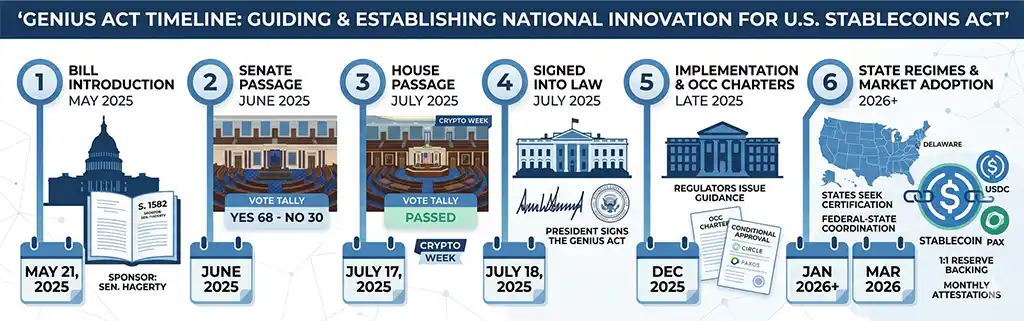
The GENIUS Act establishes stablecoin licensing requirements with a July 18, 2026 implementation deadline. Investors gain clearer protections but may face restrictions on yield-bearing stablecoins. Exchanges must adapt to new reserve requirements and redemption policies, potentially affecting available products.
What is the CLARITY Act and when will it pass?
The CLARITY Act establishes SEC jurisdiction over digital securities and CFTC jurisdiction over digital commodities. The House passed the bill in July 2025; Senate negotiations continue in 2026 with two committee versions requiring reconciliation. Passage would provide clearer rules for exchanges, brokers, and custodians.
What are the top cryptocurrency trends in 2026?
AI agents managing portfolios autonomously, real-world asset tokenization expanding beyond Treasuries, stablecoin payments infrastructure maturation, DePIN sector growth, and prediction market expansion represent the five dominant trends shaping the industry.
Is Ethereum a good investment in 2026?
Analyst forecasts cluster between $4,500-$7,000 with bull cases toward $11,000. Ethereum’s role in RWA tokenization provides fundamental demand, while potential CLARITY Act clarity on ETH classification and ETF expectations offer catalysts. Risks include competition from Layer 2 solutions and alternative smart contract platforms.
What are the biggest risks of investing in crypto in 2026?
Quantum computing poses long-term encryption threats. Macro volatility and Fed policy uncertainty create price risk. Regulatory developments, while generally positive, could introduce unexpected restrictions. Smart contract vulnerabilities and exchange security remain operational concerns.
How do crypto taxes work in 2026?
Current rules treat crypto as property, with capital gains on sales and ordinary income on mining/staking rewards. The Parity Act proposes de minimis exemptions for small stablecoin transactions and improved lending treatment. IRS reporting requirements are expanding for offshore exchanges.